
“The National Company of the Belgian Railways (NMBS /SNCB) wishes to conclude a framework agreement for the development, production and delivery of EMUs (Electric Multiple Unit) and BEMUs (Battery Electric Multiple Unit).” This is the main message of the public tender launched by Belgium’s national passenger trains’ operator NMBS / SNCB at the end of 2022. The new trains are expected for 2030. Seven years from now. In railway terms, that’s ‘next month’.
You can find a summary of this tender here. It’s public information via the European Union.
In total, this is a framework agreement for a fleet of up to 170,000 seats. The new train sets are dubbed AM30 or MR30. AM is French for automotrice. MR is Dutch for motorrijtuig. These multiple unit are self motorized, unlike a pull-push train where a standalone locomotive pulls or muses a series of carriages (coaches).
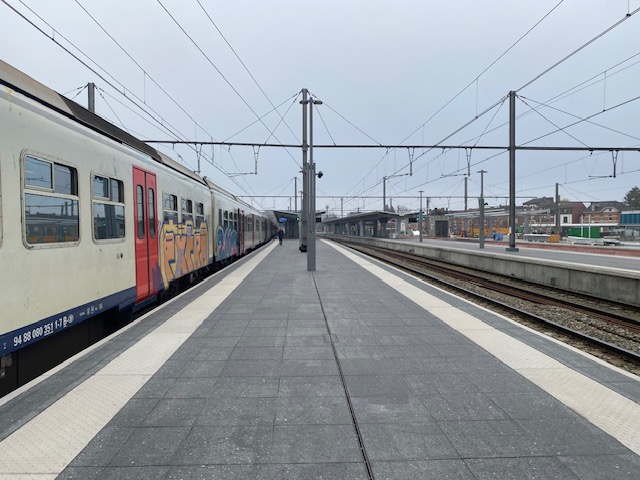

Multifunctional three-car EMUs
These AM30 motor vehicles will be used for the operation of suburban/local (S/L) and InterCity (IC) connections, both with high-capacity and low-capacity variants.
“For the sake of cost efficiency and standardization, the NMBS chooses to use the same (B)EMU platform for the different operating types on which the motor vehicles will be used. This EMU platform must consist of three cars with a nominal length of 80 meters, of which:
- the two end cars are identical single deck carriages (only interior fittings differ according to the type of operation, with facilities for travelers with reduced mobility, for bicycle transport, for luggage transport, etc.);
- the intermediate car is either a single deck or a double deck carriage.”
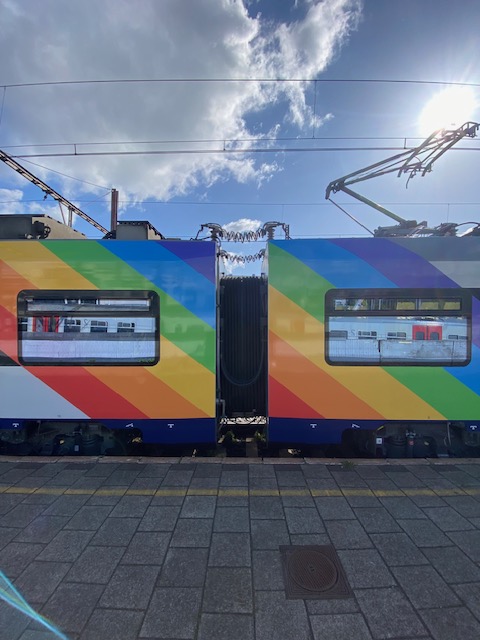
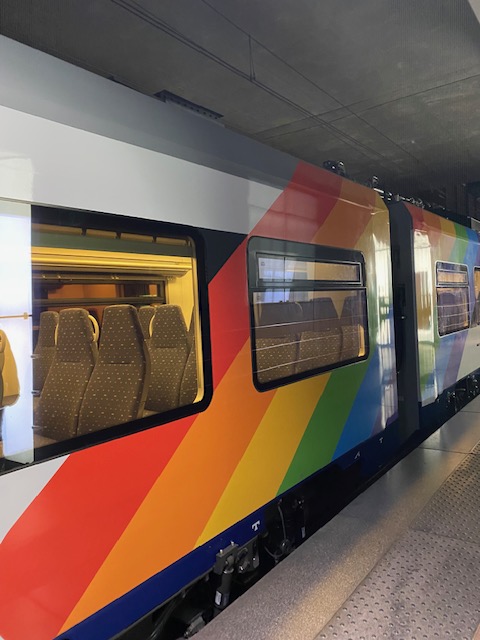
This means NMBS / SNCB is looking for three-car EMU’s. The operator has many of those. Currently the AM80 ‘Break’, the AM96 ‘DMT’ and the AM08 Siemens Desiro are three-car units.

Expectations
“Depending on the desired operation type (S/L or IC, with high or low capacity), the number of seats per (B)EMU will vary. Optionally, an extra intermediate cabinet (double deck) can also be provided for a number of EMU configurations (InterCity).”
“All motor vehicle types can be used on the 3kV DC electrified Infrabel network and the BEMU can also be used on the non-electrified lines of this network using a battery power supply. The single-deck (B)EMU can also be used outside the Infrabel network up to the border stations, either under a lower overhead line voltage of 1.5 kV DC (in the Netherlands) or with the aid of a battery supply (Netherlands, France and Germany).”
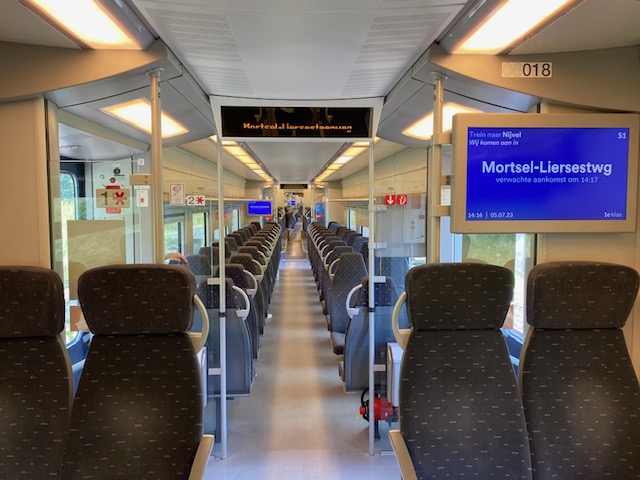
The main technical characteristics of the motor vehicles are
- Maximum speed of 160 km/h for all EMUs and 120 km/h for the BEMU when using the battery.
- Access possible through any door from the platforms with a height of 28 cm, 55 cm and 76 cm with at least one autonomous access (for each passenger) from a platform with a height of 76 cm in both end boxes and on both sides of the vehicle. The other access doors of all single-decker coaches (end cars and intermediate cars where applicable) provide a level access from the platform height of 76 cm.
- 8 places for bicycles per (B)EMU.
- Homologation for the Infrabel network (both on 3kV DC electrified lines and on non-electrified lines) and for cross-border stations in the Netherlands, France and Germany.
- Equipped with the latest safety systems (NTC TBL1+ in Belgium and ETCS Baseline 3 level 2).
- Double-deck intermediate car (where applicable) in accordance with the Belgian BE2 gabarit according to EN15273-2 to optimize capacity and passenger comfort.
- Equipped with modern technologies to optimize passenger comfort, operation (control), maintenance and breakdown service (diagnosis and telemetry).
- Concept developed on the basis of proven technology to achieve high reliability, reliability, availability and standardization of the equipment.
“Scenarios for the maintenance of the motor vehicles will be described in the specifications. The NMBS is free to order one of these scenarios as an option.”
“The assignment will be concluded in the form of a framework agreement (RO) with a term of 12 years. Given the complexity and the delivery time of the deliveries, this time frame is necessary to place staggered orders that fully cover SNCB’s need for AM30-(B)EMUs.”

So now what?
Train constructors such as Stadler, Siemens, CAF, Alstom and Bombardier, Škoda Transportation and others were to apply by February 2023.
So now, NMBS / SNCB experts will study the files and a long decision making process will be underway. Then the manufacturers not chosen have time to lodge a an appeal. Then a decision will be made. Is 2030 realistic. Let us put it this way. The Desiros, called AM08 referring to 2008, were actually launched in 2012. All manufacturers and all rail operators suffer from production and introduction delays.
Rest assured the NMBS / SNCB will announce which has been chosen in due time.
 Trip By Trip
Joepie, nieuwe treintjes!
LikeLiked by 1 person
Jaaa! Maar nog wel even geduld 😉
LikeLike