
October 2024. During a week-long whistle-stop tour of Germany, we visit Dessau-Roßlau in Saxony-Anhalt, Weimar in Thuringia, Coburg in Upper Franconia (Bavaria) and Kassel in Hesse. Smaller cities, yes. But each with their own significance. Untouched by overtourism. We’re avoiding using the white trains of DB Fernverkehr, Deutsche Bahn‘s long-distance section and opt to use the red trains of DB Regio and other regional operators.
A city museum is almost a genre in itself. A good city museum introduces you to the city you’re visiting. We love a good city museum because often we don’t really know much of the city’s history and life.
So we decided to visit Stadmuseum Kassel or Kassel City Museum.
Stadtmuseum Kassel
The Kassel City Museum focuses on the history of the northern Hessian city of Kassel. After renovation work and a new concept for the permanent exhibition since 2010, it was reopened in June 2016.


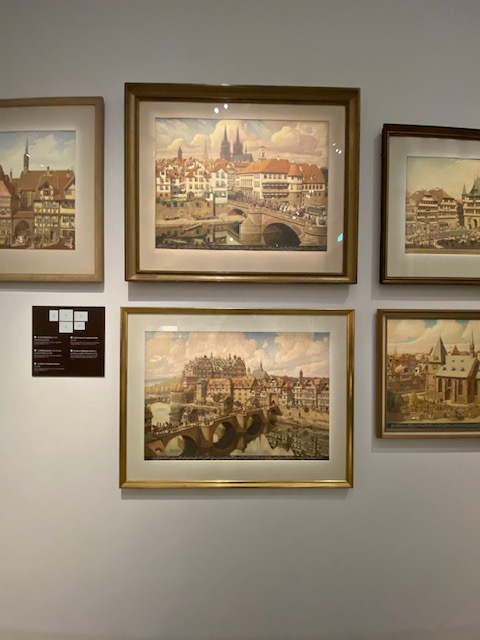
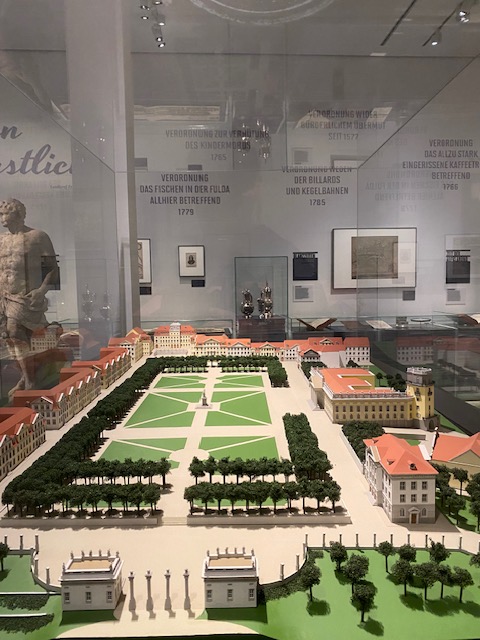


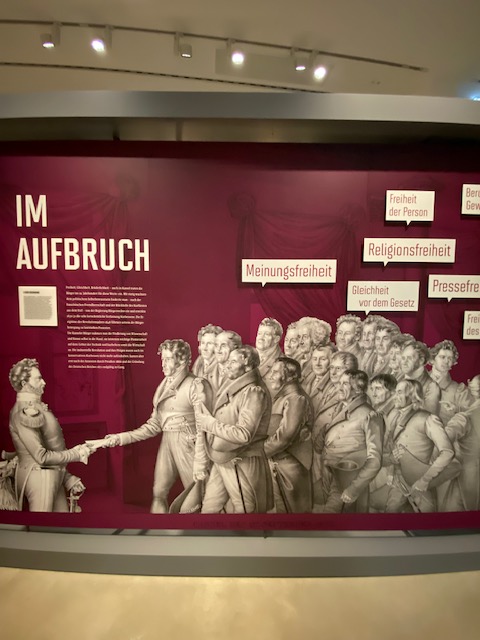


History of the museum
he idea of a museum dedicated to Kassel’s city history dates back to the 19th century, with various collections scattered across the city. Efforts to establish a unified museum gained traction in the 1970s when overcrowding at the Hessian State Museum highlighted the need.
In 1978, the city council approved plans, and public donations were sought. Initially, the museum operated temporarily at Ständeplatz, as debates over a permanent location – including the Karlshospital, Garrison Church, and Renthof – continued.
Rising costs and logistical challenges delayed construction, and by 1986, the museum remained at Ständeplatz.
In 2001, renovations and plans for an extension began, culminating in a major redesign in 2010.
Construction faced setbacks due to structural issues, contamination, and cost overruns, delaying reopening to 2016.
The museum’s expansion added a tower, increasing exhibition space to 1,920 m².
Today, the museum features a permanent exhibition on Kassel’s history, educational spaces, and an event hall, while also housing administrative offices, a library, and a museum shop.

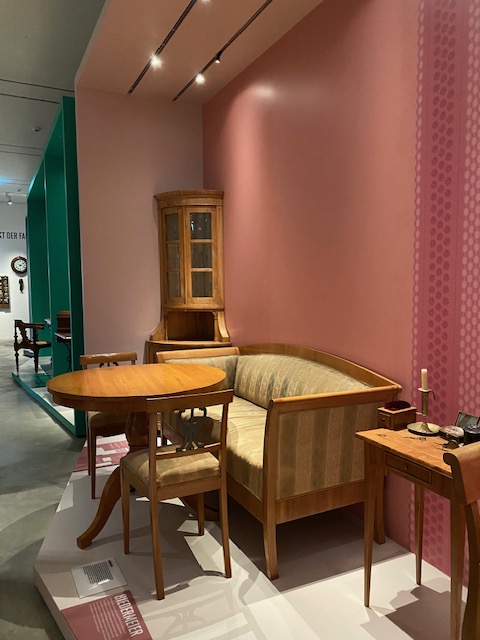

Culture House
Since its founding in 1979, the city museum has been housed in the Kulturhaus (Culture House), also known as the Kunsthaus (Art House), on Ständeplatz in Kassel-Mitte.
Designed by Albert Scholtz, the building was constructed between 1869 and 1871 and underwent several renovations over time. It was inaugurated on 27 December 1871 by the Kunsthausgesellschaft (Art House Association).
However, the rental income from local clubs using the building proved insufficient to pay dividends to the Kunsthausgesellschaft’s shareholders. In 1876, the shareholders proposed selling the building to the city, and in 1877, the city acquired it by assuming the association’s debts.
To maximise its utility, the city added another floor and established a school in the building, though the art association retained some rooms for exhibitions.
In 1907, the building was modernised with electric lighting, allowing exhibitions to remain accessible after dark.
In May 1935, the city ceremonially returned the building to the art association for its exclusive use as an exhibition space, commemorating the association’s 100th anniversary.
However, in November 1939, the building was requisitioned by the Food and Economic Office, rendering it unavailable for exhibitions. During World War II, bombing raids destroyed the building, leaving only its outer façade intact. It was rebuilt between 1953 and 1955, incorporating a 1950s-style staircase that remains today.
Lay-out of the museum
The permanent exhibition begins in the KasselFoyer on the ground floor, located near the reception desk and museum shop. This area, referred to as ‘memory storage’, features exhibits and audio recordings that provide an introduction to Kassel’s history before visitors enter the main exhibition.
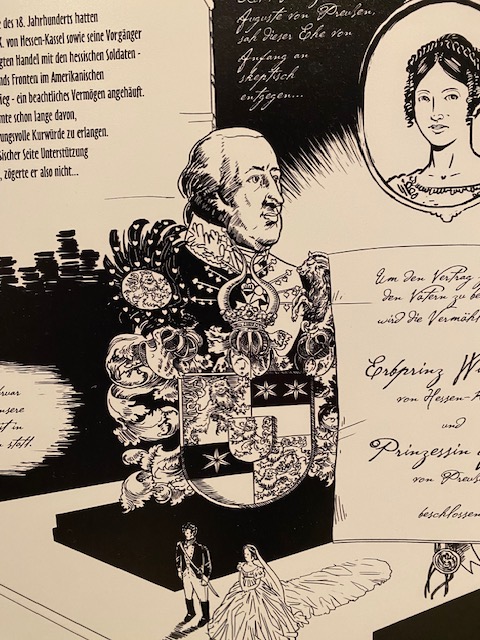
The new permanent exhibition is organised into three sections. The first, ‘The Residence City of Kassel – from the Beginnings to the 18th Century‘ is on the ground floor and covers the city’s history from its first documented mention in the early Middle Ages to the end of the 18th century.
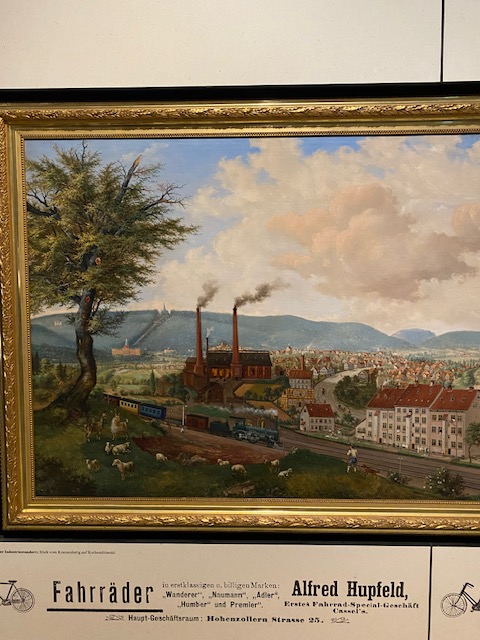
The second section, ‘The Rise of the Bourgeoisie – 19th Century‘, located on the first floor, explores the 19th century, culminating in Kassel’s designation as a major city in 1899/1900.
A wall newspaper, featuring embedded paintings, runs the length of this section to illustrate key events.
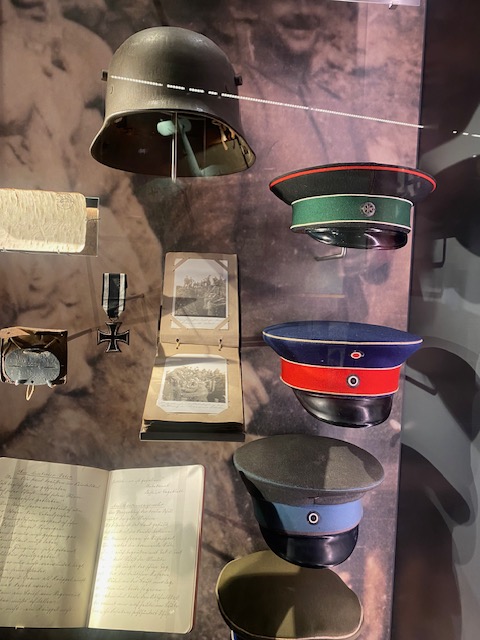
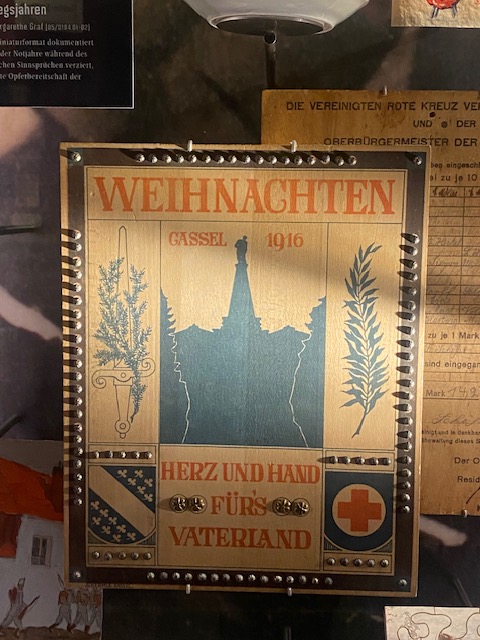
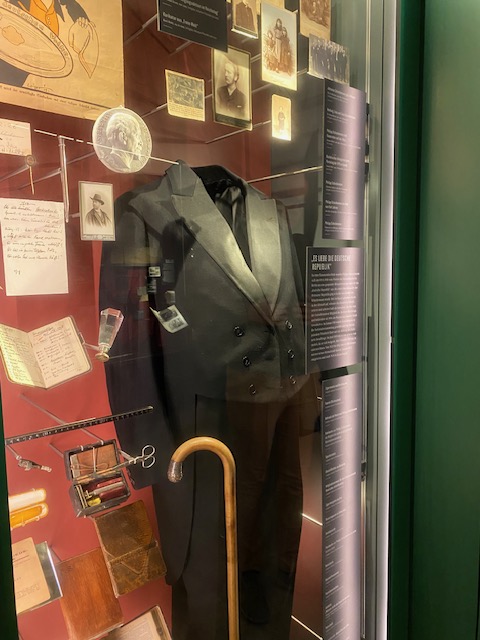
The third section, ‘War and Peace – 20th Century‘, situated in the attic, examines World War I, the National Socialist era, post-war reconstruction, and German reunification.
The tower extension houses the museum’s special exhibition area, which consists of three rooms.
Two of these are connected to the permanent exhibition on the first and second floors, while the third, located beneath the KasselBlick event room, offers panoramic views of the city from its balcony.
From 1992 to 2002, the museum’s publications were issued by Marburg Jonas Verlag, alongside other independent works on Kassel’s history. Since 2004, the Friends of the City Museum have published the Blickpunkt Stadtmuseum twice a year.


Cassel with a C
We like good city museums and this is a good one. We learned a lot about Kassel, the Landgraviate of Hesse, the Landgraviate of Hesse-Kassel, the Electorate of Hesse and the Kingdom of Westphalia. The area was annexed by Prussia in 1866. A reminder that the history of Germany is not straightforward.
We also learned that until 1926, Kassel was spelled Cassel.
So?
We enjoyed this museum. It was very educational, without being too educational.
Dessau – Weimar – Coburg – Kassel 2024
- REVIEW | European Sleeper night train.
- GERMANY | Bauhaus in Dessau.
- DESSAU | Technikmuseum Hugo Junkers Engineering Museum.
- REVIEW | Radisson Blu Fürst Leopold Hotel Dessau.
- SAXONY-ANHALT | A day in Dessau.
- GERMANY | Bauhaus in Weimar.
- GERMANY | Weimar Classicism, the Wittumspalais of Duchess Anna Amalia and the Weimar Haus Experience.
- GERMANY | The ‘Weimar’ in Weimar Republic.
- REVIEW | Hotel Elephant Weimar.
- THURINGIA | A day in Weimar.
- COBURG | Ehrenburg Palace.
- FRANCONIA | Veste Coburg.
- REVIEW | Ibis Styles Coburg.
- FRANCONIA | Coburg, cradle of crowns.
- KASSEL | Bad Wilhelmshöhe ft. Bergpark, Palace, Löwenburg and Hercules.
- REVIEW | FischerS hotel Kassel.
- KASSEL | GRIMMWELT Brothers Grimm museum.
- HESSE | Technik‐Museum Kassel.
 Trip By Trip
8 Comments Add yours