
Autumn 2025. We – Sam and Danny, Michel and Wille, and Timothy – are travelling to Japan for a quite classic tour of the Land of the Rising Sun. We are flying separately as we used miles. On the planning: Tokyo, Kanazawa, Shirakawa, Osaka, and Expo 2025, Hiroshima, Himeji, Miyajima, Kyoto, Nara, Nagoya, Hakone, and back to Tokyo. Three weeks plus some extra days.
Prior to the group trip, I – Timothy – am solo in Tokyo. Using artificial intelligence, I concocted a busy four days featuring Ito on the Izu Peninsula and Sawara, also known as Little Edo. I also end this Journey Across Japan with a solo spell in Minato, near Taito and Tamachi Station.
I wasn’t going to write about the short hop from Brussels Airport in Zaventem to Milan Malpensa Airport in Ferno, Lombardy. A Brussels Airlines flight, operated by Air Baltic. But the cyber attack on Collins Aerospace on Friday 19 September 2025 changed that. Collins Aerospace provides software for the check-in and boarding process.
My flight was on Thursday 25 September. Almost a week after. On Wednesday 24 September, Brussels Airlines mailed me this: “Due to a technical issue at Brussels Airport, it is only possible to do manual check-in and boarding. We strongly advise all passengers to check in online and to use the Self Bag drop when arriving at the airport. Please arrive well in time (2 hours before departure). We advise you to frequently check the status of your flight on our website for further updates. Your Brussels Airlines team.”
I was not pleased. Am I too spoiled expected the issues being resolved a week after the cyber attack? If Brussels Airport and Collins Aerospace were government-owned, politicians would cry for action and privatisation. Now, silence. Aren’t private companies supposed to be flexible, efficient and troubleshooting?
On 24 September, Brussels Airport issued this press release:
Brussels Airport to gradually deploy new check-in and boarding system as of Monday, 29 September in order to return to normal operations as quickly as possible.
Collins, the American external service provider of the check-in and boarding systems at Brussels Airport, cannot confirm that their systems impacted by the cyberattack can be restored. Therefore, Brussels Airport is taking additional measures to ensure continuity of operations while working on a full return to normal operations as soon as practical.
Brussels Airport, in concertation with Collins, has decided to bring forward the launch of the new check-in system, which was originally scheduled to be implemented in November 2025. This next-generation system requires the installation of new hardware, including new servers and 500 new workstations. We expect that starting on Monday, it will be possible for airlines to be gradually connected to this new system. Although this process usually takes several weeks, Collins is mobilising its team, supported by our own IT experts, to accelerate the work. Our ambition is to have the new system operational as quickly as possible.
To provide airlines and ground handlers with as much predictability as possible and to relieve pressure on airport staff, Brussels Airport has asked airlines to maintain the current level of cancellations (around 10%) until Sunday 28 September included. We will continue to evaluate the situation daily, in line with the progress of the rollout of the new system.
Those measures come on top of the mitigating actions already implemented since the start of the incident on Friday evening.
We are deeply grateful to the wider airport community and our staff for their incredible dedication under these exceptional circumstances, and we thank our passengers for their patience and understanding. Despite the current disruption and unavailability of the current check-in system, Brussels Airport continues to operate more than 500 flights per day and to transport more than 70,000 passengers per day.
I’m not optimistic. It doesn’t help my flight, SN3153, has a history of major delays.
On the ground
After a easy ride on the 3AM Airport Express coach from Antwerp to Zaventem, I go to the bag-drop devices. I print the labels and drop my bags. Easy. So far so good, nothing different.
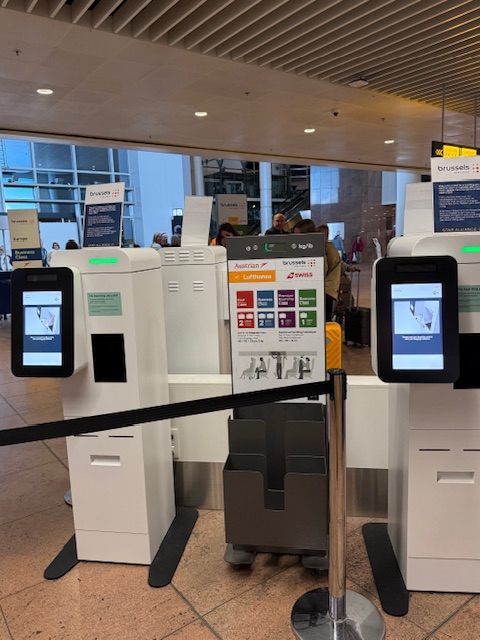
After walking up and down Terminal A and a quick sanitary pitstop at The Loft, I go to my gate. And indeed, check-in is manual.
‘Manual check-in’
This means the gate keeper doesn’t scan my boarding pass, but checks my name on a laptop. A bit odd, but it works.
So, to be honest, I did not suffer from the hack.



The flight
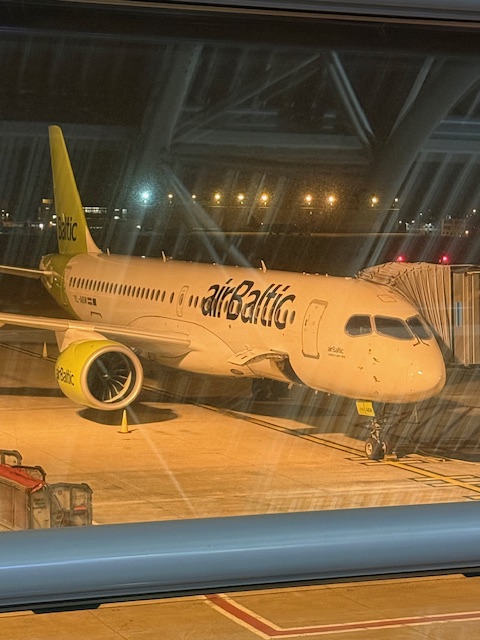
My SN3153 flight is operated by Air Baltic. Air Baltic uses an Airbus A220-300 (YL-ABW), formerly known as a Bombardier. Danny described such flight when we traveled to the Baltic States. That review will come online in 2026.
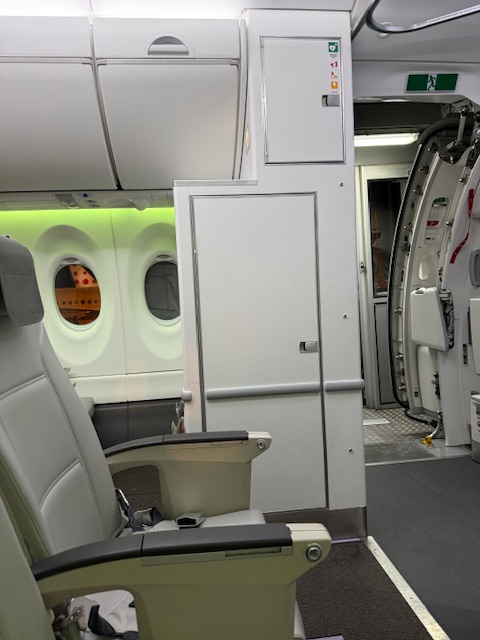
Oddly, I was the only one in business class. I got a green tea and a tray with breakfast. A slice of roast beef, two types of cheese, bread rolls, yoghurt, jam and strawberries. Pretty decent.
The flight was advertised to be just under two hours, but in reality it was around an hour and twenty minutes. The flight departed late, but in the ed our delay wasn’t much. Could be worse.
I got to admire the Alps. Is that the Mont-Blanc? Or the Matterhorn?
So?
My worries were unfounded. I got in time in Milan to go through the Schengen boarder control and try the lounges I’lm entitled to go to.
 Trip By Trip
4 Comments Add yours