
On 26 and 27 April 2025, the Rubenshuis in Antwerp will exhibit an exceptional recent acquisition. It is a rare preliminary study of Jacques Jordaens‘ painting ‘Moses and his Ethiopian Wife‘. The sketch reveals the painter’s creative thought process and emphasises how modern Jordaens was. The 17th-century drawing can be viewed exceptionally in the library; admission is free.
Jordaens’ painting of ‘Moses and his Ethiopian Wife’ is a powerful statement about equality. Researchers recently discovered that the work is based on an early sketch. This discovery prompted the Rubenshuis to purchase the valuable preliminary study. It provides a unique insight into Jordaens’ artistic thought process.
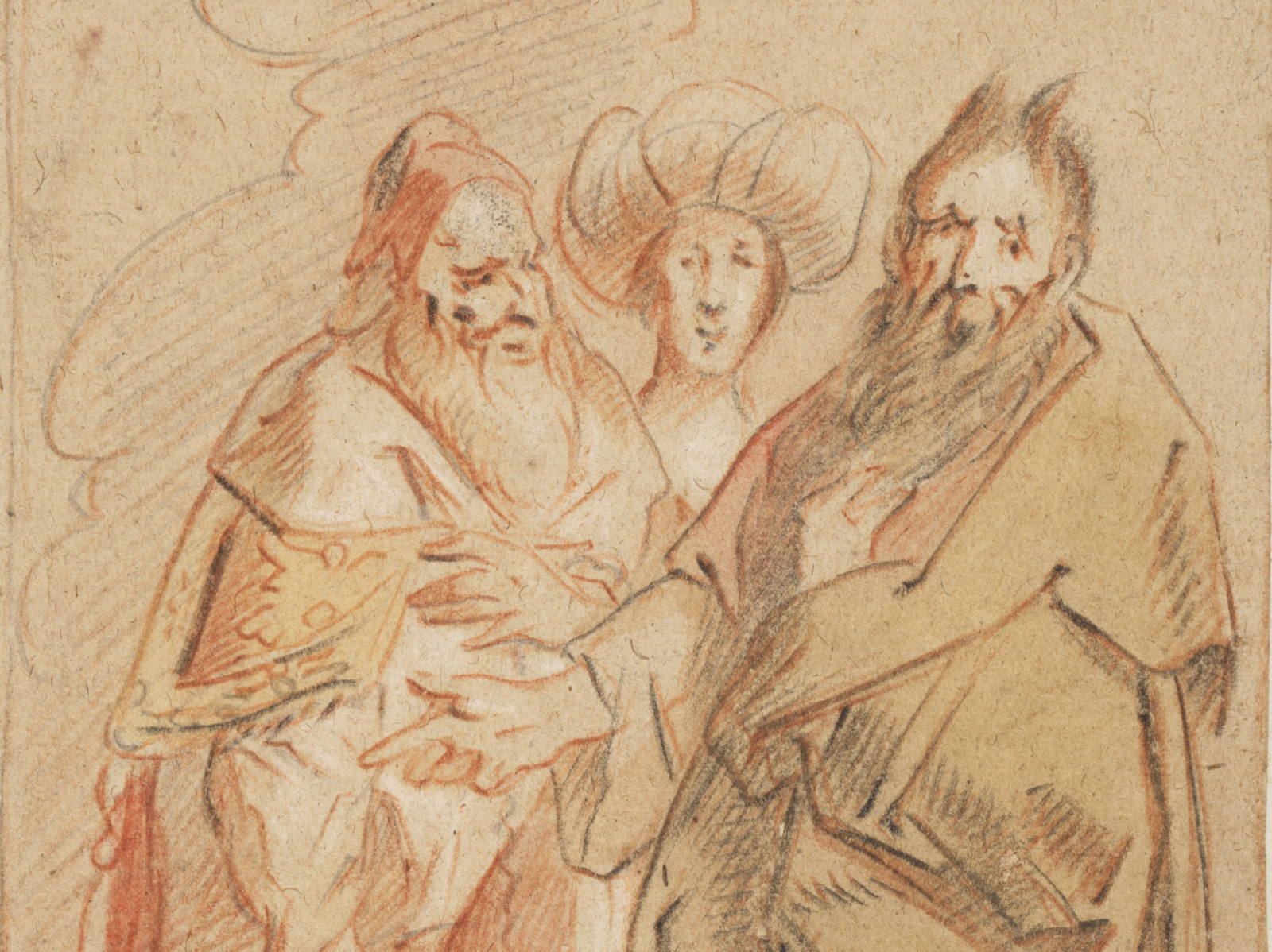
The connection between the sketch and the painting is not immediately apparent: the compositions differ greatly from each other. Yet there are striking similarities. On the right of the drawing, we recognise Moses. His horns, like stubborn tufts of hair, are visible in the painting. Also note his frown, sharp nose, red cheek and dark beard. Even the hand gesture and the folds of his robes are related.
Jordaens’ painting: a modern Biblical scene
Moses is usually depicted with the Ten Commandments, but in the painting ‘Moses and his Ethiopian Wife ‘all attention is focused on the beautifully dressed black woman next to him: his Ethiopian wife, possibly Sephora. With a powerful hand gesture, Moses seems to address us. Perhaps a call to recognize his African wife as an equal.
He also had to defend her in the Old Testament. In the ‘Book of Numbers‘, Moses is criticized by his sister Miriam and brother Aaron for marrying a black woman. God punishes Miriam for this: she becomes a leper for seven days and has to leave the community.
Drawing offers rare insight
The purchased sketch and the painting go back to the Biblical story, but both in a different way. The drawing literally follows the Biblical text: you see Moses next to his brother and sister, and God in a cloud. In the painting, Moses is standing with his wife. The cloud has disappeared, the stone tablets are added. Moses also directs his gaze differently.
Jordaens shifts the focus: it is not disapproval that is central, but love. That is why Aaron and Miriam disappear, and Moses’ wife takes their place. She is not depicted as an African stereotype, but as an individual woman with her own personality. For the 17th century, this is astonishingly progressive.
Jordaens is often accused of taking the easy way out. The sketch, which offers a rare insight into his creative process, proves just the opposite. We see an artist who searches, thinks and adjusts: about composition, meaning and about how a story comes across most powerfully.
Inclusive painting in the 17th century: international conference
We do not know whether Jordaens ever painted an African woman from life. But it is clear that — like Peter Paul Rubens — he depicted African figures in a remarkably human way. The nuances in skin colour and individual features demonstrate respect, while predecessors and contemporaries often remained stuck in caricatures and clichés.
This look at Jordaens’ thought process shows how the artist was far ahead of his time. He is one of the few old masters in Western art who takes a critical look at the (then) relationship between white and black people. His painting shows that 400 years ago, however exceptional, there was already a campaign for equality.
Art historical research into Rubens and his contemporaries continues to yield new insights.
These fresh perspectives on diversity and inclusivity will also be discussed during the conference ‘Tout le monde pour ma patrie: Rubens and the World‘ on 5 and 6 May 2025.
International researchers will come together there to position Rubens as a man of the world: both an influential artist and a source of inspiration, as an extra in broader stories that take place elsewhere. The relationship between the purchased preliminary study and Jordaens’ painting will also be discussed.
Art and museums in Antwerp
- M HKA 2025 | Bruno Zhu – Panamarenko – ‘The Situation is Fluid’ – Today’s Place – Hugo Roelandt.
- FOMU 2025 | Chrystel Mukeba – Katja Mater – Lee Miller – Mashid Mohadjerin.
- ANTWERP | ‘Panamarenko. Infinite Imagination’ exhibition until 4 May 2025 at KMSKA.
- ANTWERP | ‘Compassion’ in the MAS: the many faces of compassion.
- 2025 at the museums of Antwerp.
- 2025 at Royal Museum of Fine Arts of Antwerp (KMSKA): René Magritte, Marthe Donas, Panamarenko, Hans Op de Beeck.
- ANTWERP | Graphics Museum De Reede ft. Francisco Goya, Edvard Munch, Félicien Rops and Albrecht Dürer.
- ANTWERP | Rubens Experience and Rubens Garden at Rubenshuis.
- Antwerp will have a new Museum of Contemporary Art Antwerp M HKA.
- ANTWERP | Innovations in the Middelheim Museum provide a completely new visitor experience.
- A visit of the Flemish Tram and Bus Museum – Vlaams Tram- en Autobusmuseum (VlaTAM) in Antwerp.
- ANTWERP | Discovering queer(ed) art with the Queer Tour at the KMSKA fine arts museum.
- REVIEW | Illusion Antwerpen, an active and photogenic museum.
- Antwerp museums and sports facilities team up with European Disability Card for accessible leisure activities.
- Museum Mayer van den Bergh.
- ANTWERP | Inside Rubens House.
- Museum Plantin-Moretus in Antwerp.
- ANTWERP | Museum Vleeshuis up for restoration.
- BOOK | ‘Antwerp. An Archaeological View on the Origin of the City’ by Tim Bellens.
- Red Star Line Museum.
- Paleis op de Meir.
- DIVA, Antwerp Home of Diamonds.
- ANTWERP | Red Star Line Museum of (e)migration.
 Trip By Trip
💙
LikeLiked by 1 person
🎨
LikeLike