
March 2025. We’re embarking on a train trip to Sicily. We fly from Brussels Airport to Leonardo da Vinci Rome Fiumicino Airport with ITA Airways. Then we take an Intercity Notte sleeper train by Trenitalia from Roma Termini Railway Station across Italy to Syracuse. Yes, the train is loaded on a ferry to cross the Strait of Messina. After visiting Syracuse, Catania and Palermo, we return to Rome, and home. With 25,832 km², Sicily is only 20% smaller than Belgium (30,689 km²). Quite a lot in four days.
Three cities in four days sounds like a whirlwind, as we did in Andalusia in 2023. But it didn’t feel that way. We only had two hotels in Sicily, and not three. Also, even if Sicily is almost as large as Belgium, the geographical stretch was less than in Spain two years ago.
Introducing Sicily
Sicily, the largest island in the Mediterranean Sea, is an autonomous region of Italy located just off the southern tip of the Italian Peninsula. Separated from the mainland by the Strait of Messina, it covers an area of approximately 25,711 km² and is home to around five million people.
The island’s diverse landscape, rich history, and cultural heritage make it one of the most fascinating destinations in Europe. From ancient Greek ruins and Norman cathedrals to pristine beaches and volcanic landscapes, Sicily offers a wealth of experiences for visitors.
History of Sicily
Sicily’s history is shaped by the numerous civilisations that have occupied and influenced it over millennia. The island has been a crossroads of cultures due to its strategic location in the Mediterranean, attracting settlers, invaders, and traders from across Europe, Africa, and Asia.
The earliest known inhabitants of Sicily were the Sicani, who were followed by the Elymians and the Sicels. Around the 8th century BCE, Greek settlers arrived and established colonies, including Syracuse, which would become one of the most powerful city-states of the ancient world. The Greeks brought with them architecture, art, philosophy, and governance, leaving an indelible mark on the island’s culture. The Valley of the Temples in Agrigento and the theatre of Taormina are lasting testaments to this period.
The island later came under the control of the Carthaginians before the Romans seized it during the Punic Wars (3rd–2nd centuries BCE). Under Roman rule, Sicily became an important grain supplier for the empire, but the decline of Rome led to a succession of rulers, including the Vandals, Ostrogoths, and Byzantines.
In the 9th century, the island was conquered by the Arabs, who introduced advanced irrigation systems, new crops such as citrus fruits, and an era of prosperity and cultural fusion. The Arab influence remains evident in Sicilian cuisine, architecture, and language.
The Normans took control of Sicily in the 11th century, ushering in a golden age of tolerance and artistic achievement. The Normans blended Arabic, Byzantine, and Latin influences, as seen in the Palatine Chapel in Palermo and Monreale Cathedral.
The island later came under the rule of the Holy Roman Empire, the House of Aragon, and the House of Bourbon before becoming part of unified Italy in 1861.
What to see and do?
Sicily is a treasure trove of historical sites, nature, and vibrant cities, making it a compelling destination for all kinds of travellers.
Palermo, the capital, is a bustling city filled with architectural splendour. Visitors can explore the stunning Palermo Cathedral, the Norman Palace with its glittering Palatine Chapel, and the vibrant Ballarò market. The city’s rich food scene offers delicacies such as arancini (stuffed rice balls) and panelle (chickpea fritters).
Catania, located on the eastern coast, lies in the shadow of Mount Etna, Europe’s tallest active volcano. The city boasts impressive Baroque architecture, lively markets, and easy access to Etna, where visitors can hike, take a cable car, or join guided tours to see the craters and lava flows.
Syracuse, once a powerful Greek city-state, is home to the Archaeological Park of Neapolis, which contains a well-preserved Greek theatre, a Roman amphitheatre, and the Ear of Dionysius, a limestone cave with remarkable acoustics. The nearby island of Ortygia, the historic centre of Syracuse, charms visitors with its narrow streets, elegant piazzas, and the striking Cathedral of Syracuse, built on the site of an ancient Greek temple.
In the west, Agrigento’s Valley of the Temples is one of the most remarkable archaeological sites in the world. The well-preserved Doric temples, set against a stunning rural backdrop, showcase the grandeur of Ancient Greek civilisation.
Further west, the medieval town of Erice sits atop Mount Erice and offers spectacular views, cobbled streets, and the impressive Castello di Venere. Nearby, the salt flats of Marsala and Trapani provide a picturesque setting, particularly at sunset.
The Aeolian Islands, a UNESCO World Heritage site, lie off Sicily’s northern coast and attract nature lovers and adventure seekers. These volcanic islands offer activities such as hiking on Stromboli, swimming in the turquoise waters of Panarea, and soaking in the thermal mud baths of Vulcano.
Sicily is also known for its beaches, with some of the best found in San Vito Lo Capo, the Zingaro Nature Reserve, and the island of Favignana. The southern coast boasts the Scala dei Turchi, a striking white limestone cliff that contrasts beautifully with the blue sea.
For those interested in religious and traditional festivals, the Festa di Sant’Agata in Catania and the Easter celebrations in Enna are spectacular events showcasing Sicilian devotion and culture.

Cuisine and wine
Sicilian cuisine is a blend of Mediterranean influences, reflecting the island’s complex history. Signature dishes include pasta alla Norma (with aubergines and ricotta), caponata (a sweet and sour aubergine dish), and cannoli (crispy pastry tubes filled with sweet ricotta). The island is also famous for its granita, a semi-frozen dessert often paired with a brioche.
Sicily is one of Italy’s top wine regions, producing a variety of wines, from robust reds such as Nero d’Avola to crisp whites like Grillo. The Marsala wine from the western part of the island is particularly renowned.
What we did
We started in Syracuse, we went in a day trip to Catania, we crossed the island to Palermo and explored Palermo.
Syracuse had the most ‘vacation vibe’. Out of the three, it felt the most leisurely. Catania and certainly Palermo are more ‘real cities’, with more people, more youngster, universities, more shopping.
But all of them have plenty on offer for citytrip minded tourists, with culture and archeology on offer.
What we missed out on
Agrigento was mentioned here before. We did not go. But we also missed out on Taormina and Noto. We also omitted Cefalù.
Taormina
I hadn’t heard of Taormina before, I must confess. Dany has already bean while on cruise.
Situated approximately 250 metres above sea level on Mount Tauro, Taormina offers breathtaking views of the Ionian Sea and the imposing Mount Etna.
The origins of Taormina trace back to around 396 BC, following the destruction of the nearby city of Naxos by Dionysius I of Syracuse. Survivors established a new settlement on Mount Tauro, which evolved into the city known in antiquity as Tauromenium. Its strategic hilltop location rendered it a significant stronghold throughout various epochs.
During the Roman era, Taormina flourished as an important urban centre. The decline of the Western Roman Empire saw the town under Byzantine control, becoming one of the last bastions of Byzantine power in Sicily. In 962, after a prolonged siege lasting 30 weeks, the Fatimids captured Taormina, renaming it ‘Al-Mu’izziyya‘ in honour of Caliph al-Mu’izz.
The Norman conquest in 1078 ushered in a period of cultural amalgamation, blending Norman, Arab, and Byzantine influences. Subsequent centuries witnessed Taormina under the sway of the Holy Roman Empire, the House of Aragon, and the Bourbons, each leaving indelible marks on the town’s architectural and cultural landscape.
The 19th century heralded the advent of tourism in Taormina. Travellers from Northern Europe, drawn by the town’s classical ruins and idyllic setting, began to frequent the area. Notably, German painter Otto Geleng‘s exhibitions showcased Taormina’s scenic beauty, enticing many to visit.
Today, Taormina is renowned for its well-preserved ancient theatre, a testament to its Greek and Roman heritage. The theatre, primarily constructed of brick indicative of Roman craftsmanship, adheres to the architectural principles of Greek design.
With a diameter of 109 metres, it stands as the second-largest theatre of its kind in Sicily, surpassed only by that of Syracuse. The theatre continues to serve as a venue for operatic and theatrical performances, as well as concerts, offering attendees a unique blend of historical ambiance and artistic expression.
Beyond the ancient theatre, Taormina’s main street, Corso Umberto I, is lined with charming boutiques, cafes, and restaurants, reflecting the town’s vibrant contemporary culture. The nearby Isola Bella, a small island and nature reserve, offers opportunities for swimming and exploration of local flora and fauna.
Additionally, the town’s proximity to Mount Etna allows for excursions to one of the world’s most active volcanoes, providing adventurous visitors with hiking and guided tour options.
Noto
We stumbled on Noto, honestly. We passed by the city during our cross-country train ride. The automated Trenitalia voice announced Noto not only in Italian and English like any other stop, but also in German.
Noto is renowned for its Baroque architecture. The original settlement, known as Noto Antica, was located approximately 8 kilometres north of the present city on Mount Alveria.
This ancient city, referred to as Netum in antiquity, was of Sicel origin. In 263 BCE, the Romans granted it to Hiero II. According to legend, figures such as Daedalus and Hercules visited the city.
During the Roman era, Noto opposed the magistrate Verres. In 866 CE, the Muslims conquered the city, renaming it Nawṭis and elevating it to the capital of one of Sicily’s three districts, the Val di Noto.
It remained an important Islamic stronghold until 1091, when it became the last city in Sicily to fall to the Christians under Norman rule.
The medieval town of Noto was virtually destroyed by the 1693 Sicilian earthquake, leading to the decision to rebuild the town at its present site, closer to the Ionian shore. This reconstruction resulted in a unique architectural homogeneity, with the core of the town built in the decades following the calamity in the typical Sicilian Baroque style.
The layout followed a grid system designed by Giovanni Battista Landolina, utilizing the sloping hillside for scenographic effects. Architects such as Rosario Gagliardi and Francesco Sortino contributed to the design of multiple structures. The town has been dubbed the ‘Stone Garden’ and is currently listed among UNESCO’s World Heritage Sites.
Today, Noto is celebrated for its harmonious and elegant Baroque architecture, which includes numerous palaces and religious buildings.
Notable among these is the Noto Cathedral, dedicated to Saint Nicholas of Myra. Its construction began in the early 18th century and was completed in 1776. The cathedral’s façade exemplifies the grandeur of Sicilian Baroque style.
Adjacent to the cathedral is Palazzo Ducezio, the town hall designed by Vincenzo Sinatra, housing neo-classical style frescos by Antonio Mazza. Other significant palaces include Palazzo di Villadorata, built by P. Labisi in 1733, and the Palazzo Astuto.
The Church of San Domenico, designed by Rosario Gagliardi, is a prime example of Baroque artistry. The Church of Santa Chiara houses a precious Madonna by Antonello Gagini and is part of a Benedictine monastery.
The Church of San Carlo al Corso, also designed by Gagliardi, features an elegant façade and an impressive interior.
Beyond its architectural treasures, Noto offers access to archaeological sites such as the remains of the ancient Greek city of Helorus, located near the Tellaro River.
Nature enthusiasts can visit nearby reserves like the Riserva naturale orientata Cavagrande del Cassibile and the Riserva naturale orientata Oasi Faunistica di Vendicari, which offer opportunities for hiking and bird-watching.
Cefalù
Cefalù is a coastal town on the northern shore of Sicily. Located approximately 70 kilometres east of Palermo, this town of nearly 14,000 residents has evolved into a significant tourist destination, seamlessly blending its historical heritage with natural beauty.
The origins of Cefalù date back to ancient times, with evidence suggesting that the area was inhabited during the prehistoric period. The town’s name is believed to derive from the Greek word Κεφαλοίδιον (‘Kephaloidion‘) meaning ‘head’ or ‘headland’, likely referencing the prominent rocky promontory that characterises the area.
Throughout its history, Cefalù has witnessed the influence of various civilisations, including the Greeks, Romans, Byzantines, Arabs, and Normans, each leaving their mark on the town’s cultural and architectural landscape.
A pivotal moment in Cefalù’s history occurred during the Norman period in the 12th century. In 1131, Roger II, the Norman King of Sicily, commissioned the construction of the Cefalù Cathedral, a magnificent example of Norman architecture that dominates the town’s skyline.
The cathedral was intended to serve both as a place of worship and as a symbol of the king’s power and devotion. Over the centuries, the cathedral has undergone various modifications but remains a central landmark in Cefalù.
Visitors to Cefalù are drawn to its array of attractions that cater to diverse interests. The Cefalù Cathedral, a UNESCO World Heritage Site, stands as a testament to the town’s historical significance. Its impressive façade and intricate mosaics reflect the confluence of cultural influences that have shaped Cefalù over the centuries.
Beyond the cathedral, the town’s medieval streets invite exploration, offering glimpses into its storied past through charming alleys, traditional houses, and quaint shops.
For those interested in history and archaeology, the Mandralisca Museum houses a collection of artifacts and artworks, including the renowned ‘Portrait of an Unknown Man‘ by Antonello da Messina.
Nature enthusiasts can hike up La Rocca, the towering limestone cliff that overlooks the town, to explore ancient ruins and enjoy panoramic views of the surrounding coastline. The ascent reveals remnants of the Temple of Diana, a megalithic structure dating back to the 9th century BC, highlighting the area’s ancient heritage.
Cefalù’s beaches are among its most inviting features, with sandy shores and clear blue waters providing an ideal setting for relaxation and water activities. The Lungomare Beach, located near the town centre, is particularly popular among both locals and tourists. The town’s vibrant culinary scene offers a taste of traditional Sicilian cuisine, with seafood dishes featuring prominently on many menus.

So?
Our visut to Sicily was succesful. We visited three cities in four days, we had night trains and day trains.
But being there, we discovered there’s more to discover. So yes, there is cause to return.
PS: Flag of Sicily
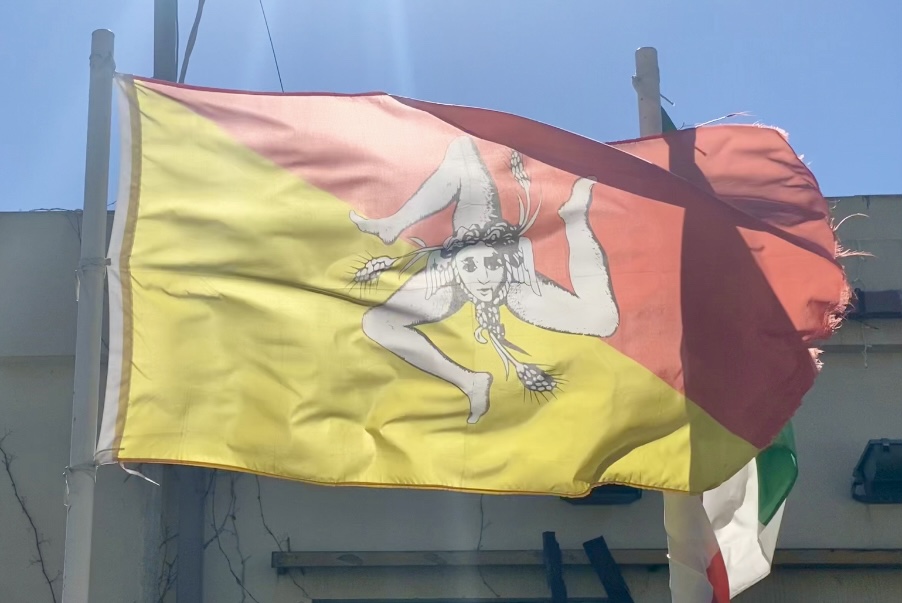
I love flags and I try to take decent photos of them. And the flag of Sicily is not an easy one.
The flag of Sicily features a triskeles – from the Greek τρισκελής – symbol, consisting of three legs arranged in rotational symmetry, and at its centre, a Gorgoneion, a depiction of Medusa‘s head, adorned with a pair of wings and three ears of wheat. In its original form, the flag did not include the wheat ears, and its colours were reversed. It was first created in 1282 during the Sicilian Vespers rebellion.
The flag is distinguished by the triskeles at its centre, which incorporates the winged head of a woman, identified as Hybla, an ancient Sicilian fertility goddess. The head is adorned with a knot of snakes and three wheat ears, from which three bent legs extend as if in motion.
This symbol represents the island’s agricultural fertility. The triskeles is also believed to symbolise the three capes of Sicily: Pelorus (Tip of Faro, Messina) in the north-east, Pachynus (Passero, Syracuse) in the south, and Lilybaeum (Cape Boeo, Marsala) in the west. These three capes outline the triangular shape of the island and correspond to the historical three valli, or administrative divisions, of Sicily.
The flag is divided diagonally into two sections: red, representing Palermo, and yellow, representing Corleone. These two cities played a key role in initiating the Sicilian Vespers uprising. The flag was used during the medieval revolution associated with the Vespers.
The triskeles with a Gorgoneion has ancient origins, appearing on coins minted in Syracuse as early as the 4th century BC. The emblem was later incorporated into the design of the Army Gold Medal, awarded to British Army officers of major rank and above who participated in the Battle of Maida in 1806. It was also used alongside the Italian tricolour during the Sicilian revolution of 1848.
During this period, it was referred to as “the sign of the Trinacria,” a reference to Sicily’s ancient name, Trinacria, meaning ‘three headlands’. This name had been revived during the Aragonese rule of Sicily following the Sicilian Vespers in 1282 and subsequently came to be associated with the symbol itself.
The diagonal red-and-yellow division of the flag dates back to 1943 when it was adopted by the separatist movement led by Andrea Finocchiaro Aprile. The wings on the Gorgon’s head were introduced in 1848, while the three ears of wheat were added in the 1940s.
In 1990, the Sicilian Regional Assembly adopted a gonfalon combining the coats of arms of Norman Sicily, the Hohenstaufen emperors, and the Aragonese kingdom of Sicily, along with the triskeles emblem.
The current design was officially recognised as the public flag of the Autonomous Region of Sicily on 4 January 2000, following the passage of a law mandating its use in public buildings, schools, city halls, and other official locations representing Sicily.
Sicily & Rome 2025
- REVIEW | Brussels Airport Diamond Lounge at A-Gates.
- REVIEW | ITA Airways Business Class Brussels to Rome.
- ROME | Afternoon tea at Hotel Hassler Roma on top of the Spanish Steps.
- REVIEW | Trenitalia Intercity Notte in Superior (Excelsior) Class.
- SICILY | Neapolis Archeological Park of Syracuse.
- SYRACUSE | Ortygia.
- REVIEW | Boutique Hotel Caportigia Syracuse.
- SICILY | Catania.
- ITALY | Trains in Sicily.
- REVIEW | NH Palermo.
- SICILY | Palermo Cathedral.
- PALERMO | Palazzo dei Normanni, the Royal Palace of the Normans in Sicily.
- PALERMO | Palazzo Butera in the Kalsa neighbourhood.
- SICILY | Palermo.
 Trip By Trip
6 Comments Add yours