
I turned 44 in June. I have this tradition – when possible – of not being in Belgium for my birthday. From Sweden in 2013 to the Châteaux of the Loire Valley in 2014, Lake Orta in 2015, Rome in 2016, London in 2018, North Carolina and Virginia in 2019, England in 2022, and Rotterdam in 2023. In June 2025, I headed to Copenhagen in Denmark with Steve.
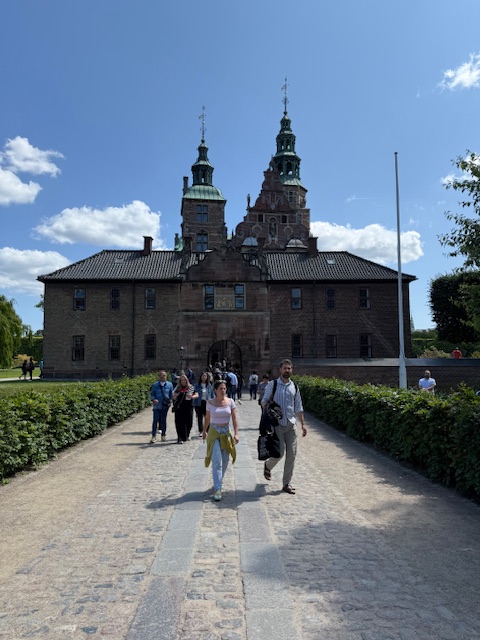
After the Ny Carlsberg Glyptotek, Steve and I walked to Rosenborg Castle or Rosenborg slot in Danish.


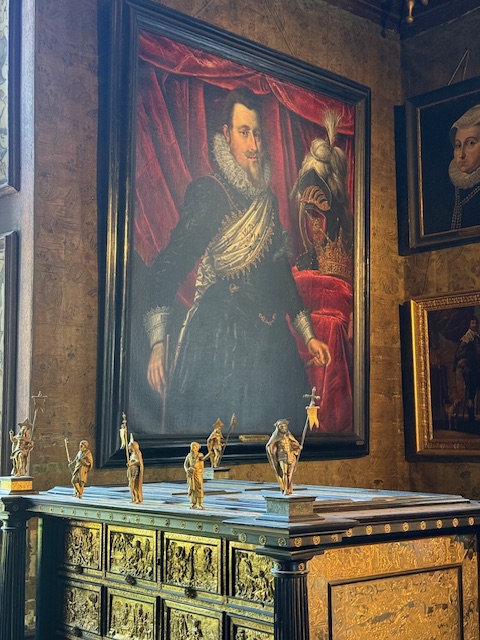


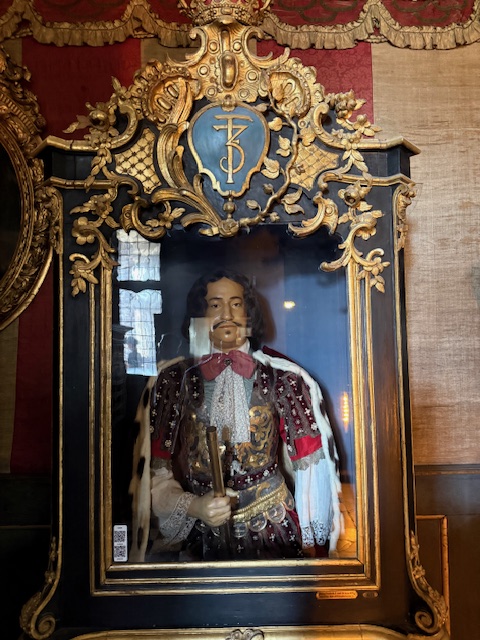


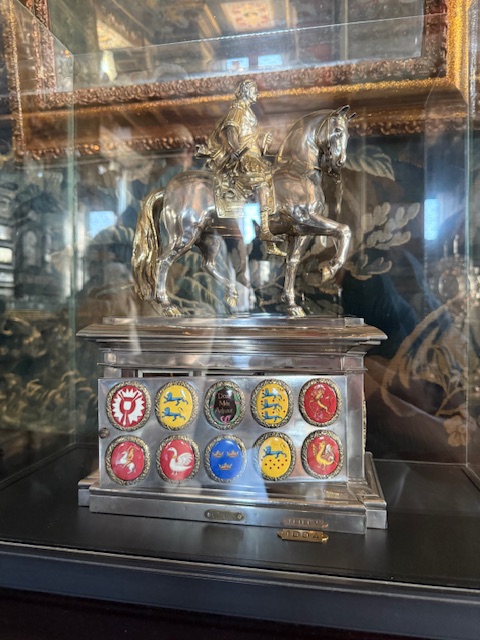

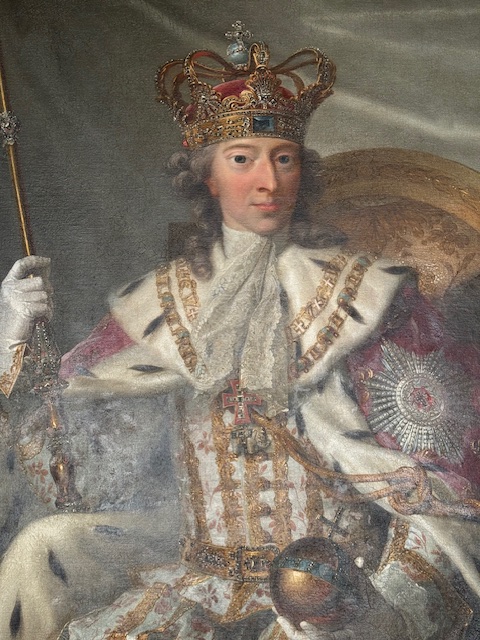
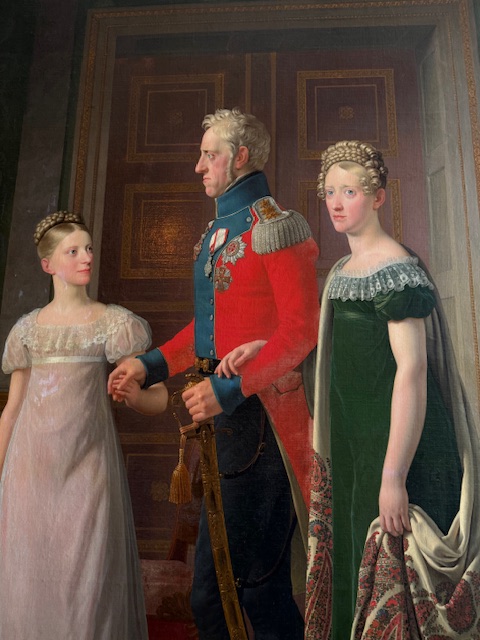

Rosenborg Castle
Rosenborg Castle is a Renaissance castle situated in Copenhagen. It was originally constructed in 1606 as a summer residence for King Christian IV and reflects the Dutch Renaissance architectural style that was prevalent in Denmark at the time.
The castle underwent several expansions before reaching its final form in 1624. The architects responsible for its design were Hans van Steenwinckel the Younger and Bertel Lange.
Until around 1710, Rosenborg Castle served as a royal residence for the Danish monarchy. After the reign of Frederick IV, it was used as a royal residence only twice, both during times of crisis: first in 1794, following the fire at Christiansborg Palace, and again in 1801 during the British bombardment of Copenhagen.
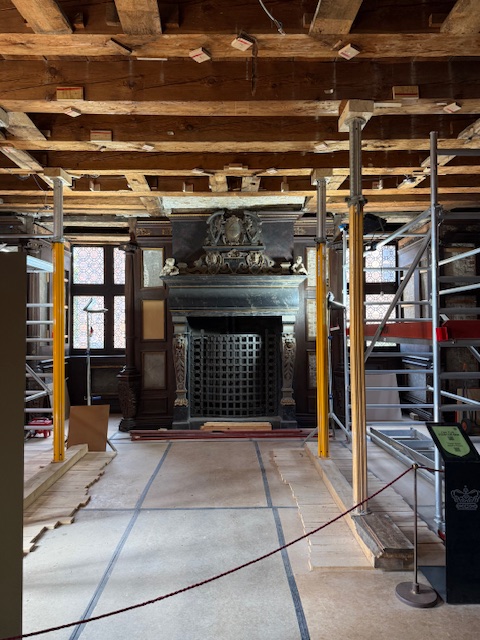
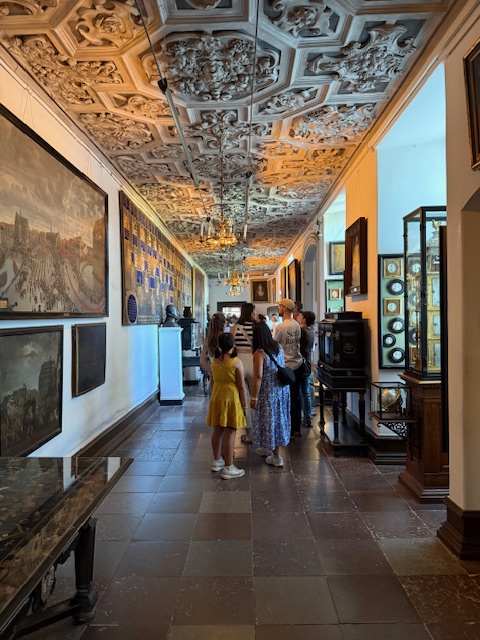
One of the castle’s most notable interior spaces is the Long Hall on the third floor, completed in 1624. Initially intended as a ballroom, it was later used for royal receptions and banquets around 1700.
It became known as the ‘Knight’s Hall‘ in the second half of the 19th century.
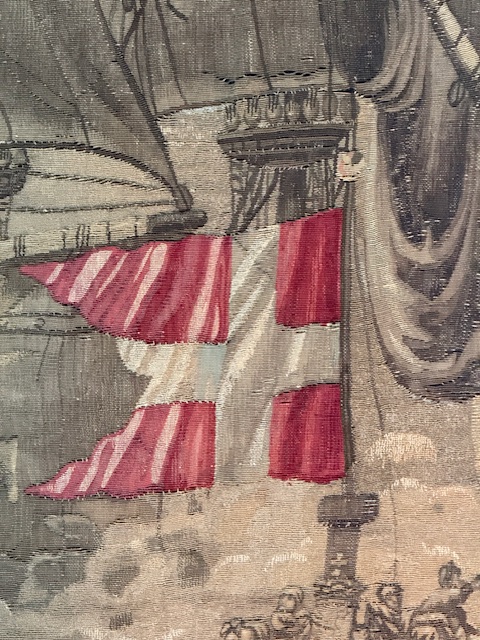
Christian V had the hall partially modernised with twelve tapestries depicting victories from the Scanian War (1675–1679). The stucco ceiling from the early 18th century features the Danish Coat of Arms and the insignia of the Order of the Elephant and Order of the Dannebrog, along with reliefs depicting key events from the early reign of Frederick IV. Ceiling frescos by Hendrick Krock illustrate the Danish Regalia.

The Long Hall houses several important artefacts, including the coronation chair of the absolutist kings, the queen’s throne accompanied by three silver lions, and an extensive collection of 17th-century silver furniture.
Rosenborg Castle has been open to the public since 1838 and contains a museum known as the Royal Collections. These include objects dating from the late 16th century to the 19th century, many of which once belonged to members of the nobility and aristocracy.
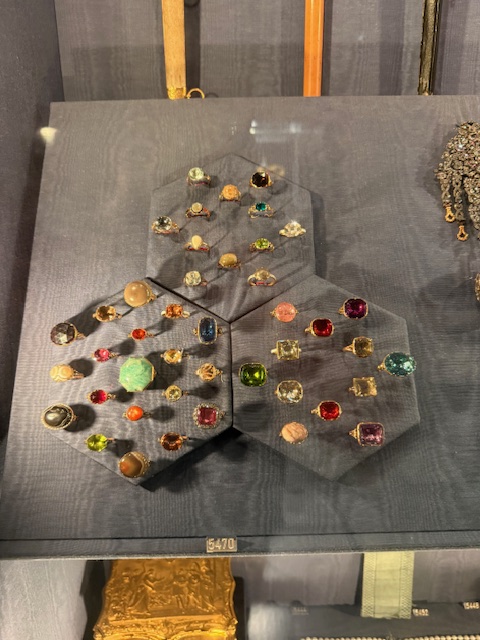
Among the museum’s most significant holdings are the Danish Crown Regalia and the Crown Jewels, displayed in the castle’s treasury. The Coronation Carpet and the Throne Chair of Denmark are also housed within the castle.
The castle is located within Kongens Have, the King’s Garden, also called the Rosenborg Castle Garden. It is the oldest royal garden in Denmark and was laid out in the Renaissance style by Christian IV before the main construction of the castle.
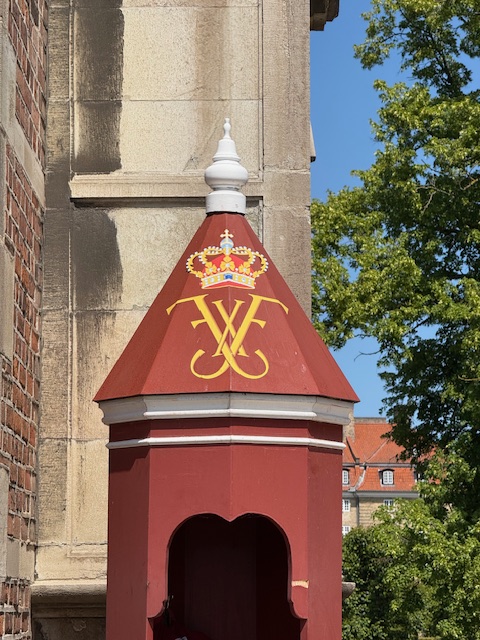
Today, the gardens are one of Copenhagen’s most visited public spaces, attracting approximately 2.5 million visitors annually. The Royal Life Guards are stationed in nearby barracks and are responsible for guarding the castle.
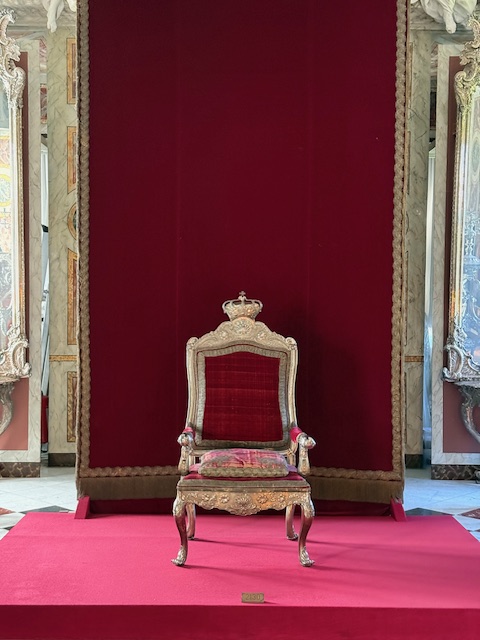



Danish Crown Regalia
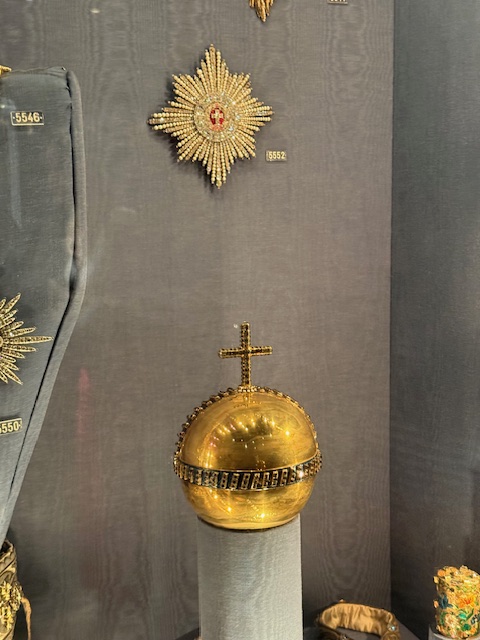
The Danish Crown Regalia are ceremonial objects symbolising the authority and continuity of the Danish monarchy. They include three crowns, a sceptre, a globus cruciger (a globe surmounted by a cross), the sword of state, and an ampulla used for anointing.
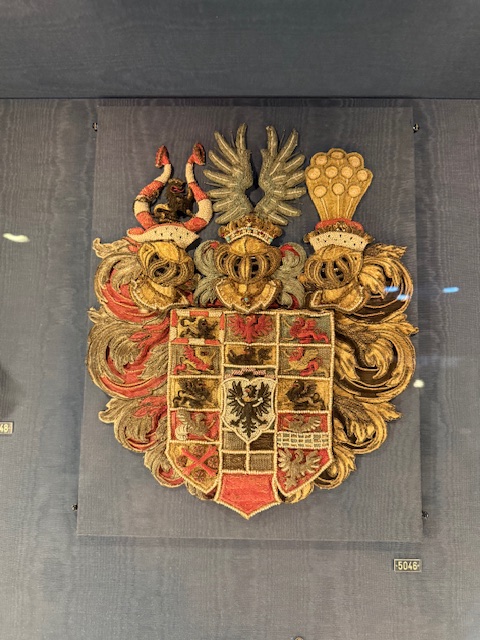
The oldest item is the sword of state of Christian III, made in 1551. Other significant objects include Christian IV’s diamond, ornately decorated saddles, carved ivory and rock-crystal pieces, precious stones, and fantastical animal-shaped brooches.
Ceremonial function and history
Before the establishment of absolutism in 1660, Danish monarchs were crowned in ceremonies where the nobility and clergy placed the crown on the monarch’s head. With the introduction of absolute monarchy, coronation was replaced by anointment, during which the monarch entered the church already wearing the crown and was then consecrated with holy oil.
For the anointing of Christian V, a new crown was created, along with the Throne Chair of Denmark—crafted from narwhal tusks and guarded by three silver lions sculpted by Ferdinand Küblich. These elements were inspired by the biblical description of Solomon’s Throne.
Following the adoption of the Danish Constitution in 1849, anointment was discontinued. Since then, the regalia have only been used during the castrum doloris of a deceased monarch. During this ceremony, the crown is placed on the coffin, the remaining regalia arranged at its base, and the casket is flanked by the three lions.
The lions were once displayed in Parliament during ceremonial openings but this tradition ceased nearly a century ago. They were also formerly placed beside the throne in the Christiansborg Palace throne room for highly formal royal audiences.
Crown jewels
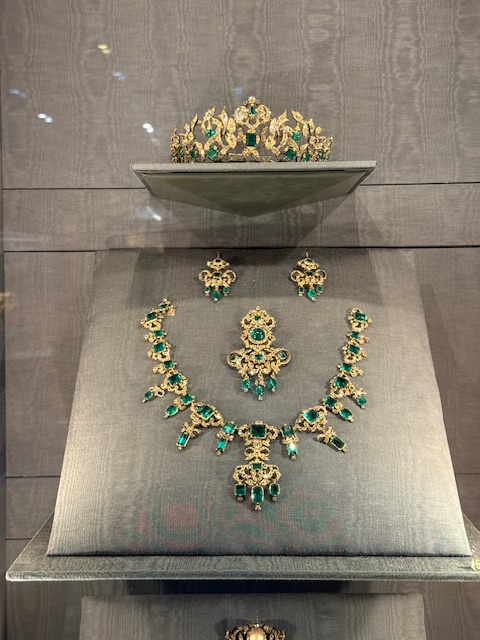
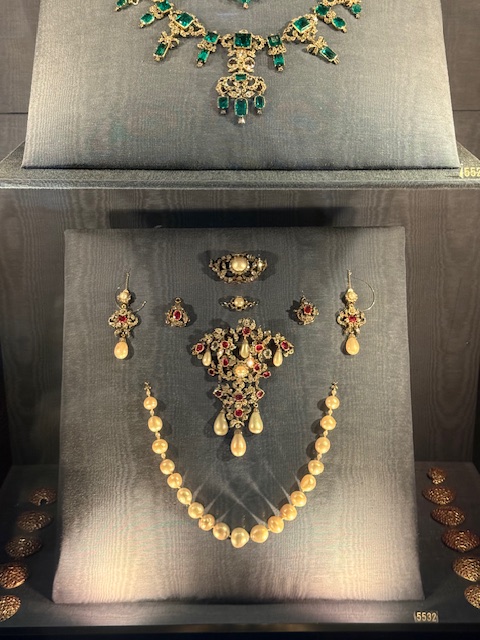
The Danish crown jewels consist of four sets of jewellery (parures) owned by the state and used by the reigning queen. Queen Margrethe II wore these during her time on the throne. They remain state property and are distinguished from the regalia, which symbolise sovereign authority.
The old regalia
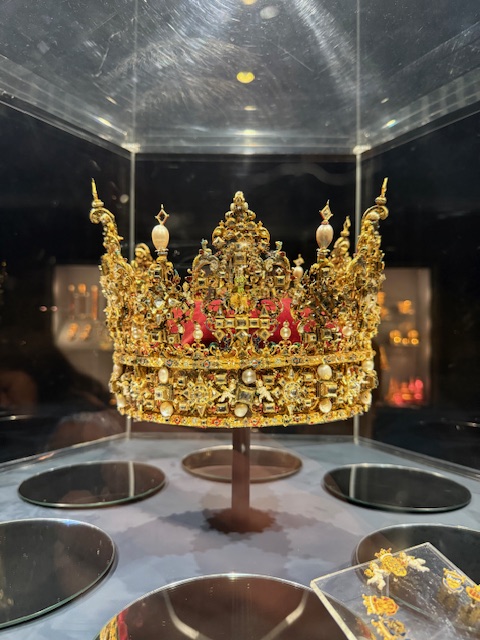
The ‘old regalia’ refers to the ceremonial items used prior to the establishment of absolutism. Among these is the crown of Christian IV, crafted between 1595 and 1596 by Dirich Fyring and Corvinianus Saur.
Made from gold, enamel, table-cut gemstones and pearls, the crown weighs 2,895 grams. It features a circlet with diamonds and pearls, enameled putti, and allegorical figures symbolising royal virtues such as Fortitude, Justice, and Charity.
Initially designed as an open crown, it was later modified with arches and a globe, though these additions were removed by Christian V for reuse in his own crown. The crown was last used at the coronation of Frederick III in 1648.
Christian III’s sword of state, dating to 1551, was made by Johann Siebe. It is crafted from gilded silver, enamel and gemstones and was traditionally the first piece presented to the monarch during coronation ceremonies.
Another ceremonial weapon, the accolade sword of Christian IV, features a blue enamelled grip set with diamonds and was used in knighting ceremonies.
The new regalia
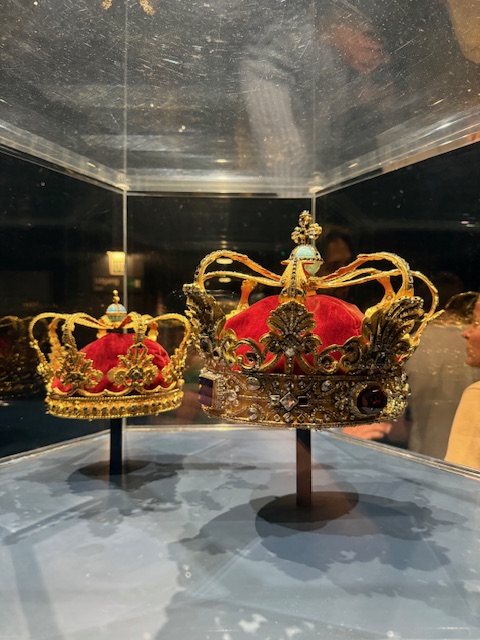
With the advent of absolutism, new regalia were created, chief among them the crown of Christian V. This crown, made in 1670–1671 by royal goldsmith Paul Kurtz, was used for the anointment of all Danish absolute monarchs up to 1849.
It is a closed crown, a deliberate departure from the open crowns of the elective monarchy, possibly inspired by the imperial crown of Charlemagne.
The circlet is divided by prominent gemstones—a sapphire traced to Frederick I at the front, a second sapphire at the back, a spinel on one side, and a garnet on the other. The crown features diamond-studded acanthus leaves and arches supporting a blue enamelled globe topped by a diamond-studded cross and a cabochon ruby. It weighs 2,080 grams and remains a symbolic item, placed on the coffin of a deceased monarch during the castrum doloris.
The Queen’s Crown
While Queen Charlotte Amalie of Hesse-Kassel was not crowned—possibly due to her adherence to the Reformed faith or the presumption that her marriage conferred the right to use regalia—her successors were. Louise of Mecklenburg-Güstrow was crowned with a custom-made crown, which was later reused for Anna Sophie Reventlow.
However, Sophia Magdalen of Brandenburg-Kulmbach commissioned her own crown in 1731, made by jeweller Frederik Fabritius. Taller and more slender than Christian V’s crown, it is decorated with table-cut diamonds believed to have come from Queen Sophie Amalie’s 1648 crown.
The sceptre
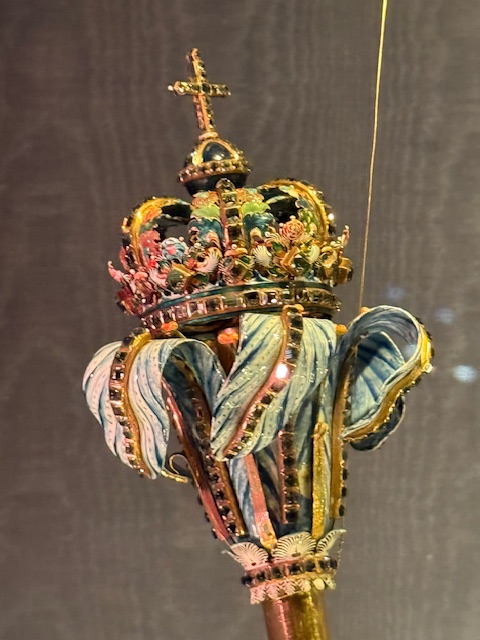
The sceptre was created for the coronation of Frederick III in 1648 by an unidentified Copenhagen goldsmith. It is made from gold, with an enameled lily at its head and a diamond-studded orb. The base is finished with an enamelled knob decorated with diamonds.
Globus cruciger
The Danish globus cruciger, also made for Frederick III’s coronation in 1648, is a gold orb encircled by enamel and diamonds. It is topped by a half-circle of the same materials, surmounted by a diamond-studded cross symbolising Christ’s sovereignty over the world.
Sword of State
The Sword of State symbolises the monarch’s judicial and military authority.
Originally presented as a wedding gift by Christian IV for the marriage of Frederick III in 1643, it was later used in anointment ceremonies. Its cross-guard and hilt are adorned with gemstones. The scabbard is covered in red velvet and features coats of arms from across the realm, each topped with a small diamond-set crown.
Ampulla
The ampulla, used to hold anointing oil, is a gold cylinder decorated with enamelled floral motifs and studded with table-cut diamonds. It was also produced in 1648 by an unknown Copenhagen goldsmith for Frederick III’s coronation.








The Coronation Chair of Denmark
The Coronation Chair of Denmark, also known as the Throne Chair (Danish and Norwegian: Danmarks tronstol, also referred to as salvingsstol or kroningsstol), was historically used for the coronation ceremonies of Danish monarchs.
Though legend claims the chair was made from the horns of unicorns, it is in fact crafted from the tusks of Norwegian narwhals. The chair was an emblem of the absolute monarchy in the dual kingdom of Denmark and Norway and is flanked by three life-size silver lions, which serve as both guards and symbolic references to royal authority rooted in biblical tradition.
It was commissioned after the establishment of absolutism in 1660. King Frederick III ordered its creation, and it was constructed between 1662 and 1671 by the court artist Bendix Grodtschilling. During the reign of his successor, Christian V, additional gilt figures were incorporated into its design.
The throne and its silver lions were inspired by descriptions of King Solomon’s throne in the Bible, specifically in the First Book of Kings, chapter 10. According to this passage, Solomon’s throne was made of ivory overlaid with gold and guarded by fourteen lions, with twelve stationed along the steps leading to the throne and two flanking its armrests. The Danish throne drew directly from this image to convey divine authority and royal grandeur.
The chair was used for every Danish coronation from Christian V in 1671 until Christian VIII in 1840. Following the adoption of Denmark’s constitutional monarchy in 1849, royal coronations and anointings were abolished.
Consequently, the Coronation Chair ceased to be used in official ceremonies and became a historical artefact.
The Silver Lions
The three silver lions guarding the chair were created by the sculptor Ferdinand Kübich between 1665 and 1670.
Each lion is modelled to life-size scale and weighs approximately 130 kilograms. Their eyes, manes, and hindquarters are adorned with pure gold. Historically, they served not only as throne guardians but also appeared at royal funerals, flanking the castrum doloris of deceased monarchs.
The silver lions and Coronation Chair have also featured in Danish and Norwegian art. On 20 November 1905, when a Norwegian delegation arrived at the Christian VII Palace in Copenhagen to offer the throne of Norway to Prince Carl, they encountered the lions blocking their path.
This scene was photographed by Peter Elfelt and later rendered into a notable painting by Paul Fischer. Variations of this painting exist, including one displayed at Oslo Castle.
The lions also appear in Danish cultural representations such as Bjørn Nørgaard’s historical tapestries in Christiansborg Palace, particularly in the panel depicting Early Absolutism. In addition, they feature in Michael Melbye’s portrait of Queen Margrethe II, also located in Christiansborg Palace.



The Coronation Carpet
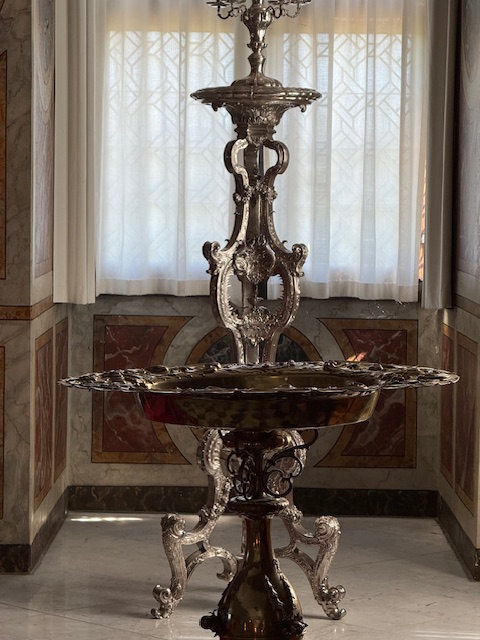
The Coronation Carpet is a Persian carpet belonging to the Danish royal family.
According to the Royal Danish Collections, the carpet was woven in Isfahan during the 17th century. Its dimensions are 12 feet 2 inches by 17 feet 1 inch. As indicated by its name, the carpet served as the surface upon which Danish monarchs were anointed during coronation ceremonies.
The carpet is made from silk pile and incorporates threads of gold and silver, reflecting the luxurious craftsmanship of Safavid Persia.
The Coronation Carpet is rarely displayed. It is presented to the public only once a year during Easter, alongside a small selection of chenille carpets.
Rosenborg Castle Gardens
The Rosenborg Castle Gardens or Kongens Have, is the oldest and most visited park in central Copenhagen. Established in the early 17th century as a royal pleasure garden for Rosenborg Castle, it covers 12 hectares and receives approximately 2.5 million visitors annually.
Located within the city centre, it remains open to the public year-round and includes several historical buildings, monuments, and summer cultural events such as art exhibitions and concerts.
Founding
The garden was founded in 1606 by King Christian IV, who acquired land outside Copenhagen’s eastern defences to create a pleasure ground. Initially laid out in the Renaissance style, the garden produced fruit, vegetables, and flowers for the royal court at Copenhagen Castle.
A modest pavilion, later expanded into Rosenborg Castle, was completed in 1624. In 1634, Charles Ogier, secretary to the French ambassador, likened the gardens to the Tuileries in Paris.
A 1649 plan by Otto Heider, the oldest known garden design in Denmark, documents its early layout, including pavilions, statues, a fountain, and cultivated plants such as mulberries, apples, pears, vines, and lavender.
Baroque transformation
As tastes evolved, the garden was reconfigured in the Baroque style. A 1669 plan includes a garden maze, then a popular feature, culminating in an octagonal summerhouse at its centre.
After the construction of Frederiksberg Palace in the early 18th century, Rosenborg Castle fell out of favour with the royal family, and its gardens were opened to the public. Johan Cornelius Krieger became head gardener in 1721 and oversaw the Baroque redesign, incorporating diagonal lime tree avenues and ornamental elements.
Layout and entrances
The park is enclosed by the streets Gothersgade, Øster Voldgade, Sølvgade, and Kronprinsessegade. Rosenborg Castle sits in the north-western corner, surrounded by a moat.
The principal entrances are the King’s Gate at Gothersgade and Kronprinsessegade, and the Queen’s Gate at Øster Voldgade and Sølvgade. Four additional entrances provide access throughout the grounds.
Two major diagonal avenues dominate the layout: the Knight’s Path (Kavalergangen) and the Lady’s Path (Damegangen). The rest of the park follows a grid pattern, a remnant of the original Renaissance structure. Specialised garden sections include a rose garden and a perennial garden near Sølvgade.
Buildings
The Rosenborg Barracks, situated at the corner of Gothersgade and Øster Voldgade, were originally built in the late 17th century as greenhouses and a pavilion by Lambert van Haven. In 1709, these structures were joined into a single orangery. Krieger redesigned the building in 1743, and from 1885 to 1985 it housed the Royal Life Guards. Today, it accommodates guards on active duty in Copenhagen.
The Commandant’s House, facing the lawn near the castle’s main entrance, was built between 1760 and 1763 by Jacob Fortling and now serves as an exhibition space. Adjacent is Slotsforvalterboligen, fronting Øster Voldgade, which dates to 1688 and was expanded in 1777. The attached Gartner’s House was built around the same time.
The Hercules Pavilion and ironwork
At the end of Kavalergangen stands the Hercules Pavilion, named for the statue of Hercules placed between two Tuscan columns. It is flanked by statues of Orpheus and Eurydice, all created by Giovanni Baratta and acquired by Frederik IV during a journey to Italy.
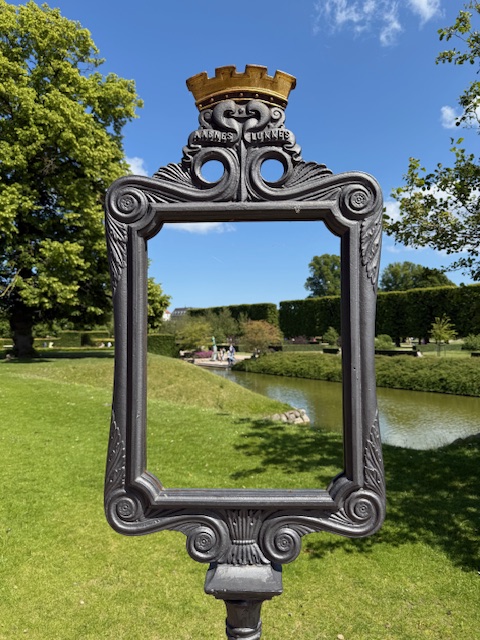
The southern perimeter of the garden along Kronprinsessegade and Gothersgade is enclosed by a wrought-iron grill with 16 small pavilions.
After the Copenhagen Fire of 1795, this area was repurposed for housing, and a new street—Kronprinsessegade—was created. City Architect Peter Meyn, inspired by Parisian street life, designed the ironwork and 14 shop pavilions completed in 1806.
Two further pavilions were added in 1920. These neoclassical structures were initially used by vendors and later offered to artists and architects. Today, they are rented on short leases, with usage conditions linked to the park’s heritage.
Public art
The oldest sculpture in the gardens is ‘The Horse and the Lion‘, created by Peter Husum in 1625. Based on an antique Roman statue, it was likely installed soon after completion. It was temporarily moved to Glückstadt in 1643 and returned to Rosenborg after Frederick III’s accession. The statue, interpreted as symbolic of political conflict, now stands near the park’s ring-riding columns.
Seventeen marble spheres, placed around the Matzen Lawn, are believed to have originated from the never-completed St. Ann’s Rotunda, an ambitious church project halted in the 18th century.
The ‘Boy on the Swan‘ fountain features a bronze sculpture by H.E. Freund, created to replace an earlier sandstone version from 1738 by the French sculptor Le Clerc. The sculpture depicts a child riding a swan that sprays water from its beak and is mounted on a granite plinth.
The park also houses a monument to Viggo Hørup, designed by Jens Ferdinand Willumsen and installed in 1907. It was destroyed by German forces in 1945 but later recast. The original statue’s head is now held by the J.F. Willumsen Museum.




A visit to the castle and the park
Rosenborg Castle can get very busy. That’s why it works with time slots. We only had to wait half an hour, but you might want to book a slot in advance.
We did not use the audioguide, just the map and we found this to be enough. We spent about an hour in the castle.
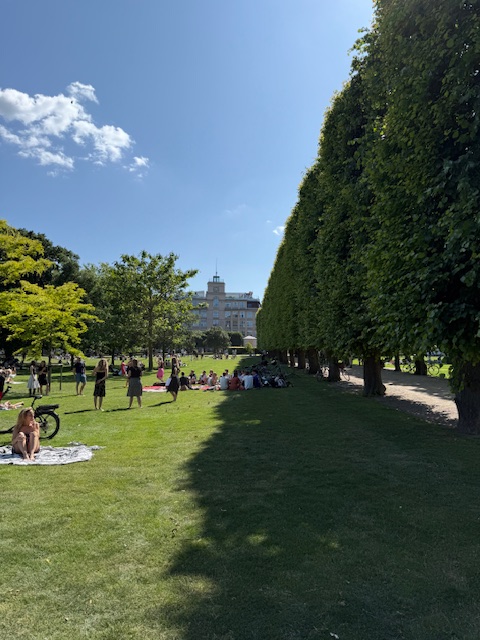
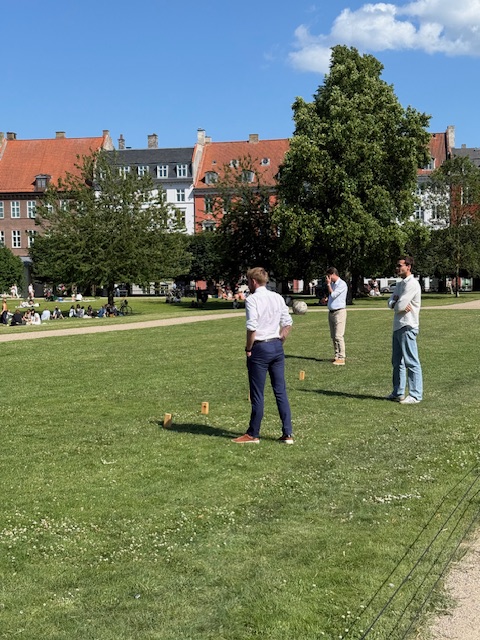
The park is large and inviting. We were there on a Friday after many people clearly finished work (early) because the weather was so nice. Denmark appreciates this work-life balance a lot and people will stop earlier on a Friday and / or for good weather. We saw groups of friends, colleagues and family gather with drinks and snacks. Playing kubb is popular.
 Trip By Trip
5 Comments Add yours