
Currently the Middelheim Museum in Antwerp is in full swing, both the art collection and the park. A total of 224 works of art will be given a new place in the art park and in the open-air depot.
In addition, some parts of the park will be further upgraded in close partnership with the Green Department. There will also be new work, such as a striking fountain sculpture by Camille Henrot. Art and nature come even closer together in the new thematic presentation.
Need a new look at collection
Everything in nature is constantly changing and moving. This also applies to museums and their collections.
Whereas museums used to be ‘immutable’ repositories of art and heritage, today they are dynamic places where visitors experience the works of art personally, from their own living environment.
The artworks themselves also acquire new perspectives and meanings due to the ever-changing world and current themes such as climate change. This applies in particular to the collection of the Middelheim Museum. A new look at the historically developed collection presentation, anchored in the art park, was imperative.
Alderman for Culture Nabilla Ait Daoud (N-VA): “Many works in the collection have been in the same place for decades. Easy to find, but not always easy to understand. That is why the Middelheim Museum is working on a new, thematic collection presentation. It offers a completely new look at the familiar collection. So that you can clearly see how and why she is so special”, she says in the press release.
Sara Weyns, director of the Middelheim Museum: “Just as the park is constantly changing, constantly renewing itself, so it is constantly moving in art. Both the public and today’s artists are constantly finding new meanings for the works in our collection. Artists put us to curiosity: about their own work or that of others, but especially about what makes us human. Artists also help us to imagine different perspectives for the future.”
Visitor comfort will also be improved in the new collection presentation. When the works of art all have their permanent place in the autumn, they will receive a new, updated description.
There will also be a new route through the museum, an easily readable museum map and better signage that will make it easier for visitors to find their way through the art park. We also tailor the public program to this. And by strengthening and protecting important landscape areas of the park zones, we make the park as a whole more climate-robust for the future.
Thematic collection presentation
The Middelheim site dates back to the 5th century and the current cultural landscape has been formed by the long-lasting and special transformation of a farm into a private castle domain as a country estate for important Antwerp residents, which was set up for the general public at the start of the 20th century as a recreational area and in 1950 as a museum site.
The development of the park landscape and the complex and changing relationship that man enters into with nature, form the basis of a new thematic arrangement of the works of art.
From the end of this year, 171 sculptures will be displayed in the art park in different clusters, inspired by different types of landscape in the museum. A lot of sculptures will change their place in the coming months for this. In the new scenography, developed by Studio Moto and Atelier voor groene ruimte, special attention is also paid for the first time to the visual and substantive relationship that the artwork enters into with the surrounding landscape.
This way the valuable greenery comes into its own even better. Protective measures for the landscape are taken where necessary. Nature and art come together even more.
On the move
A lot of sculptures have already been moved in the spring, carried out by Etoile Mecanique and Lapis Arte. Various works of art such as ‘Never Mind‘ (1993 – 2017) by the British artist Richard Deacon were given a new place. A number of works have been transferred to the renewed open-air platform.
Including the old Peugeot that was kept in balance for years by a felt-tip pen (Erwin Wurm, ‘Disziplin der Subjektivität‘, 2006).

Sara Weyns: “We are now reaping the benefits of our completely renovated open-air depot. Here we store certain outdoor sculptures that we temporarily remove from the presentation, for example to restore them. Nevertheless, the public can continue to see those works of art in this part of the park. We consciously opt for depot conditions with a small ecological footprint, combining soil permeability, biodiversity and the planting of new robust species with good, accessible storage conditions for the works of art.
All the works that were planned here have already been transferred to this location. If also the sown seeds between the platforms get a bit more ahead — the flowering was delayed by the wet spring — this gives a beautiful and surprising sight. Our open-air depot occupies a very special place in the museum sector: the pursuit of climate-neutral preservation of heritage is within reach here. At the same time, this creates more opportunities for people to make new connections with the works of art that are now a depot collection.”
New fountain sculpture by Camille Henrot
The new collection presentation will also feature a great deal of new work. Some installations that the Flemish Community acquired in 2021 as a recovery measure after corona will be on display for the first time. Another striking new work of art is the fountain sculpture ‘Adrift‘ (2023) by Camille Henrot (Paris, °1978). The French artist, to whom the Middelheim Museum dedicated the solo exhibition ‘Wet Job‘ last summer, made this new work specifically for the museum.
Sara Weyns: “The fountain sculpture is an ode to the way in which water is part of our daily lives, from the small and domestic to the major impact that water has on our well-being. The fluidity of water, but also of the bronze that is cast, symbolizes the resilient human capacity for adaptation and change. The artwork is therefore in line with the new collection presentation, where art and nature go hand in hand, and the social vision of the Middelheim Museum.
Luc Bertrand, chairman of Middelheim Promotors: “Camille Henrot is one of the very important artists of our time. With the acquisition of this work for the Middelheim Museum, we are building further on the tradition of the museum. It is a very interesting work: everyone is in movement, there is a lot of life. She has thought about where the work is, in the midst of the changing seasons, the changing light. I think we are taking the right step with this assignment to create the collection.”
Remarkable restorations
Various sculptures are being carefully restored or conserved as a result of the new collection presentation.
This is the case, for example, for the two window sculptures ‘Fenster I and II‘ (1993) by Isa Genzken and ‘Vierkantrohre Serie D 1967-2016‘ (1967-2016) by Charlotte Posenenske, the metal sculpture on the side wall of the Braem Pavilion.
Later this year we will start other impressive restorations. Among others, ‘Untitled‘ (1993) by Per Kirkeby: this large brick work was damaged last year by a falling tree during a storm. Or the iconic reflective sphere ‘Yayoi‘ (2005) by Corey McCorkle. And the installation ‘Born of Landscape Linoleum‘ (2002) by Jessica Stockholder: an assemblage of diverse objects with different materials.
Location specific
Just under fifty works of art in the museum are inextricably linked to their place and remain standing. Sometimes they are immovable due to their nature, such as the architectural sculptures by Per Kirkeby and Charles Vandenhove. Others are site-specific, that is, they are designed and installed by the artist for a specific place and lose meaning when moved. We investigated this for all works and entered into discussions with the artists or their representatives.
For example, the hard-to-find window sculptures ‘Fenster I and II’ (1993) by Isa Genzken turned out to be located in a meaningful place chosen by the artist, close to the exits of Mid Laag, with a view through to trees, arranged as a ‘folly’ that you accidentally discover.
Or, conversely, if the connection with the existing location turned out to be less important than expected, such as ‘74 Weathering Way‘ (2001) by Carl Andre: this would also be better expressed for the artist in a different, quieter lane. And this work of art now has a new fantastic place, literally in a new light.
Intensive relocation works
You cannot simply move a sculpture that has been anchored in the ground for decades. Moreover, these are all unique works of art, with different materials, techniques and vulnerabilities.
The relocation of each individual work of art requires its own preparation, working method and approach. The relocation of a total of 224 different works of art (see below) is therefore a considerably labour-intensive job.
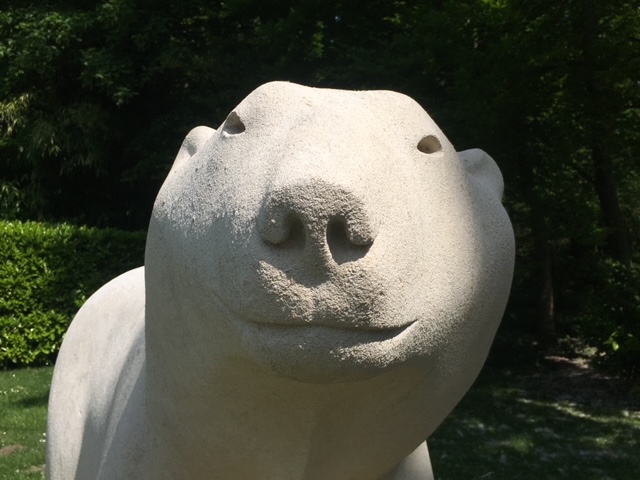
Due to the many works on the presentation and on the park, the Middelheim Museum is not organizing a separate summer exhibition this year. The museum will remain open during the works, so visitors can follow the works. From August, most of the sculptures will be moved, including some public favorites such as ‘L’ours‘ (1920 – 1922) by François Pompon and ‘La vierge folle‘ (1912) by Rik Wouters.
In short: the movement in numbers
- Total number of artworks in the new presentation: 171.
- 122 works of art get a new place .
- 49 artworks remain where they are.
- Total number of works of art in the open-air depot: 102.
- Total number of artworks moved (presentation and open-air depot): 22.
Art and museums in Antwerp
- ANTWERP | Baroque Influencers city festival of tradition and renewal.
- REVIEW | Illusion Antwerpen, an active and photogenic museum.
- Antwerp museums and sports facilities team up with European Disability Card for accessible leisure activities.
- FOMU 2023 | Reimagined collection, strippers – Nicaragua – Kurdistan and people touching each other.
- ANTWERP 2023 | MoMu fashion museum presents IO Van Oostveldt and Man Ray exhibitions.
- ANTWERP | Rubens House closed for renovation.
- Inside the KMSKA or Royal Museum of Fine Arts Antwerp.
- VIDEO | Inside the Royal Museum of Fine Arts of Antwerp.
- Museum Mayer van den Bergh.
- ANTWERP | ‘Stories of Refuge’ exhibition at Red Star Line Museum.
- 2023 at the museums of Antwerp.
- 2022 in the museums of Antwerp.
- ANTWERP | ‘Stories of refuge’ exhibition at Red Star Line Museum.
- ANTWERP | Inside Rubens House.
- ANTWERP | Garden of renovated Rubens House to be open air exhibition space.
- ModeMuseum MoMu – Fashion Museum Antwerp 2021.
- ModeMuseum MoMu – Fashion Museum Antwerp 2022.
- ‘Freight’ and ‘Listen’ exhibitions at MAS in Antwerp.
- ‘Masculinities: Liberation through Photography’ exhibition at FOMU, Antwerp’s photography museum.
- ANTWERP | Goshka Macuga’s ‘Figures of Absence’ honours underrepresented women in public domain art.
- Museum Plantin-Moretus in Antwerp.
- ‘Eurasia – A Landscape of Mutability’ exhibition at Antwerp’s M HKA modern arts museum.
- ANTWERP | Geert De Weyer Gallery, a space for illustrators’ and comic strip authors’ art.
- Museum Plantin-Moretus will exhibit long-lost illustration by Rubens: ‘Opticorum Libri Sex’.
- ‘100 X Congo’ exhibition at Museum Aan de Stroom (MAS) in Antwerp.
- ANTWERP | Museum Vleeshuis up for restoration.
- REVIEW | ‘Cool Japan’ exhibition at Museum Aan de Stroom (MAS) in Antwerp from 18 October 2019 to 19 April 2020.
- BOOK | ‘Antwerp. An Archaeological View on the Origin of the City’ by Tim Bellens.
- Red Star Line Museum.
- Paleis op de Meir.
- DIVA, Antwerp Home of Diamonds.
- ANTWERP | Red Star Line Museum of (e)migration.
- ANTWERP | Museum Mayer van den Bergh is expanding into former District Hall.
- ANTWERP | Traveling exhibition #StolenMemory at Museum At the Stream (MAS).
- Museum At the Stream opens ‘City at war, Antwerp, 1940-1945’ exhibition on 8 September.
 Trip By Trip
8 Comments Add yours