
Iceland in November and December? Really? I saw an Icelandair promotion on Instagram which I couldn’t resist. The catch? It had to be late November to the start of December 2022. But I could – easily – enthuse Oriol to come along for a road trip in the South and West of Iceland.
Day 6 started with a big hike.
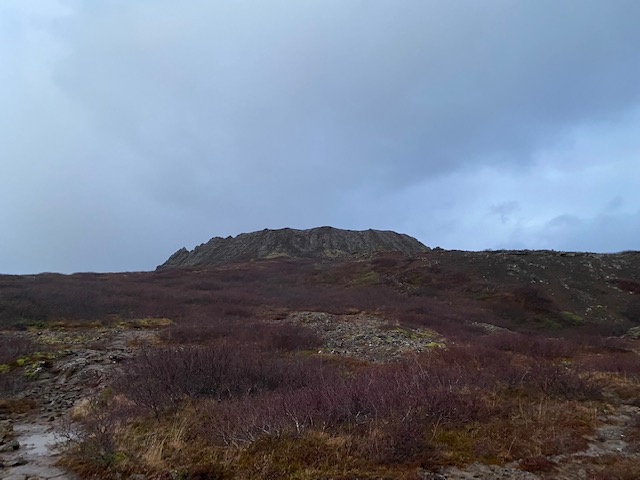
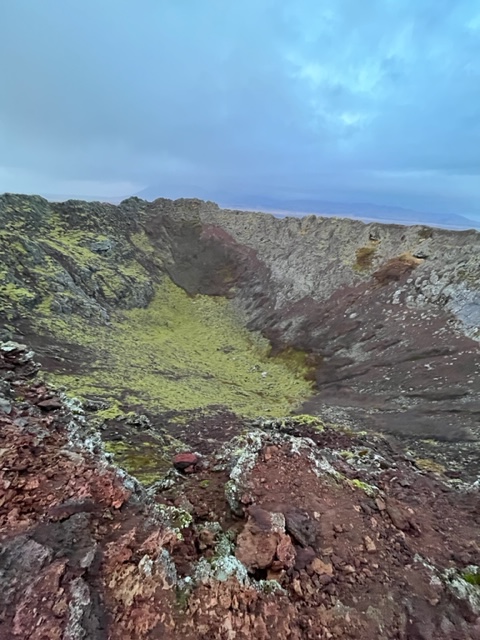
Eldborg Crater
Rising 60-meter above from the surrounding lava, Eldborg Crater is located on the eastern part of Snaefellsnes Peninsula. The spatter cone is 200-meter in diameter with a depth of 50-meters. It was known to be one of the most active volcano 5000-8000 years ago.
This oblong volcano raises 100 meters above sea level.Eldborg means “Fortress of Fire”.
The hike is described on tourism website as being easy. Quod non. The lava stones are difficult, it was muddy when we we were there and the final stretch is (too) steep. Oriol took the photos of the crater. I couldn’t reach it. The way down would have been too difficult.
The hike is 6 km return (in total) and allow over two hours.




Bjarnarfoss
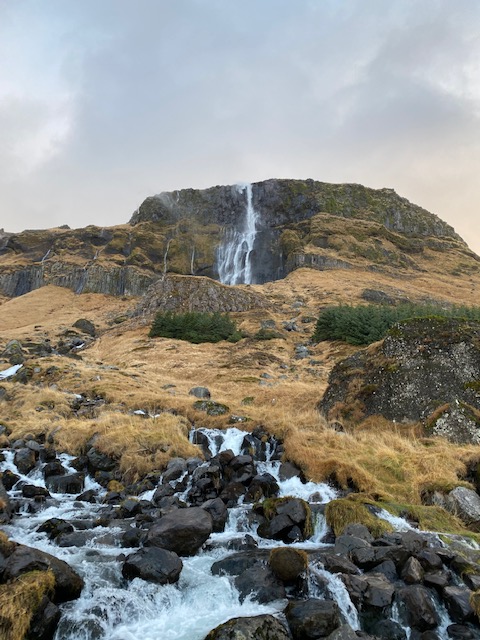
Bjarnarfoss or Bjarná Waterfall is located on the south of Snæfellsnes Peninsula. It falls 80 meters in two tiers from basalt cliffs. The most enjoyable and interesting point of the waterfall is quite high in the cliffs and it takes an effort to walk up the steep slope.
We didn’t go that far. Eldborg had taken too much daylight time and we had other stops planned.

Búðakirkja
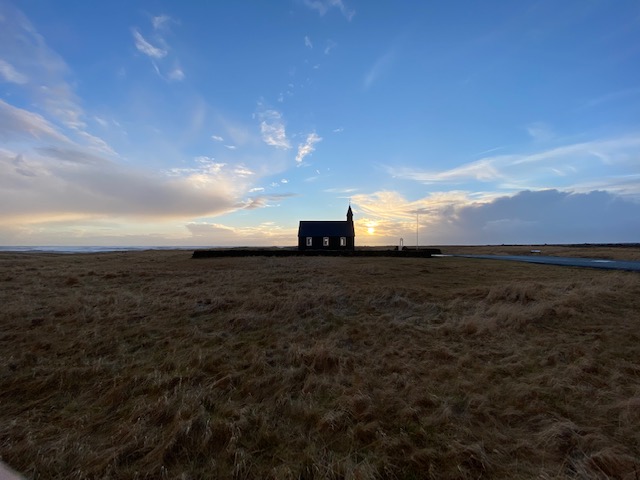
Búðakirkja is a small wooden church near Bjarnarfoss. It is a local parish church that was first established in 1703 but the current church was built in1848. The church is known for its beauty, both the building itself and in contact with the surrounding area. The church is still used to this day, both for traditional church events for the parish, but also for other events like destination weddings, music events, and storytelling to name a few.
Make sure to look for Búðakirkja and not Búðir, because your GPS or satnav will take on the other side of the river on someone’s property.
But it did give us a chance to see a beautiful rainbow.


Arnarstapi and Hellnar
Arnarstapi or Stapi is a small fishing village at the foot of Mt. Stapafell between Hellnar village and Breiðavík farms.
Placenames in the vicinity of Arnarstapi and nearby Hellnar village are inspired by Bárðar saga Snæfellsáss, an Icelandic saga relating the story of Bárður, a half human and half ogre. Arnarstapi was a natural site for landings and harbor for small vessels, and therefore ideal for a shipping port.
In the olden days, Arnarstapi was thus from very early on, a busy fishing port and commercial centre servicing the West coast area under the Danish crown and a merchant monopoly of Denmark was in effect from 1565. From then on and through the 17th and 18th century, agents of the Danish crown had custodial power over Arnarstapi and commercial rights by royal appointment over nearby lands, formerly owned by Helgafell monastery and monopoly of all trade in the area.
Today Arnarstapi is still a somewhat busy harbor during the summer months serving private fishing and recreational vessels as well with its maintained docks that were renewed in 2002. Being a popular destination of tourists in summer, Arnarstapi is today a thriving centre for local tourism activities where there is a variety of natural and culinary attractions as well and a cluster of second homes are located in and around the village.
But outside summer it’s quite dead.
There is much beauty to be found in nearby attractions, and an old horse trail past Neðstavatn is now a popular hiking trail across the lava and along the beach between Arnarstapi and Hellnar. This walk is about one hour. The lava field is called Hellnahraun, and its coast where at its westernmost edge can be found the ancient small village of Hellnar is a natural preserve.
Along the coast there are some unique rock formations to be seen. There the waves of the ocean play along with the sun and the daylight to produce a natural show of which the most spectacular[editorializing] can be experienced at the cliff Gatklettur, and the rifts Hundagjá, Miðgjá and Músagjá.


Although Hellnar village used to be a major port of call for fishing vessels and the largest and busiest centre of fishing and fishing vessels in Snæfellsnes, there were also a few farms in and around Hellnar village along with quite a few semi-permanent and short-stay living quarters for seamen and the migrating workforce.
Hellnar village can in all probability trace its function as a major port of call back to the Middle Ages, and the oldest written source of it being describes as a fishing port dates back to 1560.
On the beach some spectacular rock formations are to be seen, one of which is a protruding cliff called Valasnös, which reaches across the ocean front and into the sea. Tunneling into this cliff there is a cave known for colorful changes of lighting and shades that vary in tune with the natural light and the movements of the sea.

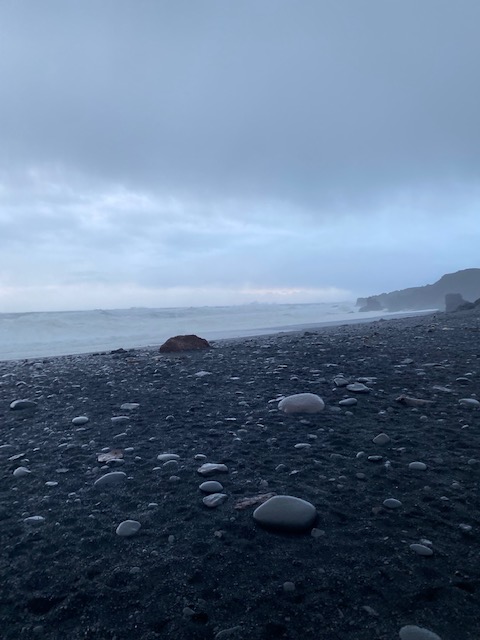
Djúpalónssandur
Djúpalónssandur is a sandy beach and bay on foot of Snæfellsjökull. It was once home to sixty fishing boats and one of the most prolific fishing villages on the Snæfellsnes peninsula but today the bay is uninhabited.
Four lifting stones are in Djúpalónssandur, used by fishermen to test their strength. They are Fullsterkur (“full strength”) weighing 154 kg, Hálfsterkur (“half strength”) at 100 kg, Hálfdrættingur (“weakling”) at 54 kg and Amlóði (“Useless”) 23 kg. They were traditionally used to qualify men for work on fishing boats, with the Hálfdrættingur being the minimum weight a man would have to lift onto a ledge at hip-height to qualify.
On the beach there are remains of the Grimsby fishing trawler Epine (GY7) that was wrecked there on March 13, 1948.



Snæfellsjökull
Snæfellsjökull (“Snow-fell Glacier”) is a 700,000-year-old glacier-capped stratovolcano is situated on the westernmost part of the Snæfellsnes Peninsula. Sometimes it may be seen from the city of Reykjavík over Faxa Bay, at a distance of 120 km.
The mountain is one of the most famous sites of Iceland, primarily due to the novel ‘Journey to the Center of the Earth’ (1864) by Jules Verne, in which the protagonists find the entrance to a passage leading to the center of the earth on Snæfellsjökull.
The mountain is included in the Snæfellsjökull National Park (Þjóðgarðurinn Snæfellsjökull). Unfortunately, visibility was non-existent.

Kirkjufell
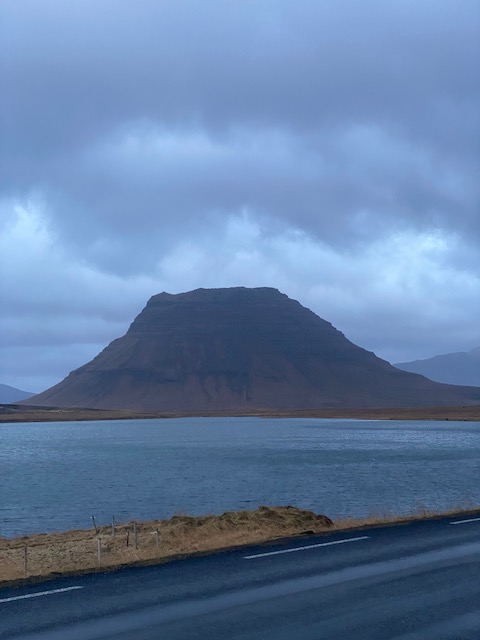
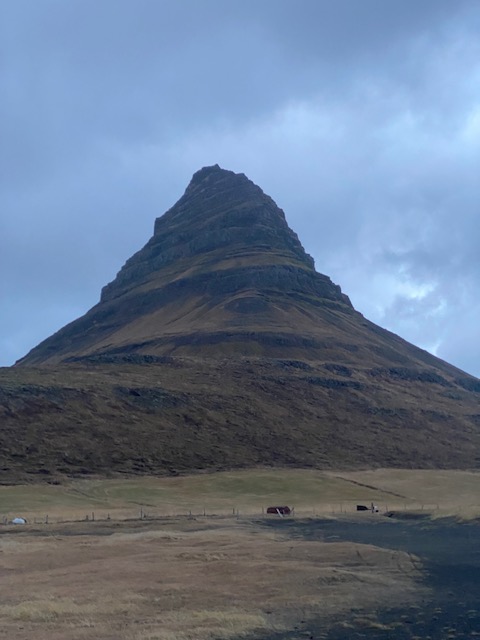
We did get some views of Kikjufell or Church Mountain. Kirkjufell is a 463 m high hill near the town of Grundarfjörður. It is claimed to be the most photographed mountain in the country.
Kirkjufell was one of the filming locations for ‘Game of Thrones‘ season 6 and 7, featuring as the ‘Arrowhead Mountain‘.
Kirkjufell contains volcanic rock but is not itself a volcano. It is a former nunatak, a mountain that protruded above the glaciers surrounding it during the Ice Age, and before that was part of what was once the area’s strata.



Stykkishólmur
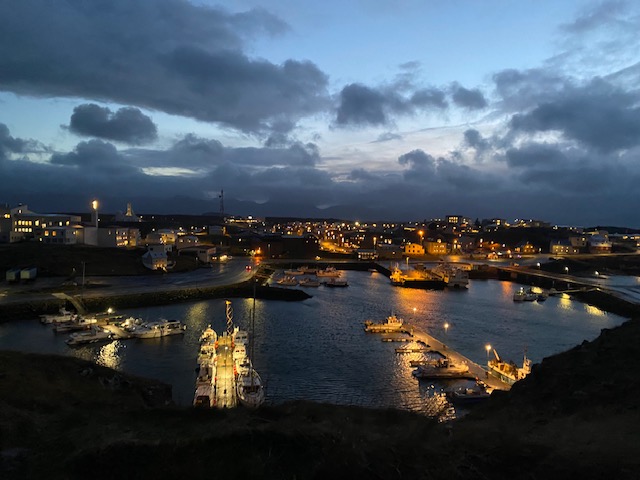
We ended the day in Stykkishólmur. The town is a center of services and commerce for the area. Most of the people make their living from fishing and tourism.
The origin of Stykkishólmur can be traced to its natural harbour. The location became an important trading post early in Iceland’s history: the first trading post in Stykkishólmur is traced back to the mid-16th century, even before Denmark implemented the Danish–Icelandic Trade Monopoly (1602 – 1787).
From that time trading has been at the heart of the settlement’s history. In 1828 Árni Thorlacius built a large house for his home and companies, the Norwegian House, which has been renovated and accommodates the local museum.
Stykkishólmur looks the part of a fishing village with lighthouse and is very photogenic.


Iceland, November & December 2022
- REVIEW | Icelandair Brussels Airport (Zaventem) to Reykjavík (Keflavík International Airport) on Boeing 737 MAX 8 in Economy.
- ICELAND | Kevlavík – Bridge Between Continents – Reykjanesviti Lighthouse – Reykjanestá – Gunnuhver Hot Springs – Grindavík – Reykjavík.
- REVIEW | Hotel Cabin in Reykjavík.
- ICELAND | Seljalandsfoss Waterfall – Skógafoss – Sólheimajökull – Dyrhólaeyjarviti – Reynisfjara – Vík.
- REVIEW | Hotel Katla in Vík.
- ICELAND | Skeiðará Bridge – Diamond Beach – Jökulsárlón – Skaftafellsjökull – Dverghamrar – Kirkjugólf – Fjaðrárgljúlfur – Skaftáreldahraun.
- ICELAND | Aurora Borealis or Northern Lights at Reynisfjara Black Sand Beach near Vík.
- ICELAND | Fjaðrárgljúlfur – DC-3 Plane Wreck at Sólheimasandur – Geysir – Gullfoss.
- ICELAND | Secret Lagoon in Flúðir.
- REVIEW | Guesthouse Flúðir.
- ICELAND | Þingvellir or Thingvellir National Park – Hvalfjörður Fjord – Húsafell.
- REVIEW | Guesthouse Bjarg in Borgarnes.
 Trip By Trip
9 Comments Add yours