
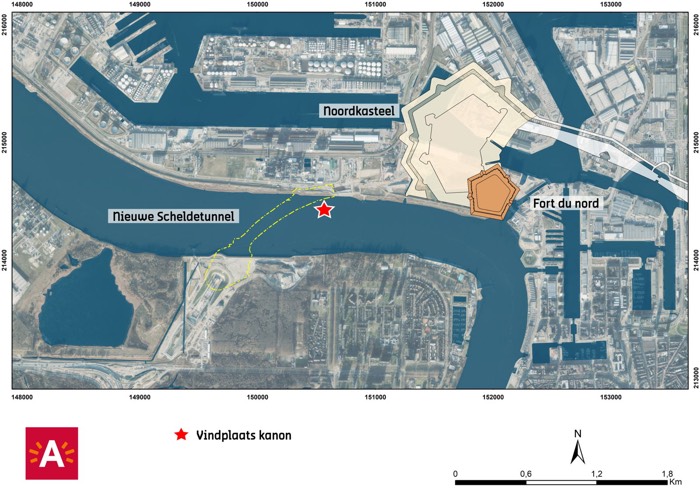
The Scheldt Tunnel is being constructed for the Oosterweel connection, in Antwerp between the St. Anne’s Woods (Sint-Annabos) on the left bank and the former polder village of Oosterweel on the right bank. In preparation for these works, the Scheldt River is being dredged and the shipping channel is being temporarily relocated. When removing the silt layers, a special find was made last week: a cannon was excavated. It most likely dates from the time of Napoleon and is now being further investigated.
Lantis and the City of Antwerp are working together on the archaeological follow-up of the Oosterweel works. The dredging works for the future Scheldt Tunnel are being archaeologically supervised because there are still many finds hidden in the Scheldt silt.
This became apparent from the inspection of the soil surface that was carried out prior to the dredging works, using techniques such as geophysical research (a method of field research without disturbing the soil) and sonar. The first layer of the Scheldt sludge was then removed, and the work zones were then dredged in phases. During the processing of the now removed sludge, employees found the cannon.
Napoleon’s naval fleet
The discovery of the cannon fits in very well with the picture of the city of Antwerp as a military stronghold under the Napoleonic regime.
During the French period (1794-1815), Napoleon Bonaparte had a great interest in the city on the Scheldt because of its strategic importance. He turned Antwerp into a modern port with a naval arsenal and fortified the city in many places. A second rampart was built around the older city rampart, and various batteries or gun emplacements were also built on the Scheldt.
In 1811, the pentagonal Fort Ferdinand, also called Fort du Nord, was built in the Scheldt bend. It was the predecessor of the Noordkasteel (North Castle) that was built in 1862.

36-pounder
Based on the shape, the cannon is very likely of French origin and dates from the end of the 18th century. It is possibly a 36-pounder. An anchor is visible on the barrel of the cannon, which occurs on standard types of the French military fleet. The year of casting was usually on the back of such cannons, but this part is illegible due to the long time on the Scheldt bottom and must first be cleaned.
A 36-pounder weighs 3.5 tons and is more than 3 meters long. Such cannons were used on warships, among other things, and were loaded with cast iron balls of approximately 18 kilograms (36 ‘French’ pounds).
Before use, the metal cannon was placed on a wooden base on wheels: a ‘ship’s gun carriage’ or roller horse. This allowed the recoil of the shot to be absorbed without damaging the surface. Further historical research should reveal how this specific piece of heavy artillery ended up in the Scheldt water.
Further research
The cannon is now being transferred to the immovable heritage depot of the Antwerp municipal archaeology service. After specialized cleaning, the historical context can be further investigated and it can become clear whether details, such as the year of construction, have been preserved. It may be exhibited in a suitable place in the city after the restoration.
Mayor of Antwerp, avid historian and federal formateur Bart De Wever (N-VA): “Napoleon can rightly be called the father of the Antwerp renaissance. During a visit in 1803, the French first consul, later emperor, promised to make Antwerp a ‘ville de commerce de premier rang’, which could compete with London and Amsterdam. The work on straightening the Scheldt Quays and the first modern docks began soon after his visit.”
“The seeds of the resurrection of Antwerp as a trading metropolis with a world port were therefore actually sown by him. There were even designs for an enormous mirror city on Linkeroever (Left Bank), with a stone bridge over the Scheldt. But in practice, Napoleon’s ambitious plans did not so much serve commercial, but mainly military purposes.
“In Antwerp, he diligently built a war fleet that had to break through the continental blockade with which the British navy had the European mainland in a stranglehold. However, the enormous warships that Napoleon launched in the Scheldt city could not prevent Antwerp from being liberated in 1814 after a short but fierce battle by the Allies.”
“Our city subsequently reaped the benefits of the port improvements that were initiated under Napoleon. The legacy of the period of the French occupation is very extensive, but few things appeal to the imagination as much as a ship’s cannon to make the past tangible. I am therefore very pleased with this discovery, and I hope that additional scientific research can teach us more about this special story from the history of our city.”
Unfinished business
The city archaeologists continue to monitor the dredging works, which will continue in 2025. According to the previous soil research, the chance of interesting finds in this region remains possible. Interested parties can follow the archaeological site on www.antwerpenmorgen.be.
 Trip By Trip
10 Comments Add yours