
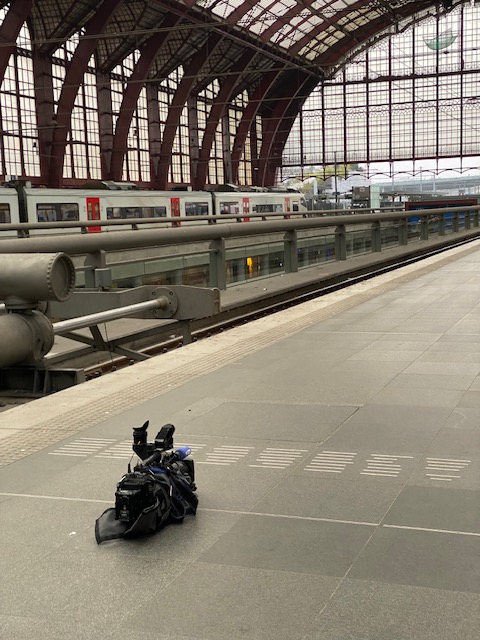
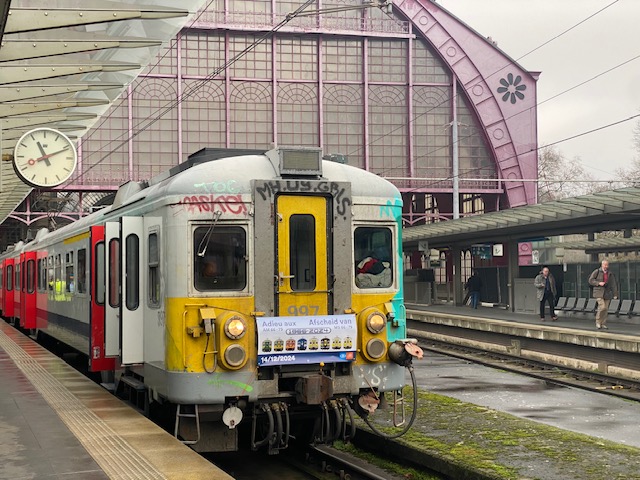
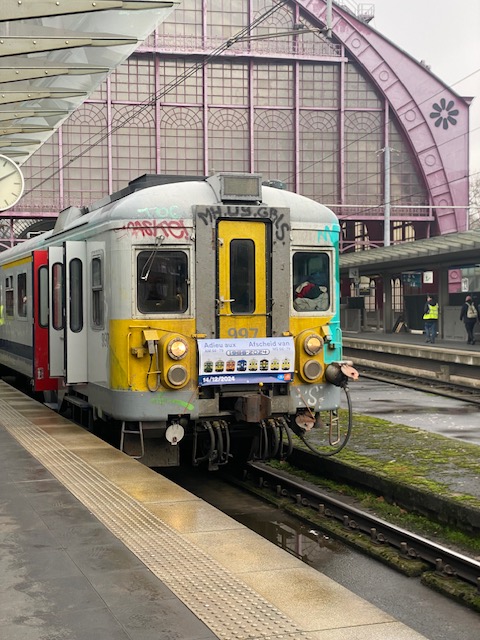
Train geeks young and old gathered today, Saturday 14 December 2024, for the farewell tour or retirement ride of NMBS / SNCB‘s Classical Twin EMU, also known as AM66, MS66, MR66, ‘Klassiekje‘ or ‘Classique‘. The retirement ride started at Schaarbeek / Schaerbeek in Brussels, stopped and stops (as I’m writhing this post) Antwerp-Central, Ghent-Saint-Peter’s, Ath (Aat), Jurbise (Jurbeke), Soignies (Zinnik), Binche, La Louvière-Sud (Zuid, South) and back to Schaarbeek / Schaerbeek.
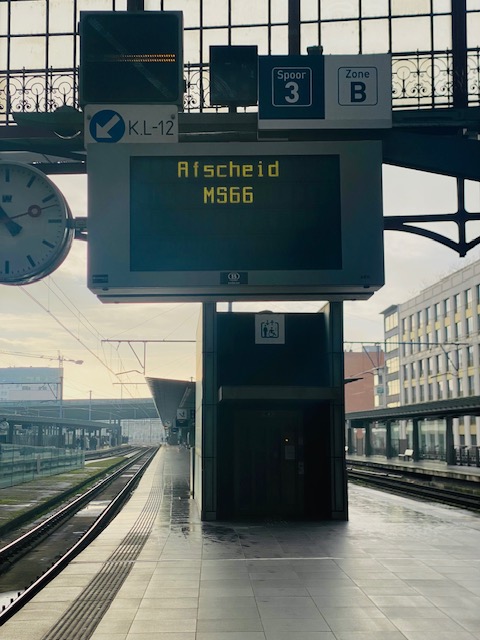
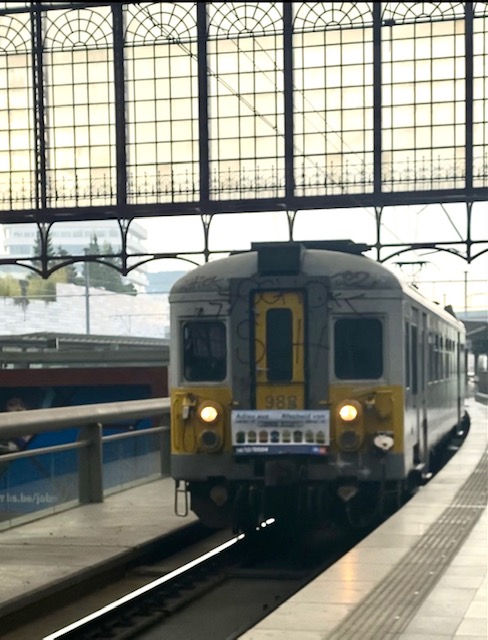
I write ‘retirement ride’, but rumor has it they could still be deployed on the journey from Liège-Guillemins to Aachen Main Station.
Also, I didn’t join the farewell tour. I just went to the station to take some photos. Yes, I’m a train geek too. But not at the level of most trainspotters.

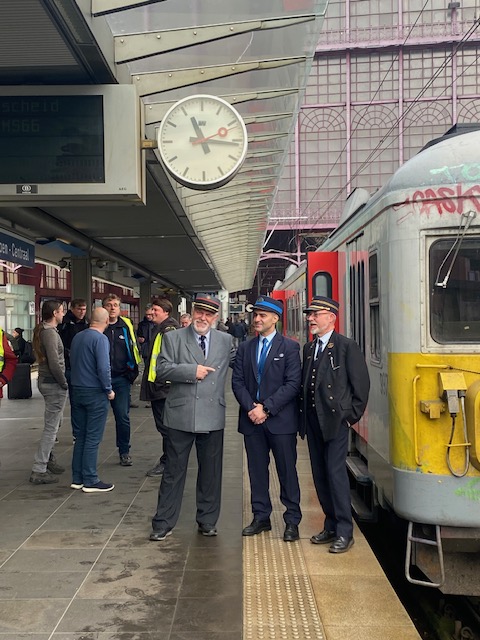
The AM66
The Classical Twin EMU is a series of electric train sets produced for NMBS / SNCB. Between 1939 and 1979, 400 to 500 of these units were built, though sources vary slightly on the exact number.
The earliest units were painted in two shades of green, but from unit 035 onwards, a darker green became standard. Initially, these sets featured narrow visibility stripes, which were later widened. Units 001 to 034 were also repainted in this darker green.
From 1984, units numbered 152 and above were painted burgundy red. Train sets of the MS56 or MR56 series, constructed with stainless steel, were not fully painted. In Dutch, ‘MS‘ refers to motorstel (motorised unit), while ‘MR‘ (motorrijtuig) is the official modern term. The French equivalent is ‘AM’ (automotrice).
Most of the train sets were manufactured by La Brugeoise et Nivelles in Bruges (now part of Bombardier) with electrical systems by ACEC in Charleroi (now Alstom).
Six units were built in 1970 for Sabena, now Brussels Airlines, for the newly electrified Brussels to Brussels Airport route. In 1988, 15 units from the MS54 series were converted into postal trains for De Post / La Poste (now Bpost).
Personal experiences with the twin units
When I began working as a train guard at NMBS / SNCB in 2012, these twin units were a common sight all over Belgium. The burgundy-coloured units remained unmodernised and lacked any broadcasting system.
Despite this, they were frequently used on omnibus services between Antwerp and Nivelles in Walloon Brabant, often operating in sets of three to five coupled units. Without announcement systems, passengers were generally self-reliant and rarely missed their stops.
I cannot recall the exact date of my last journey on a Klassiekje, but it was likely on the Antwerp to Turnhout route. I always hoped the first-class carriage would be on the Antwerp-Central side, allowing me to film our arrival into the station’s magnificent railway hall.
Klassiekjes were simple, devoid of computers, and highly reliable, but their outdated height and systems eventually rendered them impractical for modern use.
Technical specifications
The train sets have an axle arrangement of (A1)(1A) + (A1)(1A) and are powered by four electric motors, one in each bogie. Units from the MR66 series onwards have a top speed of 140 km/h, an increase from the original 130 km/h, and feature single-leg pantographs instead of double-leg designs.
Earlier models, such as the MS70JH series, used traction motors controlled by resistors and Jeumont-Heidmann rollers. Later models, like the MS70TH series, introduced thyristor choppers by ACEC Charleroi, although these were not permitted in Germany due to voltage compatibility issues.

International use
The twin units were primarily designed for 3000 volts DC. While they could operate in the Netherlands on 1500 volts DC, they ran at half power. This capability was used for L-train services on the Liège-Guillemins–Maastricht line until 2012. On the Antwerp–Roosendaal line, their deployment was limited to emergency situations.
Interior and comfort
The twin units’ interiors reflect their age. They lack air conditioning and closed toilet systems but feature effective heating systems, ensuring comfort in winter. The seating layout in second class is 2+3, but modern passengers with laptops and backpacks often find the space restrictive. First class offers a more spacious 2+2 arrangement.


Modernisation and decline
Between 1999 and the early 2000s, the MS66 to 74 series were modernised with a new grey livery and updated interiors. Some were adapted for CityRail and Regional Express services, featuring electronic announcements, standing compartments, LED tail lights, and static converters. By 2019, these sets were reverted to the NMBS / SNCB New Look colours.
However, the rolling stock’s age led to its gradual retirement. By 2024, only a few modernised units, such as the MS70JH series, remained operational.
Preservation
Some units have been preserved. Notably, unit 624, built in 1966, was retired in December 2023 but briefly re-entered service in January 2024 due to equipment shortages before being retired again in March.
Legacy
The Classical Twin EMU series once dominated NMBS / SNCB’s electric services, ranging from intercity to local connections. Their reliability and simplicity made them a staple of Belgian rail transport, leaving a lasting impression on passengers and railway workers alike.
 Trip By Trip
49 Comments Add yours