
March 2025. We’re embarking on a train trip to Sicily. We fly from Brussels Airport to Leonardo da Vinci Rome Fiumicino Airport with ITA Airways. Then we take an Intercity Notte sleeper train by Trenitalia from Roma Termini Railway Station across Italy to Syracuse. Yes, the train is loaded on a ferry to cross the Strait of Messina. After visiting Syracuse, Catania and Palermo, we return to Rome, and home. With 25,832 km², Sicily is only 20% smaller than Belgium (30,689 km²). Quite a lot in four days.
Both Danny and I had visited Rome three times each before this trip. So for our day in Rome, we wanted something new to do. We decided to go to the EUR neighbourhood. Famous for its architecture, but outside the typical Rome routes.
EUR, sounds very European, no? After all, the 1957 Treaty of Rome founded the European Economic Community, which now is the European Union. But no. EUR stands for Esposizione Universale Roma or Rome Universal Exhibition.

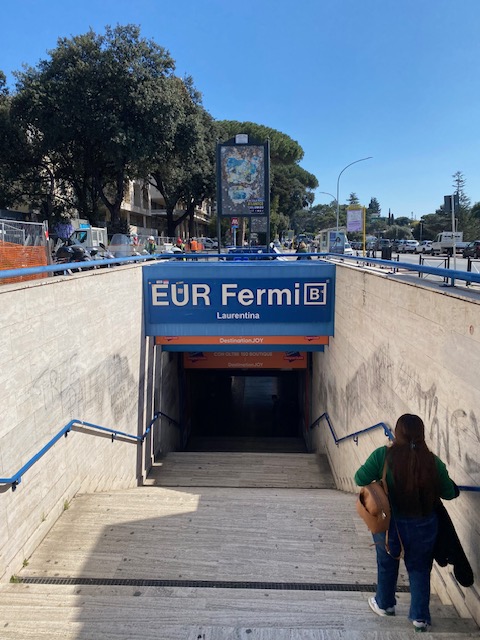

Introduction
EUR is a residential neighbourhood and the main business district in Rome. It forms part of Municipio IX. The area was originally selected in the 1930s as the location for the 1942 World’s Fair, which Benito Mussolini intended to inaugurate to commemorate twenty years of Fascist rule. The project was initially referred to as E42, after the planned year of the exposition.
It was also envisioned as a means to guide the expansion of Rome towards the south-west and the Tyrrhenian Sea, creating a new urban centre for the capital. However, the exhibition never took place due to the outbreak of World War II.
The majority of the land in the area is owned by EUR S.p.A., a company jointly held by the Italian Ministry of Economy and the Metropolitan City of Rome Capital.
The idea for the development was to celebrate the twentieth anniversary of the March on Rome and the beginning of the Fascist regime. The autonomous agency tasked with organising and constructing the site, called E42, or Esposizione 1942, was established on 26 December 1936.
On 26 April 1937, Mussolini planted a cluster pine at the centre of the site, symbolising the foundation of the future EUR district. His broader goal was to extend Rome’s urban fabric towards the sea.
Vittorio Cini, the general commissioner of the agency, submitted to Mussolini a list of the most notable Italian architects, including Adalberto Libera, Enrico Del Debbio, Giuseppe Terragni, Giovanni Michelucci, Eugenio Montuori, and Giovanni Muzio.
From this list, Marcello Piacentini was appointed head of the project, joined by Giuseppe Pagano Pogatschnig, Luigi Piccinato, Luigi Vietti and Ettore Rossi. The first version of the project, covering an area of four square kilometres, was presented in 1938.
The name was subsequently changed to EUR, and the final version of the masterplan was presented in 1939. Work ceased in 1942 due to the war, and the site remained incomplete.


From exhibition to business
During the Second World War, the unfinished buildings suffered extensive damage. After the war, Rome’s authorities decided to repurpose the area as an out-of-town business district, a concept other European capitals such as London and Paris would not explore until several decades later.
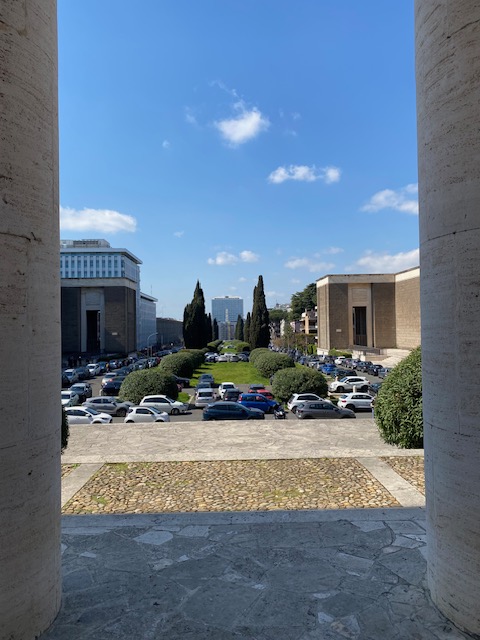
In the 1950s and 1960s, the Fascist-era structures were completed, and additional modern buildings were constructed for use as offices and government institutions, surrounded by landscaped gardens and public parks.


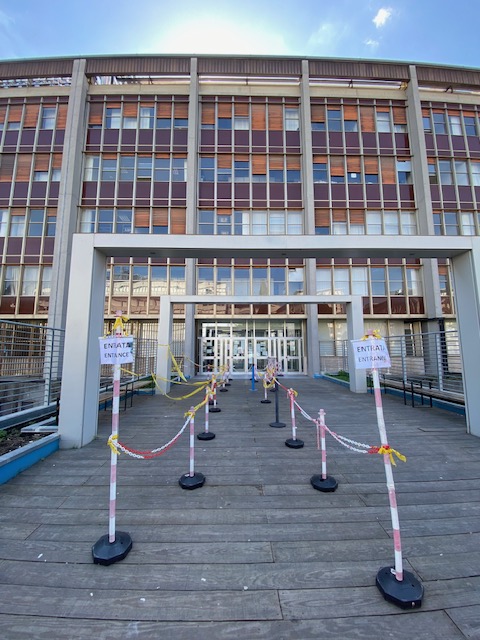
Olympic Games of 1960
EUR was largely completed in time for the 1960 Summer Olympics in Rome, with significant infrastructure such as the Palazzo dello Sport, designed by Pier Luigi Nervi and Marcello Piacentini, and the Velodromo finalised during this period.
The original development agency became a Società per Azioni (joint-stock company) on 15 March 2000 and continues to oversee aspects of the district’s management and organisation.

Architecture
The architectural project initially sparked debate over its principles, resulting in a compromise between two rival factions in Italian architecture. Marcello Piacentini represented the traditionalist or “reactionary” current, while Giuseppe Pagano represented the modernist or “progressive” side.
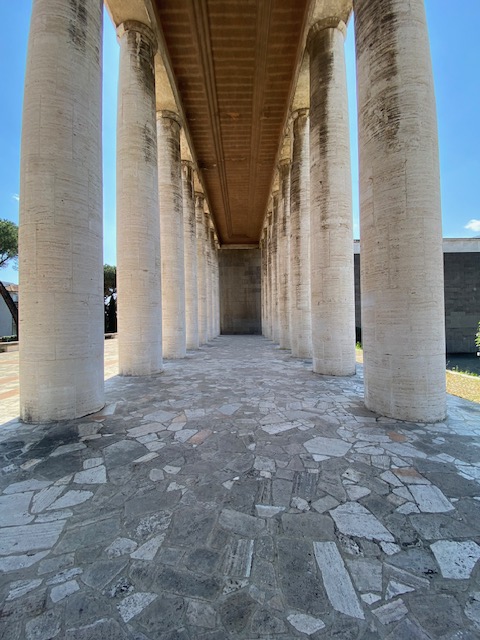
Both brought their preferred collaborators to design individual buildings. EUR thus presents a vision of how Italian urban design might have developed had the Fascist regime endured, with broad axial boulevards and monumental architecture in either stile Littorio,a simplified neoclassicism inspired by Ancient Rome, or Rationalism, a modernist style executed in traditional Roman materials like limestone, tuff and marble.
Layout
The layout of EUR, presented under Piacentini’s direction in 1938, followed orthogonal axes and was composed of imposing buildings clad in stone. The architecture drew heavily on Roman Imperial planning, fused with Rationalist design, resulting in a restrained yet grand style.
Palace of the Italian Civilisation
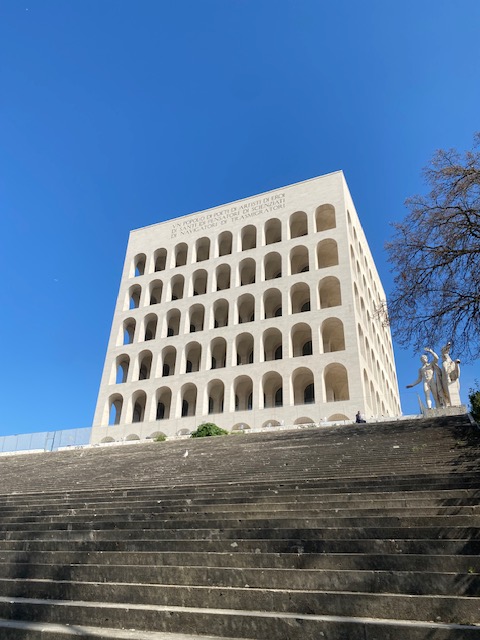
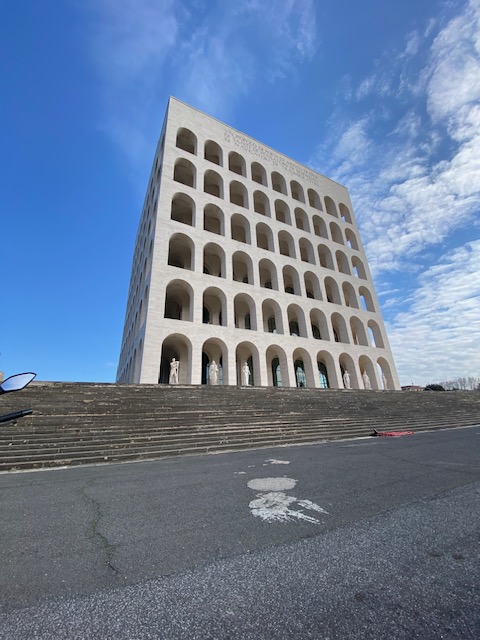
The most iconic building in EUR is the Palazzo della Civiltà Italiana, constructed between 1938 and 1943 and commonly referred to as the Colosseo Quadrato or Square Colosseum. Designed by Giovanni Guerrini, Ernesto Lapadula and Mario Romano, it was also influenced by metaphysical art.
The building itself was off-limits while we were there. “Closed”, a guard said. The Palace seemed well-protected.


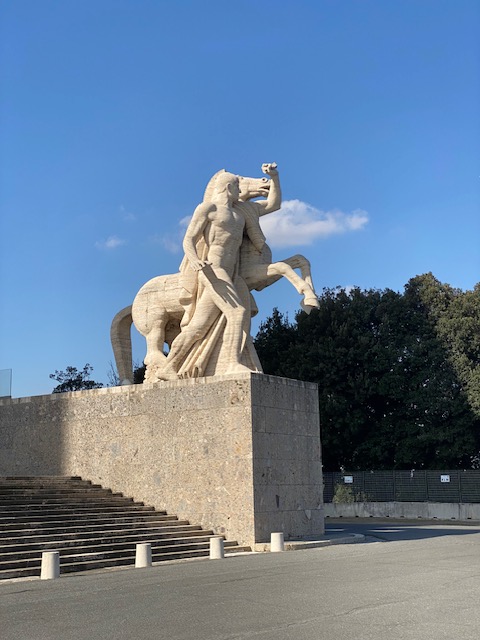


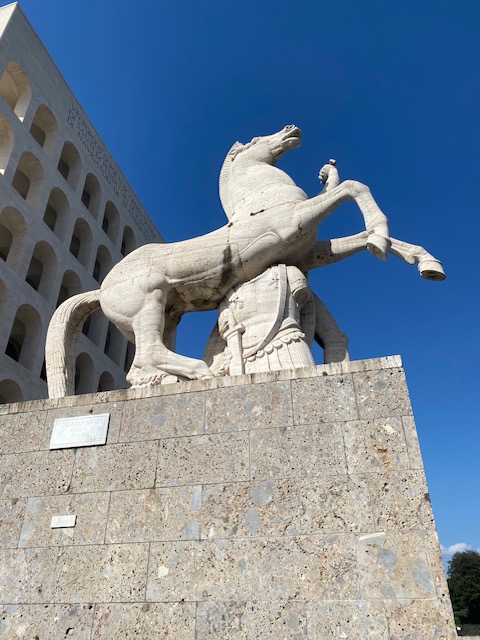




Marconi
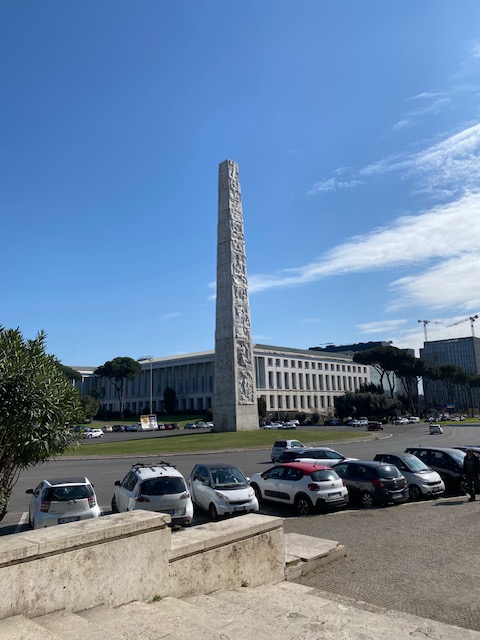
In 1938, Luigi Moretti, together with Fariello, Saverio Muratori and Ludovico Quaroni, won the competition to design the Imperial Square, now known as Piazza Guglielmo Marconi. Although the building fronting the square was never completed, its foundations were later incorporated into the Grattacielo Italia (Skyscraper Italy), designed by Luigi Mattioni.
Other prominent buildings in the district include the Palazzo dei Ricevimenti e dei Congressi or Palace of Reception and Congress, the Archivio Centrale dello Stato or Central State Archives, the Basilica Parrocchiale dei Santi Pietro e Paolo or Parish Basilica of Saints Peter and Paul, the Palazzo degli Uffici or Office Palace, originally featuring a statue titled ‘Genius of Fascism’), the INA Palace and the INPS Palace.


Museums
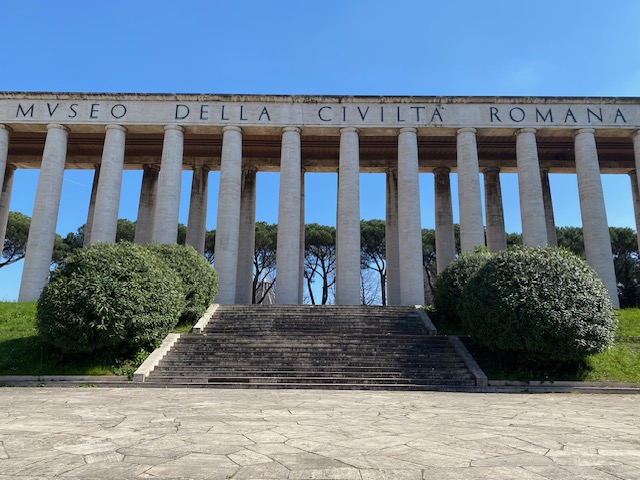
Several museums are located in EUR, including the Museum of Roman Civilisation (Museo della Civiltà Romana), the National Museum of the Middle Ages (Museo Nazionale dell’Alto Medioevo), and the Prehistoric Ethnographic Museum Luigi Pigorini (Museo Nazionale Preistorico Etnografico). A new planetarium, connected to the Astronomy Museum, opened in 2004.
Headquarters district
EUR serves as the headquarters for a number of major companies and public institutions, including Confindustria, the Ministry of Health, the Ministry of Communications, the Ministry of the Environment, the SIAE (the Italian Society of Authors and Publishers), the Italian Trade Agency (ICE), Eni, UniCredit, Poste Italiane, INAIL, INPS, and various multinational firms.
The NATO Defense College was also based in EUR from 1966 to 1999.
The district hosts several educational institutions. Among the public schools are Liceo Scientifico Statale Stanislao Cannizzaro, Liceo Ginnasio Statale Francesco Vivona, and ITC Vincenzo Arangio Ruiz. Private institutions include the Istituto Massimiliano Massimo and the Highlands Institute. A bibliopoint is also maintained at the Istituto Superiore Leon Battista Alberti.



Formula E
EUR has also played a role in the world of motorsport. There were three failed attempts to host a Formula One Grand Prix in the district—first in 1985 as the Grand Prix of Europe, then as the Rome Grand Prix in 2009 and 2012.
However, in 2018, the Formula E Championship held a race on the Circuito Cittadino dell’EUR, a street circuit passing through the neighbourhood. The race was won by British driver Sam Bird. Mitch Evans won the 2022 edition, racing for Jaguar.
In film
The area has appeared in numerous films, especially for its distinctive architecture. It featured prominently in Michelangelo Antonioni’s ‘L’Eclisse‘ (1962) and Bernardo Bertolucci’s ‘The Conformist‘ (1970), and various buildings appeared in Federico Fellini’s ‘8½‘ and ‘Boccaccio ’70‘.
The location was also used in the 1991 film ‘Hudson Hawk‘ as the headquarters of Mayflower Industries, and in the 1999 adaptation of Shakespeare’s ‘Titus Andronicus‘.
A scene from the 1982 film ‘Tenebrae‘, involving the death of Lara Wendel’s character, was filmed in EUR. Large portions of ‘The Last Man on Earth‘ were also shot there. The burial scene of Marco Sciarra in the 2015 James Bond film ‘Spectre‘ was filmed at the Museum of Roman Civilisation.
A visit
From the historic centre of Rome, use public transport to get to EUR. The area is walkable, but you could be surprised by its vastness. There quite a few restaurants, mostly catered to the many office workers there.
EUR is not really touristy, it’s ‘real life’. The car is king. Cars and (full) parking spaces everywhere and in the way of pretty pictures. While EUR is walkable, it’s not the most pedestrian friendly place.
Sicily & Rome 2025
- REVIEW | Brussels Airport Diamond Lounge at A-Gates.
- REVIEW | ITA Airways Business Class Brussels to Rome.
- ROME | Afternoon tea at Hotel Hassler Roma on top of the Spanish Steps.
- REVIEW | Trenitalia Intercity Notte in Superior (Excelsior) Class.
- SICILY | Neapolis Archeological Park of Syracuse.
- SYRACUSE | Ortygia.
- REVIEW | Boutique Hotel Caportigia Syracuse.
- SICILY | Catania.
- ITALY | Trains in Sicily.
- REVIEW | NH Palermo.
- SICILY | Palermo Cathedral.
- PALERMO | Palazzo dei Normanni, the Royal Palace of the Normans in Sicily.
- PALERMO | Palazzo Butera in the Kalsa neighbourhood.
- SICILY | Palermo.
- SICILY | Syracuse – Catania – Palermo + Agrigento – Taormina – Cefalù.
- REVIEW | Trenitalia Intercity Notte in Deluxe Class.
 Trip By Trip
5 Comments Add yours