
Inspired by the 2023 Eurovision Song Contest, we travelled by train to England in March. Combining ESC host city Liverpool with the industrial heritage of Manchester. Manchester to Liverpool was also the first steam railway line ever. A perfect pretext to travel to The North.
After concluding Liverpool, we travelled from Liverpool Lime Street Railway Station to Manchester Oxford Street Railway Station on the route of the very first passenger railway line ever built. Railways genesis.

There once were four direct railway routes between Liverpool and Manchester. Only two remain, the two centre routes of the four.
Of the remaining two direct routes, the northern route of the two is fully electric, while the now southern route is a diesel-only line.
The remaining two direct routes are:
- The northern route from Liverpool Lime Street terminus station via Earlestown, Newton-le-Willows and Lea Green to Manchester Victoria. This line follows the route of the original 1830 Liverpool and Manchester Railway.
- The southern route from Liverpool Lime Street terminus via Warrington Central to Manchester Piccadilly operates on lines formerly owned by the Cheshire Lines Committee.
So, we took the northern route. The line follows George Stephenson‘s original 32-mile or 51.5 km Liverpool and Manchester Railway of 1830, which was the world’s first intercity passenger railway and the first to have run ‘scheduled’ services.
Many early steam locomotives were initially used on this line including Stephenson’s Rocket, which won the Rainhill Trials in 1829.

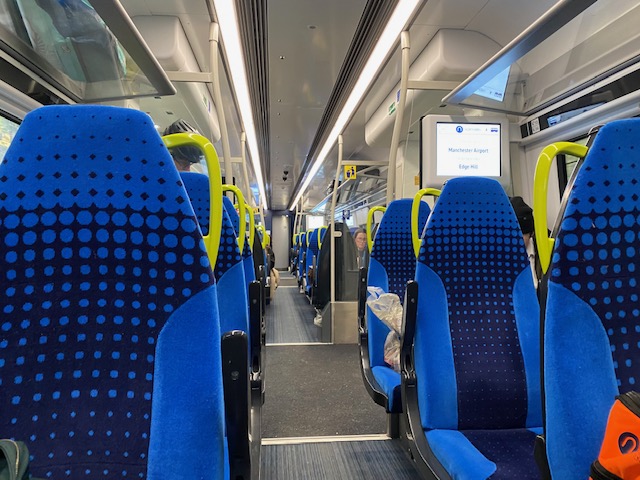
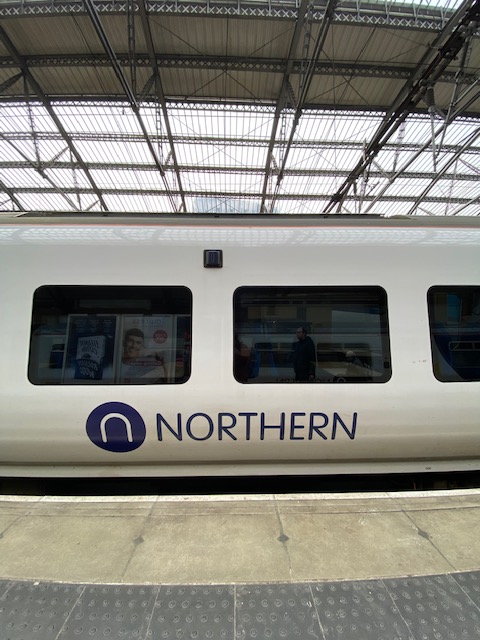

The line also includes a number of listed structures including stations and bridges, particularly the Rainhill Skew Bridge and the nine-arch Sankey Viaduct. The line uses Spanish-built CAF Class 331 electric EMU units.
First passenger train, first death
The opening ceremony of the Liverpool and Manchester Railway on 15 September 1830 was a deadly one.
William Huskisson was a prominent British politician and Member of Parliament who was attending the ceremony as a guest of honor. After the train carrying the dignitaries had stopped at Parkside station, Huskisson stepped out of his carriage to speak to the Arthur Wellesley, 1st Duke of Wellington, who was also in attendance.
As the train began to move again, Huskisson attempted to re-enter his carriage but was hit by another locomotive travelling in the opposite direction. He suffered severe injuries, including a shattered thigh bone and internal bleeding, and was rushed to a nearby home where he died a few hours later.
The incident was a tragic reminder of the dangers of early railway travel and the need for improved safety standards. It also drew widespread attention to the potential of railways as a transformative technology for transportation and commerce.


Nowadays
Our journey didn’t feature such drama, it didn’t feature any drama at all. The journey as such is unspectacular. It’s a short journey, mostly flat. You’d expect that for the original railway.
No, it’s the idea of riding the first railway line which makes the journey attractive.
Liverpool & Manchester 2023
- BEHIND THE SCENES | Gustaph and ‘Because Of You’ to represent Belgium at 2023 Eurovision Song Contest in Liverpool.
- REVIEW | Avanti West Coast Lounge London Euston station.
- REVIEW | London Euston to Liverpool Lime Street on Avanti West Coast’s pride train.
- LIVERPOOL | 2023 Eurovision Song Contest venues & locations: arena, fan village, EuroClub, EUROfansCLUB.
- A visit to the Museum of Liverpool.
- LIVERPOOL | Merseyside Maritime Museum ft. Piermaster’s House, Border Force National Museum and International Slavery Museum.
- LIVERPOOL | Western Approaches / Liverpool War Museum.
- REVIEW | Radisson Red Liverpool.
- Discovering Liverpool.
 Trip By Trip
Very interesting post! Thank’s for share Timothy.
Have an amazing day!
LikeLiked by 1 person
Thank you Elvira. Have a great day!
LikeLiked by 1 person
Thank’s Timothy, you as well.
LikeLiked by 1 person