
Autumn 2024. Ten years after my first trip to Seoul in 2014, I am returning to the Republic of Korea, better known as South Korea. Not solo this time, but with Oriol, who has never been to Korea. On the itinerary: flying with Qatar Airways to Incheon via Doha, the capital Seoul, the historic city of Gyeongju, Busan, Jeju Island and a second stint in Seoul, where we are joined by Sehyeon. We’re spending two weeks in South Korea. The ROK is such a popular destination now. Will we experience overtourism?
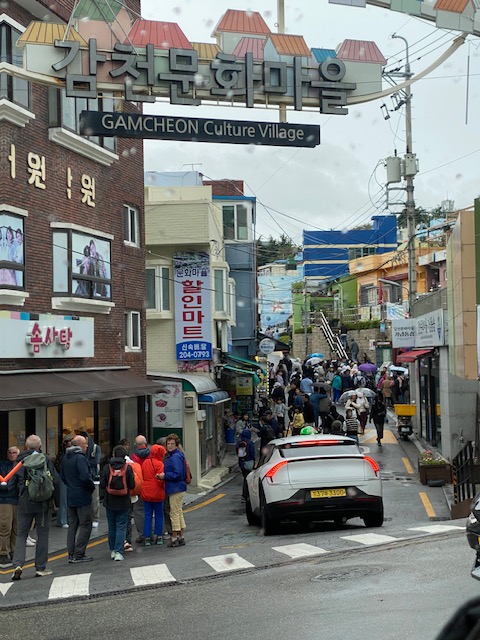
After arriving at Busan Station and dropping our bags at Commodore Hotel, we took a bus or two to Gamcheon Culture Village (감천문화마을), a well-known hotspot in Busan.
Gamcheon Culture Village
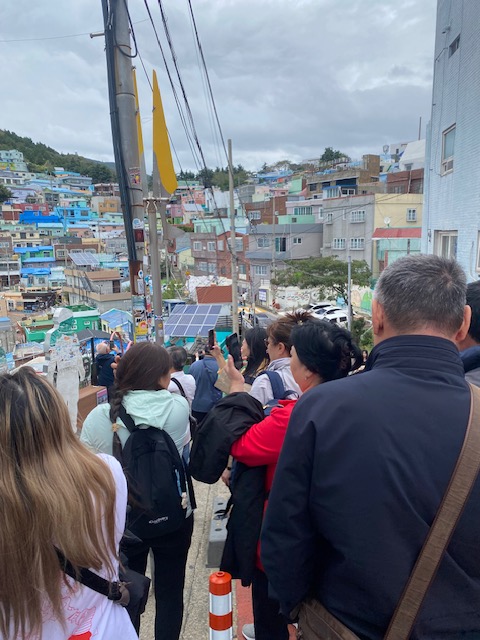
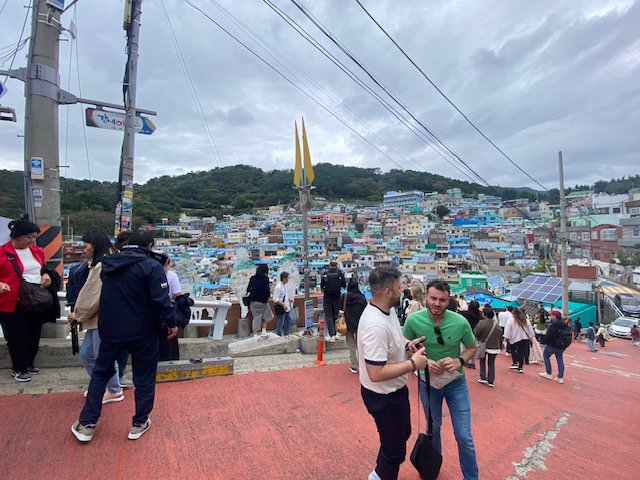
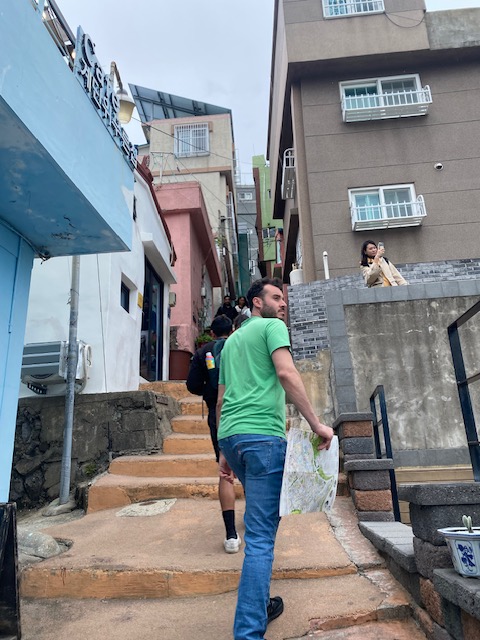
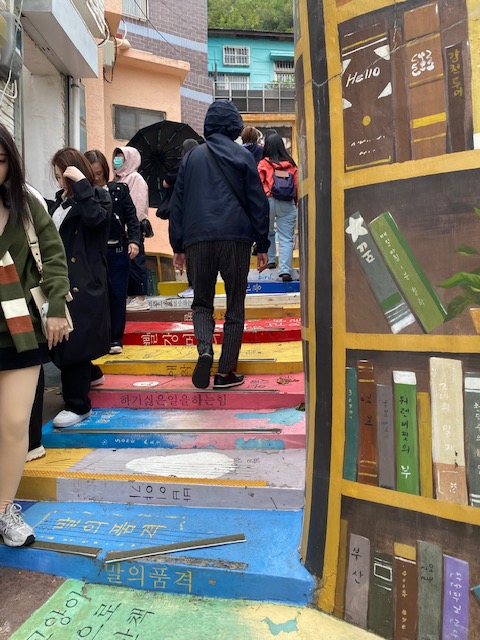
Gamcheon Culture Village is a colorful neighborhood known for its brightly painted hillside homes, murals, and narrow, winding alleys. This district, sometimes called the ‘Santorini of Korea‘ (for the right and the wrong reasons) is unique due to its artistic transformation, initiated as part of an urban regeneration project that has turned it into one of Busan’s most popular tourist attractions.
With its colorful exteriors and quirky street art, the area has transformed from an impoverished village into a major destination for local and international visitors. Its history, socio-economic challenges, and recent issues with overtourism, however, reveal a complex reality behind the cheerful facade.
The origins of Gamcheon date back to the Korean War (1950-1953) when refugees from North Korea and other parts of the South flocked to Busan.
As South Korea’s only city free from the reach of North Korean forces during the war, Busan became a sanctuary, but space was limited. Many of the new residents found their way to Gamcheon, building makeshift homes on the hillside. Most of these settlers were members of a religious group called the Taegukdo, which believed in values like modesty, community, and frugality.
The buildings in Gamcheon, designed for basic shelter and security, were utilitarian in nature, reflecting the challenging living conditions of that time. Houses were stacked along the steep hill, and the streets were narrow, creating a maze-like layout that has endured to this day.
Throughout the decades following the Korean War, Gamcheon remained largely impoverished. As Busan modernised, areas like Gamcheon were overlooked and marginalized, struggling with inadequate infrastructure and poverty.
By the early 2000s, the area was neglected, and many of its residents were elderly. Recognizing this issue, Busan city authorities launched urban revitalization projects to improve living conditions and bring in visitors.


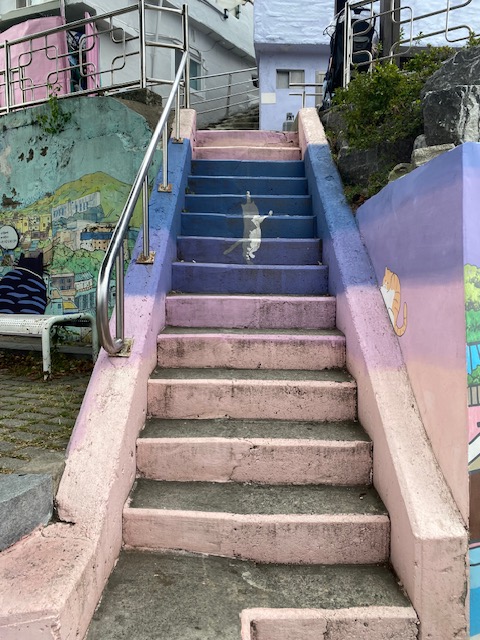
Machu Pichu of Busan
In 2009, Gamcheon was selected as the focus of the ‘Dreaming of Machu Picchu in Busan‘ project, aimed at turning the struggling neighborhood into a hub of art and tourism. Artists, volunteers, and residents were encouraged to participate in beautifying the area by painting houses in bright colors, creating murals, and installing artworks.
This effort led to the unique aesthetic that now defines Gamcheon Culture Village.
The urban regeneration effort was successful in terms of aesthetics and tourism appeal. Gamcheon attracted both domestic and international visitors, becoming a much-photographed area with its winding lanes, pastel-colored buildings, and whimsical art installations. In recent years, however, the influx of tourists has posed challenges.
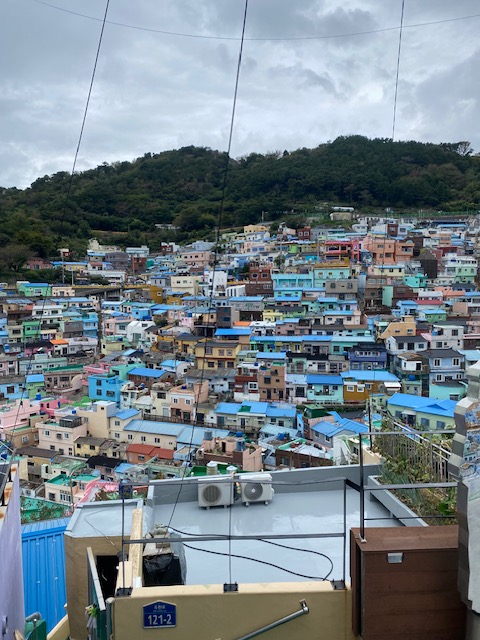


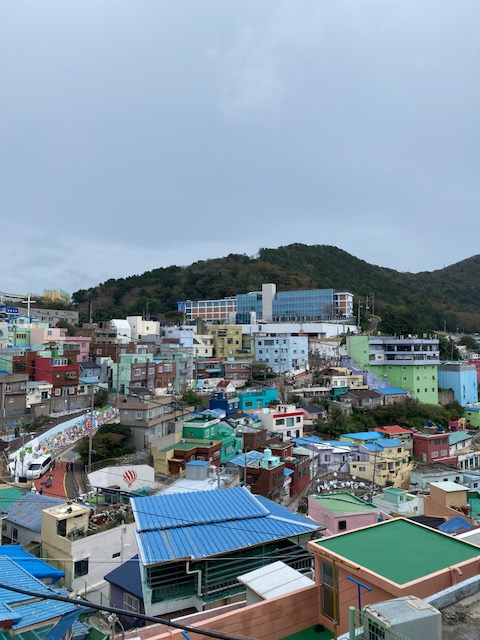

Overtourism
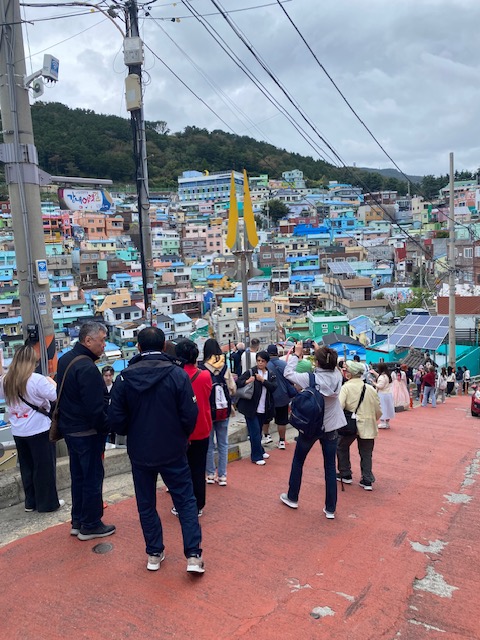
Overtourism has become a serious concern for the residents, as the constant flow of people disrupts the everyday lives of the neighborhood’s population. The small, winding streets of Gamcheon are not well-suited for large crowds, and residents have reported issues with noise, littering, and the invasion of privacy.
In addition, the attention on Gamcheon has driven up property values, making it more difficult for some residents to afford to live there, especially in a neighborhood that has long been home to low-income families and elderly individuals on fixed incomes.
While tourism has brought economic benefits to local businesses, such as cafes, souvenir shops, and small galleries, the influx of visitors has highlighted significant socio-economic disparities. Many of the original residents feel alienated by the changes to their neighborhood, which, while beautified, has lost some of its former community-centered character.
The emphasis on tourism has also led to the commercialisation of the area, which can erode the authenticity of Gamcheon’s cultural heritage. Critics argue that while Gamcheon is marketed as a symbol of Busan’s successful urban renewal, the issues faced by its residents underscore the limitations of tourism-driven development as a sustainable solution for struggling communities.
In response to the pressures of overtourism, authorities have taken some measures to protect the residents and their quality of life.
Signs are placed in the village requesting visitors to respect residents’ privacy and to refrain from making excessive noise. However, these interventions are limited, and the issue persists. Balancing the needs of residents with the demands of tourism remains a major challenge.
In recent years, discussions about establishing entrance limits, enforcing noise ordinances, or creating specific ‘visitor hours’ (as Bukchon Hanok Village unsuccessfully does in Seoul) have arisen, though such measures have yet to be widely implemented.
Some urban planners have argued for a more comprehensive approach, advocating for policies that address the root causes of poverty and improve living conditions without placing a heavy emphasis on tourism.




Case study
Gamcheon Culture Village is a fascinating case study in urban regeneration, illustrating both the benefits and challenges of transforming a marginalized neighborhood into a tourism hotspot.
Its history as a refugee settlement, shaped by the hardship of the Korean War and the modest values of its early residents, contrasts with its current image as a vibrant, art-filled destination.
While tourism has revived Gamcheon economically, it has also introduced complex issues such as overtourism, socio-economic displacement, and a loss of local identity. The future of Gamcheon may depend on finding a sustainable balance that allows both residents and visitors to coexist harmoniously, preserving the unique character of the neighborhood while also respecting the rights of those who call it home.


Neighbourgood or theme park?
Yes, there were big crowds in Gamcheon. Some photo locations have queues for you ti have thát Instagram photo. Is that ridiculous? Yes and no. Yes because why all take the same photo? But also no because these are the best photo ops.
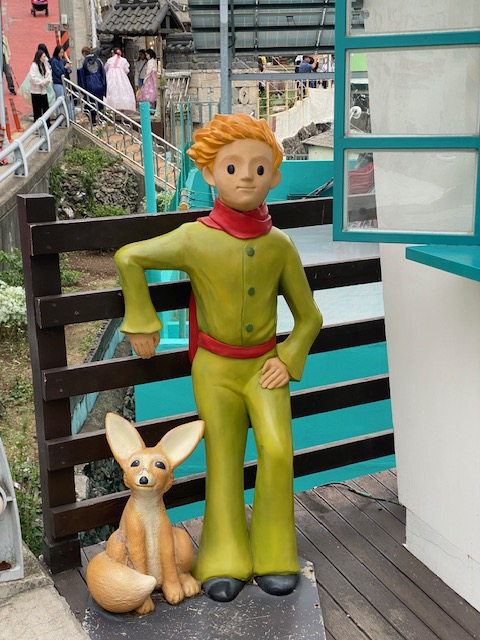
Gamcheon had a bit of theme park vibe for me. Things are made for tourists. The Little Prince is being (mis)used to make the area 애교 (aegyo). ‘Aegyo’ is the ‘kawaii‘ (可愛い) or ‘cute’ of Korea. And not only the Petit Prince is omnipresent, so is the world of Pokémon and that of Studio Ghibli.
More than being crowded – is ‘just crowded’ the same as overtourism? – it was very disneyfied. Souvenir shops and cafés everywhere, but finding a ‘real restaurant’ with ‘actual dishes’ (rather than desserts) was quite a challenge.

The Little Prince in Gamcheon
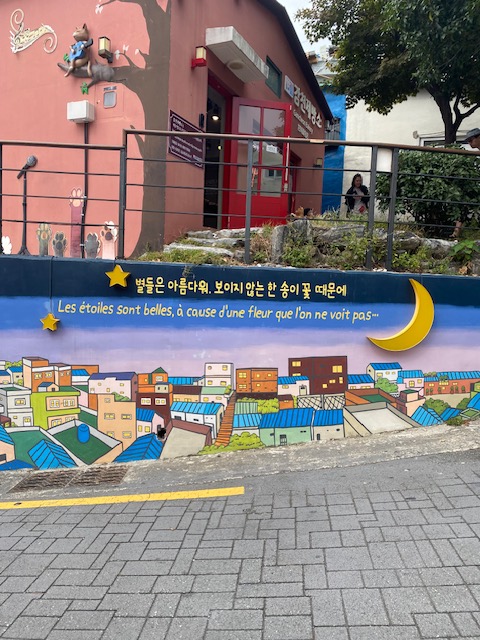
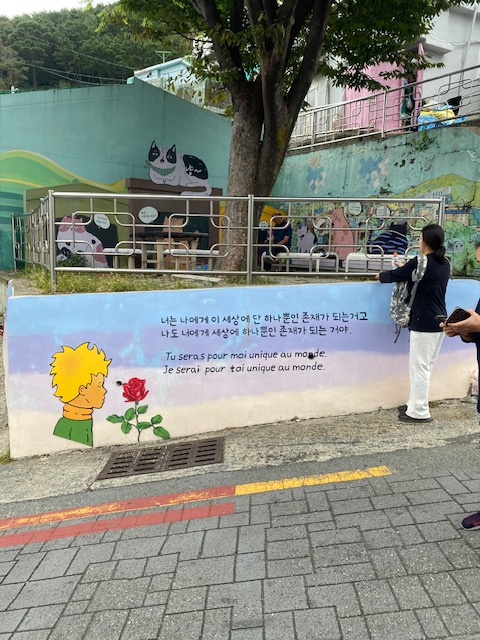
The Little Prince is a recurring figure in Gamcheon Culture Village, featured prominently in various murals, sculptures, and installations scattered throughout the area. This presence of Antoine de Saint-Exupéry’s beloved character is part of an intentional design to convey messages of wonder, innocence, and introspection, elements that resonate with the village’s artistic transformation and unique identity.
When Gamcheon underwent its artistic revitalisation in 2009, the planners and artists involved sought symbols and motifs that would be universally relatable yet unique enough to give the village a distinctive appeal.
The Little Prince, with his themes of exploration, childhood curiosity, and reflective wisdom, served as an ideal fit. His journey across planets in search of understanding parallels the experience of visitors navigating Gamcheon’s labyrinthine alleyways, each turn revealing new artworks, perspectives, and hidden corners of the neighborhood. By featuring the Little Prince, the village invites visitors to pause, observe, and reflect, embodying the story’s encouragement to see the world through a lens of curiosity and wonder.
The character also speaks to the innocence and simplicity of Gamcheon’s humble origins.
The Little Prince’s simplicity, his earnest search for meaning, and his desire for genuine connection reflect the modest aspirations of Gamcheon’s early residents. These qualities align with the values held by the village’s founding members of the Taegukdo religion. By drawing on this character, the village subtly honors the legacy of its past while transforming it into something that appeals to a broad, modern audience.
The Little Prince also offers an accessible, childlike charm that invites a more interactive experience.
His portrayal in the village often includes his famous rose or his fox companion, adding a layer of fantasy to the real-world setting and symbolizing connections that transcend cultural and linguistic barriers.


So?
You might consider avoiding Gamcheon, but why? Yes, it’s crowded. Yes, it feels ‘wrong’ to be part of the mob. But Gamcheon is a place to visit in Busan for the right and the wrong reasons.
South Korea 2024
- QUESTION | Should you be scared of travelling to South Korea?.
- REVIEW | Qatar Airways – economy – Boeing 787-8 Dreamliner – Brussels to Doha.
- QATAR | Hamad International Airport (DOH) in Doha.
- REVIEW | Qatar Airways – economy – Airbus A350 – Doha to Seoul / Incheon.
- SOUTH KOREA | Landing at Incheon, retrieving the Wowpass and taking the AREX to Seoul Station.
- REVIEW | Fraser Place Namdaemun Seoul near City Hall.
- SEOUL | Deoksugung Palace by day.
- SEOUL | Admiral Yi Sun-sin – King Sejong the Great – Gyeongbokgung Palace – National Folk Museum SEOUL | Admiral Yi Sun-sin – King Sejong the Great – Gyeongbokgung Palace – National Folk Museum.
- SEOUL | Bukchon Hanok Village – Insadong Culture Street – Jogyesa Temple – Gwangjang Market – Cheonggyecheon Stream.
- SEOUL 2024 | Dongdaemun Design Plaza.
- SHOPPING IN SEOUL | Myeongdong – Lotte Young Plaza – Avenuel – Lotte Department Store.
- SEOUL | Namsan Mountain Park and N Seoul Tower.
- SOUTH KOREA | Seoul Station.
- REVIEW | Korail KTX Seoul – Gyeongju – Busan.
- GYEONGJU | Daereungwong – Cheonmachong – Cheomseongdae Observatory – Banwolseong Fortress – Anapji Pond – Woljeonggyo Bridge – Gyo-dong.
- REVIEW | Hotel Palace in Gyeongju.
- GYEONGJU | Bulguksa Temple and Seokguram Grotto.
- GYEONGJU | Woljeonggyo Bridge – Gyeongju National Museum – Eupseong Fortress – Shopping.
- REVIEW | Korail KTX Gyeongju to Busan 1st class.
 Trip By Trip
So strange to call Gamcheon Machu Picchu. They should have said Medellin, Colombia or something more similar Anyway it is a weird revitalization project. 😊
LikeLiked by 1 person
I guess it is. Haven’t been to South America properly so I wouldn’t know…
LikeLiked by 1 person