
Autumn 2024. Ten years after my first trip to Seoul in 2014, I am returning to the Republic of Korea, better known as South Korea. Not solo this time, but with Oriol, who has never been to Korea. On the itinerary: flying with Qatar Airways to Incheon via Doha, the capital Seoul, the historic city of Gyeongju, Busan, Jeju Island and a second stint in Seoul, where we are joined by Sehyeon. We’re spending two weeks in South Korea. The ROK is such a popular destination now. Will we experience overtourism?
We looked into taking a ferry to Jeju Island, but we didn’t find any or it was unpractical. So we flew. And we flew Jin Air (진에어).
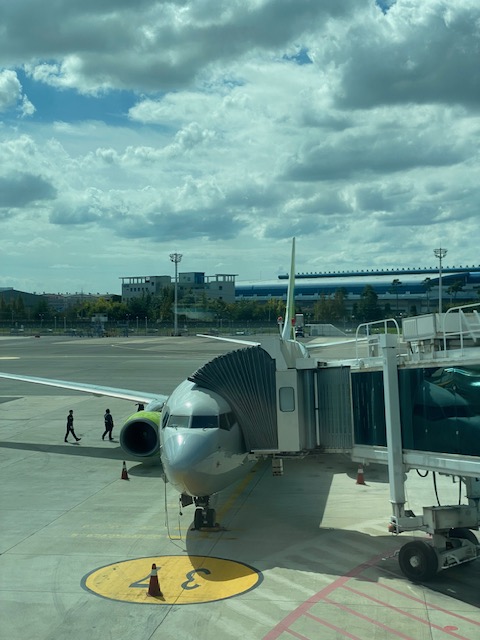
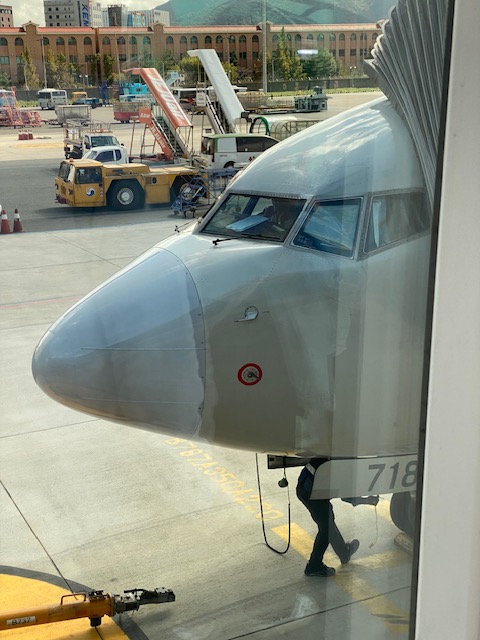
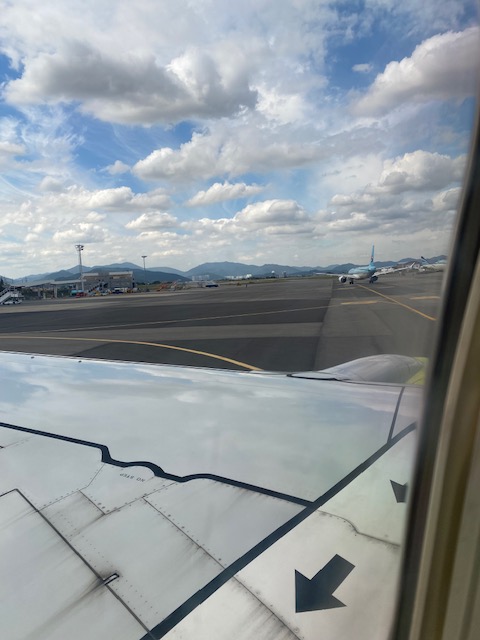

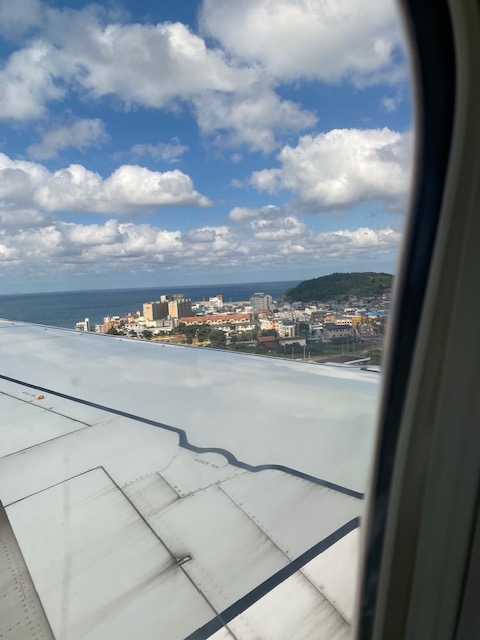

Jin Air
Jin Air is a South Korean low-cost airline, a subsidiary of Korean Air, established in 2008 to serve as a more affordable alternative to traditional airlines while expanding travel options within Asia and beyond. Headquartered in Seoul, Jin Air operates both domestic and international flights, serving as one of South Korea’s primary budget carriers.
The airline’s name, Jin Air, was chosen to reflect the Korean term ‘jin‘ which can mean ‘truth’ or ‘authenticity’, aiming to provide straightforward, reliable services at competitive prices.
Since its launch, Jin Air has grown significantly, beginning with domestic routes within South Korea and then expanding internationally as it gained popularity. Initial flights connected Seoul with popular destinations like Busan and Jeju, but by 2010, the airline began establishing routes to regional locations in Japan, China, and the Philippines.
As demand grew, Jin Air extended its network across Southeast Asia, adding destinations in Thailand, Vietnam, Malaysia, and Taiwan. Its model of affordable pricing, limited amenities, and efficient service appealed to a wide range of travelers, especially those looking for straightforward, budget-friendly options without the luxury add-ons found on full-service carriers. In 2015,
Jin Air became the first low-cost carrier in South Korea to operate long-haul flights when it introduced service to Honolulu in Hawaii, marking a milestone in its expansion.
Boeing
The airline primarily uses Boeing aircraft, specifically the Boeing 737-800 and Boeing 777-200ER models. The 737-800s form the backbone of its fleet and are utilized for short to medium-haul routes across Asia. Known for its fuel efficiency and capacity for around 180 passengers, the 737-800 is well-suited for budget airline operations, offering ample seating and a reliable performance record. For longer routes, such as flights to Honolulu, Jin Air uses the Boeing 777-200ER, which can accommodate over 350 passengers and has a range suitable for long-haul travel.
Jin Air’s choice of these aircraft models reflects its operational goals, focusing on cost-effective, safe, and versatile planes that can handle various route demands. The airline’s fleet has steadily grown to match its expanding route map, although it remains smaller than the fleets of traditional carriers, consistent with its leaner business model.
Destinations
Jin Air’s destinations span both domestic and international locations, with a strong focus on popular East Asian and Southeast Asian cities. Domestically, the airline operates multiple daily flights between Seoul’s Incheon and Gimpo airports and major Korean cities like Busan, Daegu, and Jeju Island.
Jeju, in particular, is one of the busiest routes, as it is a favored travel spot among South Koreans.
Internationally, Jin Air serves numerous key destinations in Japan, such as Tokyo, Osaka, Fukuoka, and Okinawa. It also has routes to major Chinese cities, including Beijing and Shanghai, as well as to secondary cities where tourism demand has grown.
Southeast Asia is a significant focus for the airline, with regular flights to Bangkok, Phuket, and Chiang Mai in Thailand; Manila, Cebu, and Clark in the Philippines; Hanoi and Ho Chi Minh City in Vietnam; and Kuala Lumpur in Malaysia. Jin Air has also ventured into longer-haul routes, connecting South Korea with destinations like Guam and Honolulu, thereby appealing to Korean tourists looking for budget-friendly options to tropical locales.
Low cost
Operating on a low-cost model, Jin Air focuses on essential services to keep fares low, while offering optional add-ons for passengers who want additional amenities. The airline does not include in-flight meals, entertainment, or baggage handling in its base ticket price, allowing customers to customize their travel experience by purchasing additional services if desired.
Jin Air has a no-frills approach, with the cabin configured to maximize seating and with fewer premium services than full-service airlines.
The airline’s staff and crew are known for their friendly and efficient service, a feature that has helped it maintain a loyal customer base in South Korea’s competitive aviation market.

Branding
In terms of branding, Jin Air is recognized for its bright green logo and uniform design, symbolizing a fresh, youthful approach to air travel. The airline’s branding appeals to younger travelers and families, who are often attracted by its affordable pricing and straightforward service model.
Jin Air’s emphasis on accessible travel has contributed to its growing reputation in the Korean market and beyond, making it a key player in the region’s budget airline sector. While it faces competition from other low-cost carriers in Asia, Jin Air has managed to maintain steady growth by focusing on a mix of high-demand routes and strategic expansions, such as its pioneering long-haul services.




Industry challenges
In recent years, Jin Air has faced industry challenges, including fluctuations in fuel prices, increased competition, and the impact of global travel disruptions, which have affected passenger volume and financial performance.
However, the airline has responded by adjusting its route offerings, optimizing operations, and exploring partnerships to strengthen its market position.
Today, Jin Air remains one of South Korea’s prominent low-cost carriers, with a reputation for affordability, safety, and customer-friendly services. Its ongoing growth and expansion reflect both the demand for budget-friendly travel options and the airline’s commitment to providing reliable, accessible flights across a diverse network. As it continues to expand its route map and upgrade its fleet, Jin Air remains a major player in Korea’s aviation market, contributing to the accessibility and connectivity of travel in the Asia-Pacific region.
Gimhae International Airport
Gimhae International Airport (IATA: PUS; ICAO: RKPK), located in western Busan was inaugurated in 1976. Named after the nearby city of Gimhae, the airport underwent significant expansion with the opening of a new international terminal in 2007.
Serving as the main hub for Air Busan and a focus city for Jeju Air, Jin Air, and Korean Air, Gimhae International Airport handled over 17 million passengers in 2018. However, due to increasing air traffic and spatial limitations, a new airport is currently under construction on Gadeokdo to accommodate future growth.
It’s important to note that Runway 18L/36R is exclusively used by the Gimhae Air Base for military purposes. While there are plans to open this runway to commercial airliners, it remains restricted for now.
To maintain security and privacy, photography and videography of the apron, runway, and military installations are prohibited within the airport grounds. But uhm… oops.





PUS
PUS refers to the old spelling of Busan, Pusan. The name Busan is the Revised Romanization of the city’s Korean name since the late 15th century. It officially replaced the earlier McCune–Reischauer romanization Pusan in 2000. During the Japanese colonial period, the Japanese reading of the city’s name was Fuzan.
At the airport
At first we were at the wrong terminal, but luckily we had time to spare.
Check-in was a bit bizarre. The check-in attendant stumbled over my middle name and my passport not matching my online check-in. She gave me a paper boarding pass and added my middle name.
Then Oriol and I were told to wait to be checked further. As we noticed other tourists were put aside, we worried slightly. It turned out we had to wait for our checked luggage to be scrutinized before we could go.
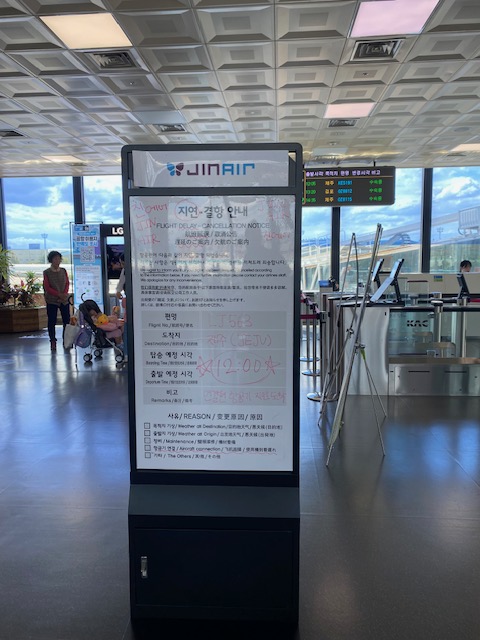
Delayed
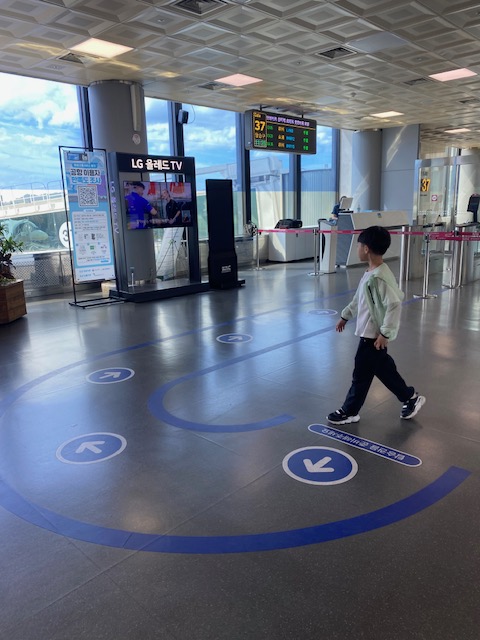
Our flight was delayed and communication was done via this board. Interesting
Boarding was straightforward
The flight
Jin Air LJ563.
Boeing 737-9B5.
HL7718.
Flight time: 48 minutes.
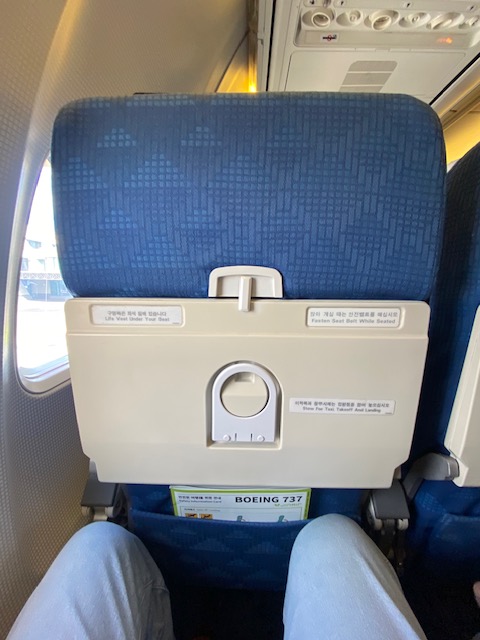
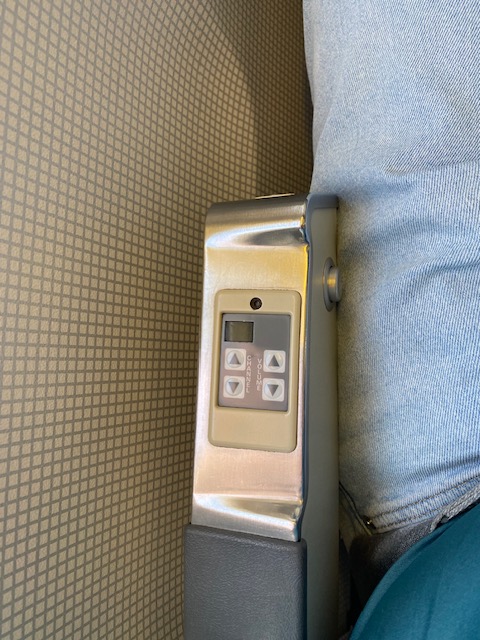
HL7718 had its first flight in 2003 and hasn’t been updated since. The cabin sports Korean Air livery and seats. Larger seats for business class and old fashion, well padded seats in economy. A throwback to my youth.
So you get decent leg room, a sturdy table and seat buttons from the olden days. No power outlet or other modern items.
Don’t expect service or anything on this 48-minute flight. It’s a short hop.


So?
Low cost, no thrills. But it does the job, doesn’t it? Apart from an awkward check-in there’s nothing bad about the experience.
South Korea 2024
- QUESTION | Should you be scared of travelling to South Korea?.
- REVIEW | Qatar Airways – economy – Boeing 787-8 Dreamliner – Brussels to Doha.
- QATAR | Hamad International Airport (DOH) in Doha.
- REVIEW | Qatar Airways – economy – Airbus A350 – Doha to Seoul / Incheon.
- SOUTH KOREA | Landing at Incheon, retrieving the Wowpass and taking the AREX to Seoul Station.
- REVIEW | Fraser Place Namdaemun Seoul near City Hall.
- SEOUL | Deoksugung Palace by day.
- SEOUL | Admiral Yi Sun-sin – King Sejong the Great – Gyeongbokgung Palace – National Folk Museum SEOUL | Admiral Yi Sun-sin – King Sejong the Great – Gyeongbokgung Palace – National Folk Museum.
- SEOUL | Bukchon Hanok Village – Insadong Culture Street – Jogyesa Temple – Gwangjang Market – Cheonggyecheon Stream.
- SEOUL 2024 | Dongdaemun Design Plaza.
- SHOPPING IN SEOUL | Myeongdong – Lotte Young Plaza – Avenuel – Lotte Department Store.
- SEOUL | Namsan Mountain Park and N Seoul Tower.
- SOUTH KOREA | Seoul Station.
- REVIEW | Korail KTX Seoul – Gyeongju – Busan.
- GYEONGJU | Daereungwong – Cheonmachong – Cheomseongdae Observatory – Banwolseong Fortress – Anapji Pond – Woljeonggyo Bridge – Gyo-dong.
- REVIEW | Hotel Palace in Gyeongju.
- GYEONGJU | Bulguksa Temple and Seokguram Grotto.
- GYEONGJU | Woljeonggyo Bridge – Gyeongju National Museum – Eupseong Fortress – Shopping.
- REVIEW | Korail KTX Gyeongju to Busan 1st class.
- BUSAN | Gamcheon Culture Village.
- BUSAN | Jagalchi Fish Market.
- REVIEW | Commodore Hotel Busan.
- KOREA | Haedong Yonggung Temple in Busan.
- BUSAN | Haedong Blue Line Park, Sky Capsules, Beach Train and Haeundae Green Railway.
- BUSAN | Shinsegae Centum City Department Store, Gwangalli Beach, Busan Tower.
- QUEER KOREA | Beomil-ro, Busan’s gay street.
 Trip By Trip
In the late 1990’s, it was spelled Pusan. Their “p” is a “b” too. They pronounce both sounds at the same time. You are so descriptive and thorough. I’m glad to know about Jin Air.
LikeLiked by 1 person
Thank you 🙂
LikeLike