
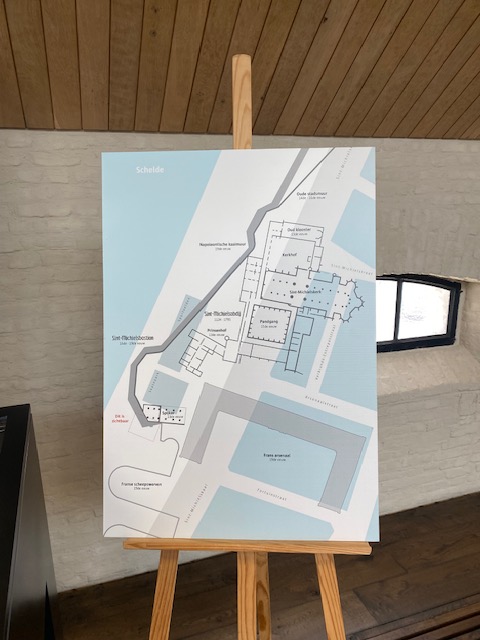
The City of Antwerp commemorates the 900-year-old Saint Michael’s Abbey or Sint-Michielsabdij. This iconic abbey stood for centuries on the banks of the Scheldt, between Sint-Michielskaai and Kloosterstraat.
During the Middle Ages it was one of the most powerful abbeys in the wider region. In the meantime, she completely disappeared from the cityscape. Her remains came to light during recent archaeological research in the context of the reconstruction of the Scheldt quays. The city now placed a memorial stone and an information panel on the renovated Scheldt Quays, on the spot where the abbey once stood. Since 7 May and until 8 September 2024, the Felix Archive will host a mini-expo about St. Michael’s Abbey.
The Antwerp St. Michael’s Abbey was founded in 1124 by Norbert van Gennep (ca. 1080-1134), later Saint Norbert. This cleric stood at the origin of the Premonstratensian order, also called the Premonstratensians. Other important monastery foundations later followed from Antwerp, including in Tongerlo, Averbode and Grimbergen.
St. Michael’s Abbey grew into a powerful and wealthy monastery that played an important role in the social and political life of Antwerp for centuries. The impressive monastery complex flourished in the 14th and 15th centuries and at that time housed rulers and other important personalities. When visiting Antwerp, renowned guests always stayed in the Prinsenhof, the luxurious guesthouse of the abbey.
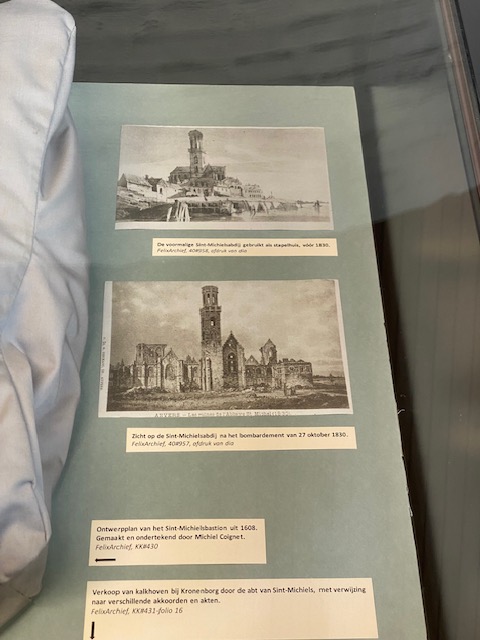
After the closure of the monastery in the French period (1794-1815), the complex began to decline. The abbey was plundered, damaged and repaired several times, and lost its glory. She suffered the final blow during the Belgian Revolution (1830-1831). The Antwerp showpiece that once shone on the banks of the Scheldt was demolished shortly afterwards, and the remains disappeared underground.






Archaeological research
During a large-scale archaeological investigation in 2021-2022 in the context of the reconstruction of the Scheldt quays, St. Michael’s Abbey briefly came to light again. City archaeologists went looking for the missing remains of the abbey. They made the cellars and foundations, the corridor, the church and the Prinsenhof visible and found more than 400 burials.
Part of the 14th-century Spijkertoren was also uncovered. They also discovered traces from the period before the monastery’s construction, including a Roman moat and a unique Merovingian coin. They also found part of the 16th-century city walls and the southern flank of the St. Michael’s Bastion (Sint-Michielsbastion). Part of the bastion was integrated into the design of the Scheldt quays and is publicly accessible.
Memorial stone
Since its demolition in the 19th century, the abbey completely disappeared from collective memory. Only a number of street names still remind us of the once mighty abbey: Kloosterstraat, Sint-Michielskaai, Sint-Michielstraat. On the occasion of the 900th anniversary, the city wants to keep the memory of this prestigious abbey alive with a memorial stone.
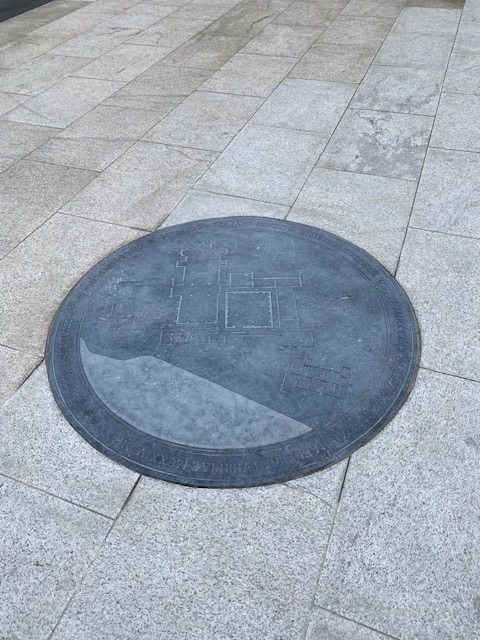
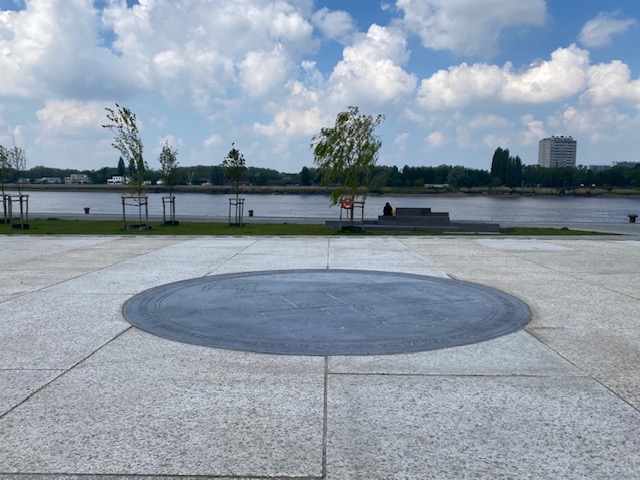
The memorial stone will be placed on the recently redeveloped Scheldt quays along the Sint-Andries neighbourhood. On the new promenade, near Sint-Michielstraat, there is a wide view, both on the Scheldt side and towards the city center. This location is located within the former monastery grounds near the old monastery. Archaeological research was also carried out at this site.
The memorial, which is integrated into the walking path, consists of a circle in bluestone in which the map of the former abbey was engraved. Around it is the inscription in Latin ‘Abbatia Sancti Michaelis Antverpiae MCXXIV-MDCCCXXX‘, which means: “Saint Michael’s Abbey Antwerp 1124-1830”.
An information panel is placed nearby with more information about the disappeared abbey.
Councilor for Urban Development Annick De Ridder (N-VA): “St. Michael’s Abbey was a showpiece on the Scheldt during the Middle Ages. It disappeared underground until archaeologists brought the remains to light again during the reconstruction of the Scheldt quays. With the redevelopment of the Scheldt quays, a 7-kilometer strip from the Dry Docks site (Droogdokkensite) all the way to Blue Gate, we are once again bringing Antwerp residents closer to the Scheldt. After all, we lived for far too long with our backs to the Scheldt, the lifeline of our city. For the new construction, we have opted resolutely for greening and blueing, but we also pay a lot of attention to the historical heritage. We are now placing a memorial stone on the site of the former St. Michael’s Abbey and we have integrated the remains of the St. Michael’s Bastion into the new construction. In this way, Antwerp’s history fits nicely into the exciting future story that we are writing with the Scheldt Quays.”
Temporary exhibition in Felix Archive
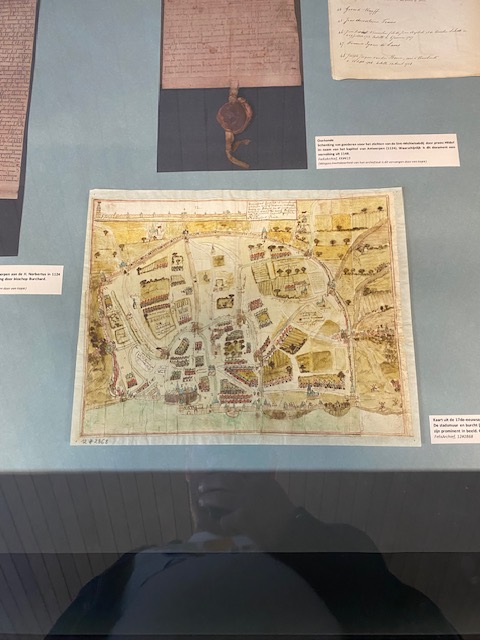
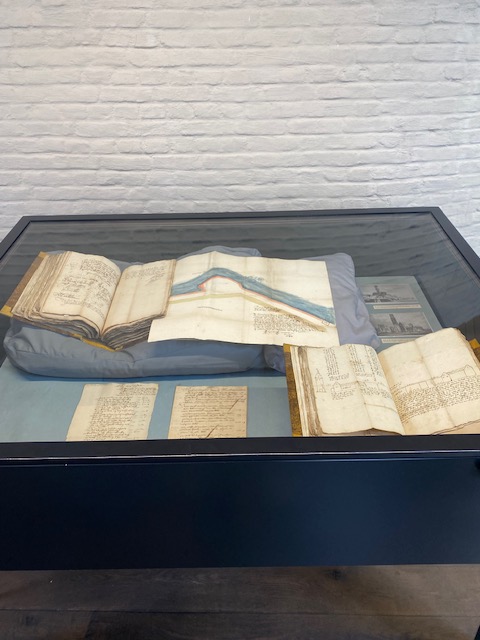
Since Tuesday 7 May, everyone can visit a unique mini exhibition about St. Michael’s Abbey on the sixth floor of the Felix Archives. The exhibition shows a selection of archive documents about the rich history of the abbey such as the foundation, the abbey and parish church, the city defenses, and sources about some royal guests.
Historical images and archaeological finds from recent excavations complement the exhibition and make abbey life tangible. All information is available on http://www.antwerpenmorgen.be, click here for the direct link.
A lot of background information and a video about two thousand years of Antwerp’s Scheldt Quays can be found at www.archeologiescheldekaaien.be.
So?
Don’t expect too much from the exhibition, it is very mini.
Art and museums in Antwerp
- RED STAR LINE MUSEUM | ‘A wanted refugee: Einstein and Red Star Line’ exhibition until Sunday 8 September 2024.
- ANTWERP | Innovations in the Middelheim Museum provide a completely new visitor experience.
- ANTWERP | New Rubens House building and garden to open on 30 August 2024.
- FOMU 2024 | Antwerp photography museum ft. Dirk Braeckman, ‘RE/SISTERS’ and Nick Geboers.
- A visit of the Flemish Tram and Bus Museum – Vlaams Tram- en Autobusmuseum (VlaTAM) in Antwerp.
- MUSEUM AAN DE STROOM | ‘City at war, Antwerp 1940-1945’.
- ANTWERP | M HKA modern art museum presents first half of 2024 activities.
- ANTWERP | Discovering queer(ed) art with the Queer Tour at the KMSKA fine arts museum.
- REVIEW | Illusion Antwerpen, an active and photogenic museum.
- Antwerp museums and sports facilities team up with European Disability Card for accessible leisure activities.
- ‘Jef Verheyen, Window On Infinity’ exhibition at KMSKA, the Royal Museum of Fine Arts Antwerp, until 18 August 2024.
- Inside the KMSKA or Royal Museum of Fine Arts Antwerp.
- Museum Mayer van den Bergh.
- 2024 at Royal Museum of Fine Arts of Antwerp (KMSKA): Rubens, James Ensor, Jules Schmalzigaug and many more.
- 2024 at the museums of Antwerp ft. Ensor Year.
- ANTWERP | Inside Rubens House.
- ModeMuseum MoMu – Fashion Museum Antwerp 2022.
- Museum Plantin-Moretus in Antwerp.
- ANTWERP | Museum Vleeshuis up for restoration.
- BOOK | ‘Antwerp. An Archaeological View on the Origin of the City’ by Tim Bellens.
- Red Star Line Museum.
- Paleis op de Meir.
- DIVA, Antwerp Home of Diamonds.
- ANTWERP | Red Star Line Museum of (e)migration.
- ANTWERP | Museum Mayer van den Bergh is expanding into former District Hall.
 Trip By Trip
3 Comments Add yours