
On Saturday 14 December 2024, Bart De Wever (N-VA) and Kathleen Van Brempt (Vooruit) presented ‘Allemaal Antwerpenaar‘ or ‘All Antwerpians‘, the City of Antwerp governing agreement for the 2025-2030 term.
Some of the 700 objectives mention trains.
The governing agreement, or bestuursakkoord in Dutch, must be ratified by an assembly of members of the participating political parties. These are the N-VA, the New Flemish Alliance, which is an economic right-wing, ethically sometimes progressive, but mostly conservative party advocating independence for Flanders and they are allergic to anything which rings Belgium. The other party is the social democratic Vooruit. The parties are expecting to approve of the document today, Sunday 15 December.
Objective #36: Eurostar, EuroCity Direct, new stations
“Together with the Transport Region, we are expanding our position as Urban Node within the European TEN-T network. We are committed to attracting European funds in the context of the subsidy calls, together with Lantis, the executive arm of the Transport Region.”
“We are seeking coordination with neighbouring regions on cross-border mobility such as freight transport and international (freight) trains.
“We continue to insist on providing a terminal for the Eurostar to London in Antwerp-Central and opening the IC-Snel between Amsterdam and Brussels for domestic transport in order to guarantee a good train connection with Brussels.”
A Eurostar terminal in Antwerp for the Eurostar blue to the United Kingdom? Yes, we’d like that too. But who’s going to pay for all the infrastructure for border checks? And where would you put that terminal? Besides logistics, domestic, regular connections between Antwerp and Brussels are seen as good enough not to warrant a stop and terminal in Antwerp.
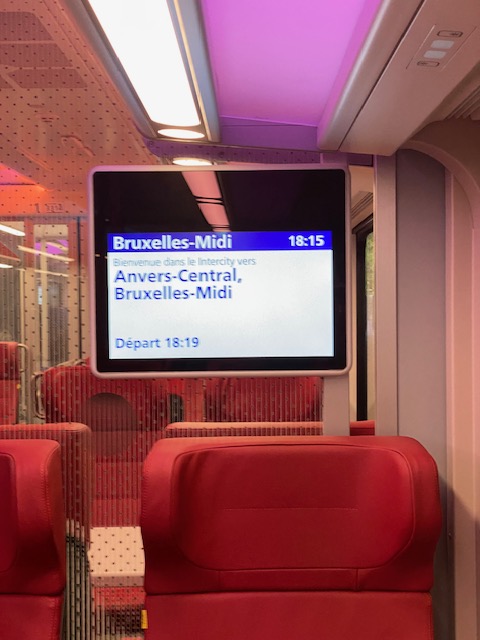
The IC-Snel, which is actually now named EuroCity Direct and starts running regularly today, is indeed forbidden for domestic use between Antwerp-Central and Brussels-South/Midi/Zuid.

Objective #37: Stopping at Linkeroever, Schijnpoort and Blue Gate
“A fully-fledged Antwerp Regional Express Network ensures that the entire (transport) region is and remains accessible by train. We urge the NMBS / SNCB to provide a stronger regional offer for passenger transport with high-quality trains and stations.”
“We are thinking here of the ring railway from Kallo to the logistics park Schijns and the (re)design of renovated and new stations Luchtbal, Linkeroever, Schijnpoort and Bluegate. We are placing the management of this offer with the new Antwerp transport authority. We are urging the federal government to provide the necessary exploitation resources.
“We are aligning the bus lines with the REN nodes, so that not all buses have to drive all the way to the city centre.”
Antwerp-Luchtbal already exists. Antwerp-Linkeroever used to exist and on Line 59, from Antwerp to Ghent, you can still see abandoned platforms. Would that be such an interesting stop?
Schijnpoort is now a depot or yard. There have been stories of the NMBS / SNCB leaving that area for Bundel Luchtbal, and Schijnpoort being sanitized and redeveloped.

Blue Gate
Antwerp-Bluegate or Blue Gate (the agreement uses a different spelling than other Antwerp websites) would be totally new.
Blue Gate Antwerp is one of the seven sub-areas of the Scheldt Quays. Petroleum Zuid (Petroleum South) was once a busy business park where innovative petroleum companies were active. From the 1960s onwards, the companies moved away and Petroleum Zuid was left largely abandoned and polluted. The site is now being remediated and developed into Blue Gate Antwerp, an innovative and future-oriented business park.
“Together with the Flemish Region, the City wants to turn it into a business park for innovative companies that highly value renewable energy and the reuse of raw materials. Blue Gate Antwerp should create around 2,000 jobs”, the Antwerp Tomorrow website says.
“There is room for production companies, research and development institutions and a logistics zone on the Scheldt side. This zone includes a centre for urban distribution that keeps polluting trucks out of the city.”
“At Blue Gate Antwerp, green and business go hand in hand. A green corridor of 14.5 hectares connects the Hobokense Polder with the green zones around the Ring. The rest of the site will also have a strong green character. A recreational cycle path through and along the corridor makes the industrial estate accessible and accessible.”
In 2016, Blue Gate Antwerp joined forces with the private partner Blue O’pen, a consortium consisting of DEC, Dredging International and Bopro. Bexco, a producer of high-tech ropes, was the first to start production here.
BlueChem, a so-called incubator, opened its doors in May 2020 and prepares start-ups in a protected environment for the development of sustainable chemistry. In the meantime, the University of Antwerp is realising BlueApp, a pre-incubator for sustainable chemistry, where companies and researchers will develop sustainable solutions for chemistry.
At the beginning of 2021, DHL opened its new CityHub for the Antwerp region at Blue Gate Antwerp. This urban distribution center will collect and deliver an average of 50,000 parcels per week in the city and in the surrounding municipalities. From now on, the city centre will be supplied exclusively by ecological, electric vehicles.
“The public partners and the private partner have jointly set up a land development company that will provide the remediation, raising and construction of infrastructure, and then make the land available to companies. These works will take place in phases, as will the real estate development. Everything is ready to shape a new economic lung for Antwerp.”
Transport Region Antwerp
What is Transport Region Antwerp or Vervoerregio Antwerpen? Flanders is divided in fifteen transport regions. “Within these transport regions, local authorities are involved in tackling mobility challenges in the area. Each transport region has developed a Regional Mobility Plan for this purpose”, Flanders introduces the concept.
The Regional Mobility Plan for the Antwerp transport region (Routeplan 2030) outlines the future of mobility in the transport region and contains actions for local and supra-local authorities to realise this vision for the future.
The regional mobility plan of the Antwerp Transport Region opts for a ‘mobility system focused on combimobility’ as the engine for the transition: multimodal travel behaviour in which travellers combine and transfer between different means of transport in order to reach a destination as smoothly and sustainably as possible.
The Regional Mobility Plan is a strategic document and sets out the medium-term mobility vision. All modes of transport are covered, for both passenger and freight transport. The plan makes statements about the important mobility challenges of the region. The shift to sustainable mobility is achieved through an interaction between three cornerstones: the mobility supply, mobility demand and spatial planning.
The plan zooms in on the various networks, interventions and supporting measures of regional importance, with a focus on the mobility supply and the mobility demand.
The Regional Mobility Plan is the result of intensive cooperation between the partners in the transport regional council. The emphasis is on the supra-local aspect, without losing sight of the local. The Regional Mobility Plan only expresses itself on visions and actions of regional importance. Both local and supra-local actors can act as initiators to roll out the actions.
So?
Objectives 36 and 37 are ambitious. Will they be realised or at least started? Let’s see about that.
 Trip By Trip
14 Comments Add yours