
Opened in late September 2025 at Train World in Schaarbeek / Schaerbeek in Brussels, the exhibition ‘Belgian Railways Under Occupation: Between Collaboration and Resistance‘ examines the complex and often painful history of the Belgian railways during World War II.
Conceived under the scientific direction of historian Nico Wouters, director of the Centre for Historical Research and Documentation on War and Contemporary Society (CegeSoma), the exhibition remains open until June 2026. It forms part of a broader initiative by the National Railway Company of Belgium (NMBS / SNCB) to confront and make accessible the historical truth about the railways’ wartime role. Alongside the exhibition, a dedicated website in Dutch and French, educational materials for schools, and a programme of lectures and testimonies are bringing this chapter of history to a wider audience.


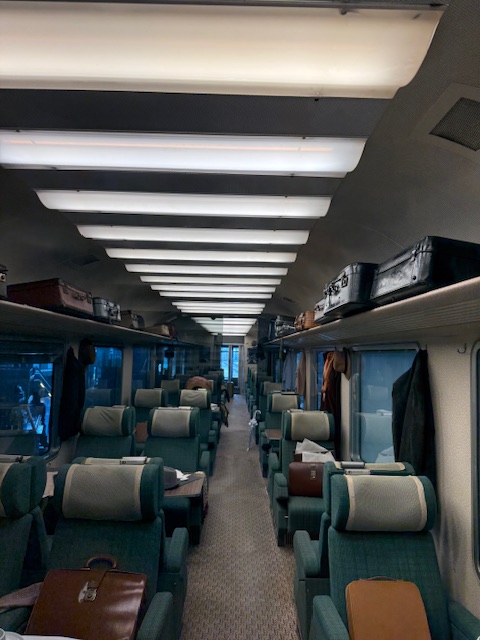

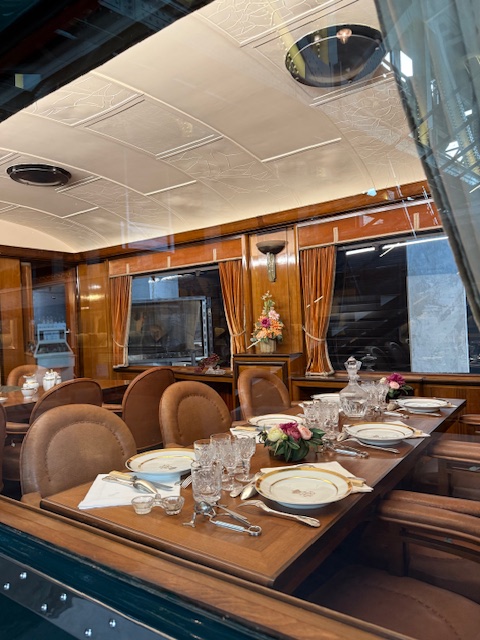

The exhibition was developed in partnership with Kazerne Dossin, the War Heritage Institute, CegeSoma, the National Museum of the Resistance, MNEMA, and the Cité Miroir Foundation. It is free to visit for anyone aged 18 or under, a deliberate effort to engage younger generations in reflecting on questions of moral responsibility and the choices made under occupation.
Educational packs and workshops, designed for pupils aged ten to eighteen and aligned with the curricula of Belgium’s three language communities, are available to schools both during and after the exhibition’s run.


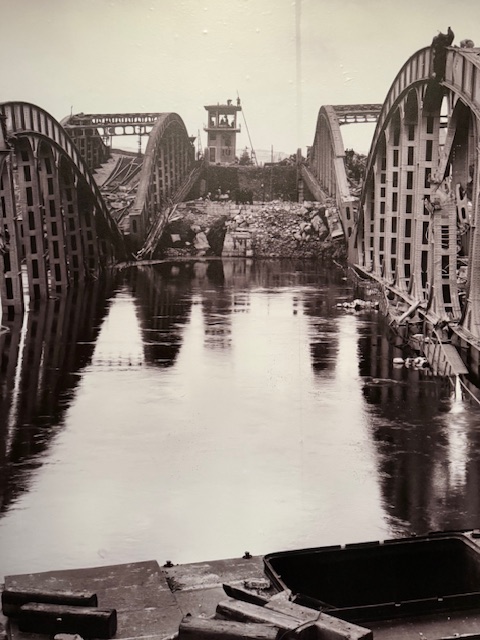


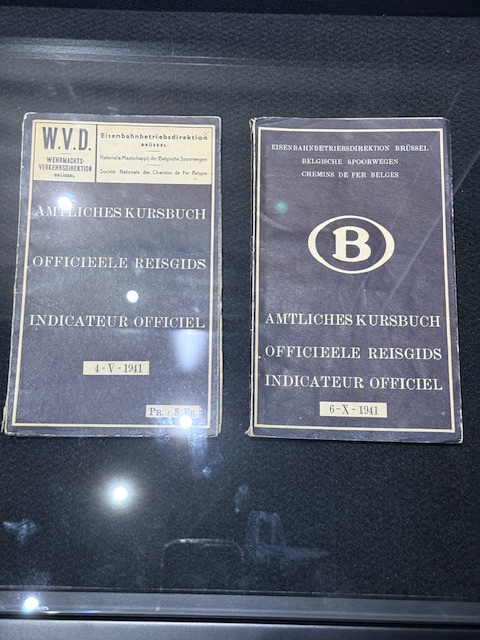
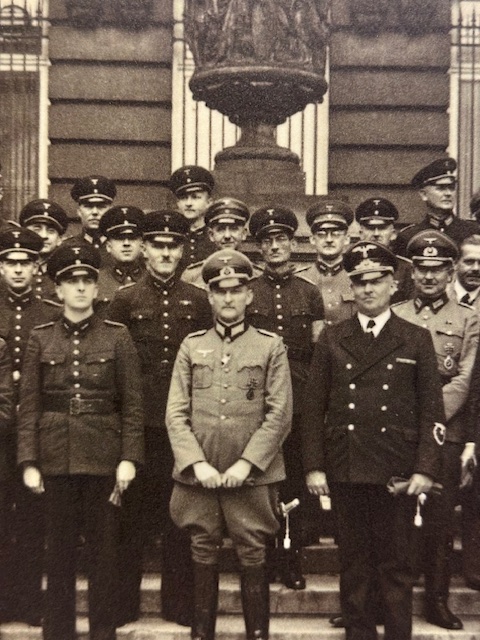
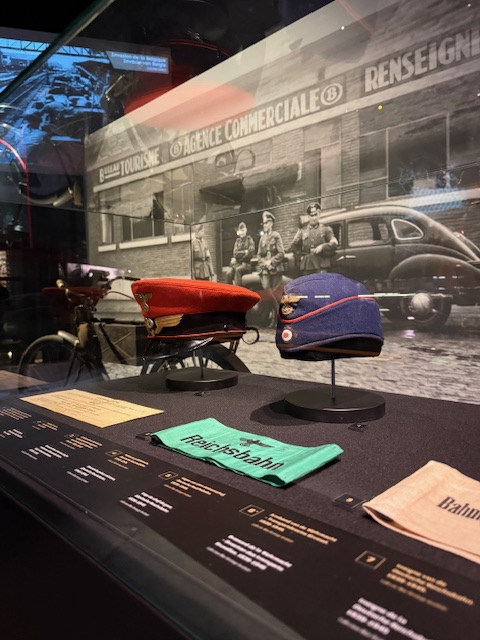


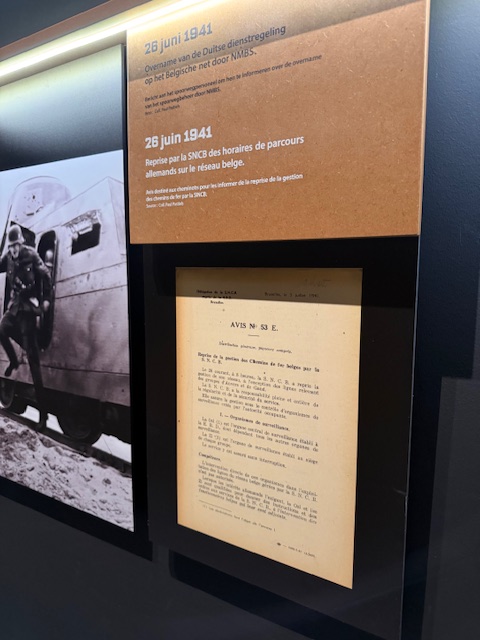

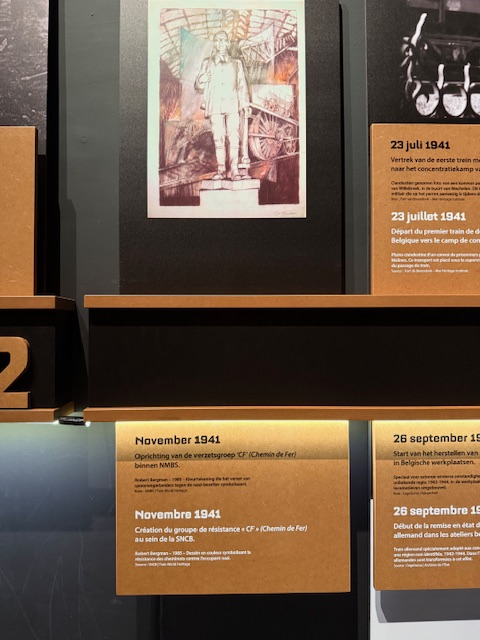


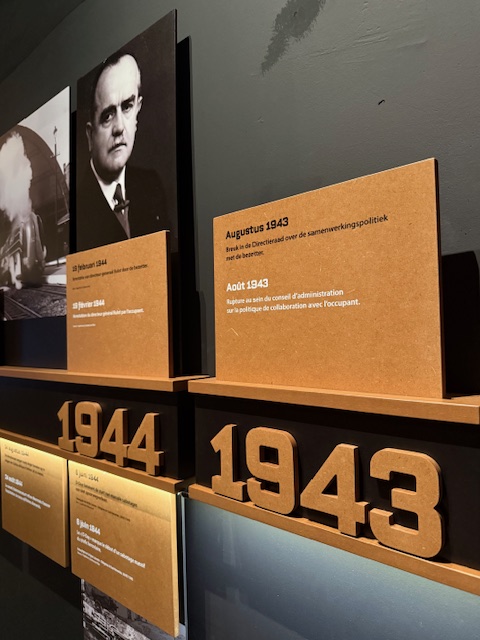


The exhibition
Arranged chronologically across five thematic sections, the exhibition follows the history of the Belgian railways from the interwar years to the Liberation. It opens in the Grand Ticket Hall, where the international context of 1919–1939 is set out, tracing the social and political tensions that led to the outbreak of war. A German Kübelwagen stands as a stark emblem of militarisation and impending conflict.
From there, visitors enter Hall 1, which presents the state of the Belgian railways on the eve of the war and during the early stages of the German invasion. Artefacts and archival documents illustrate how swiftly the occupiers took control of the rail network, turning an essential public utility into a key logistical instrument of occupation.
Hall 2 delves deeper into the moral and operational dilemmas faced by railway employees and administrators. Through documents, testimonies, and installations, it reveals how the company continued to function under German rule, navigating a narrow path between collaboration and resistance. A particularly haunting section recounts the story of the ‘ghost train’, a deportation convoy that never reached its intended destination.
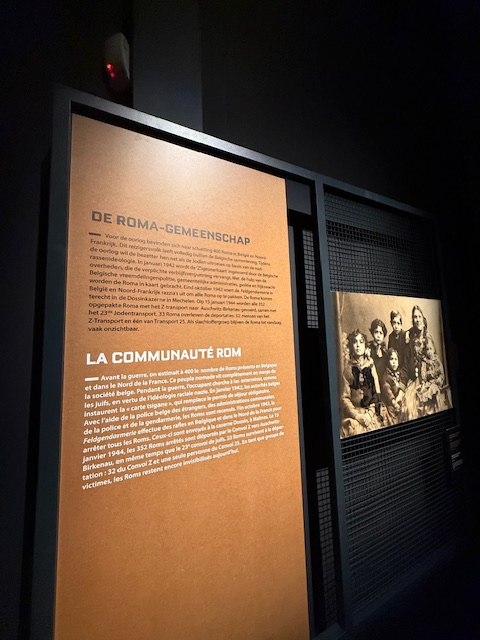
In Hall 3, the focus shifts to the deportations of forced labourers, political prisoners, Roma and Jewish people to Germany between 1941 and 1944. Objects, personal portraits, and archival records evoke the human cost of these transports.
At the centre of the hall stands a Red Cross railway carriage, used in 1944 to repatriate Belgian prisoners and deportees, an artefact that lends tangible immediacy to the history on display.
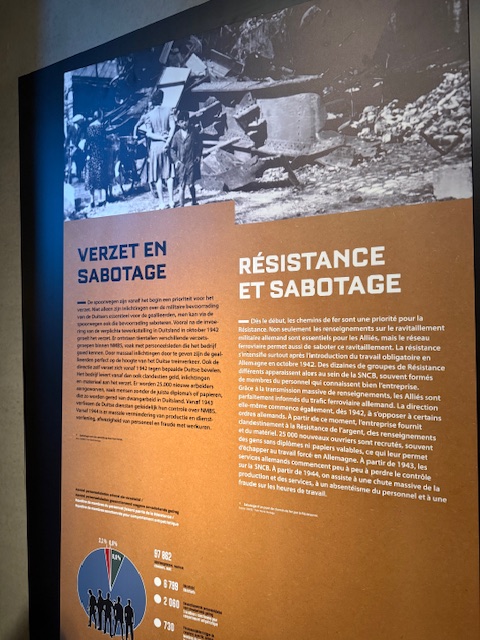
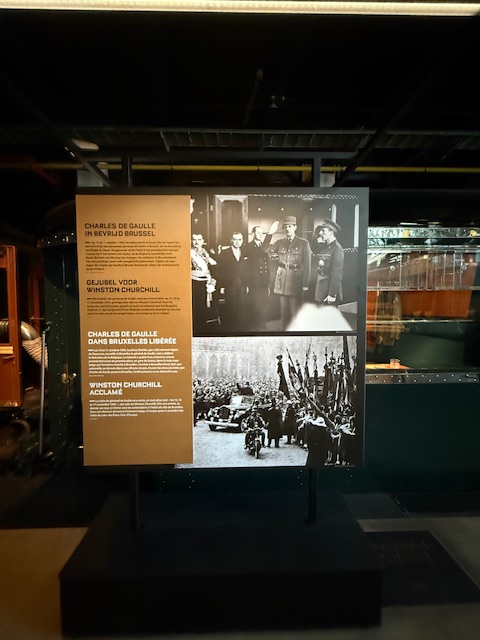
Hall 4 examines the final years of the war, the Allied bombings, acts of sabotage and resistance carried out by railway workers, and the eventual liberation of Belgium.
It also tells the story of the 20th convoy, the best-known deportation transport from Belgium, which was famously intercepted by three young resistance fighters. The preparation of this convoy, the fate of its passengers, and its symbolic significance are explored in depth.
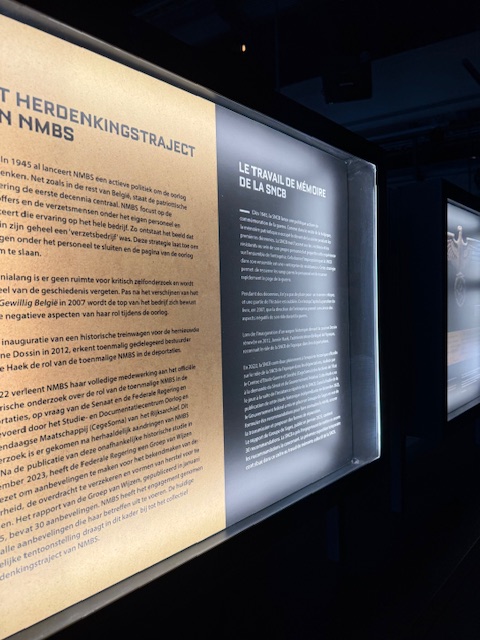
The final part of the exhibition is devoted to NMBS/ SNCB’s ongoing efforts to confront and commemorate its past, reflecting a wider commitment to remembrance and transparency.
The exhibition is supported by a public programme of lectures and testimonies, featuring Holocaust survivors and historians specialising in the Second World War. The talks, given in both French and Dutch, are being held throughout the exhibition period and will later be made available online. Among the confirmed speakers are Amir Haberkorn and Maximilien Kutnowski, both survivors of the Holocaust, alongside leading historians including Nico Wouters, Laurence Schram, Dimitri Roden, Paul Jacobs and Louis Gilliaux.
Beyond the museum, NMBS / SNCB has also made all available wartime sources—archival materials, documentation, and historical collections—accessible online, while physical access to its archives will soon be facilitated by the opening of a new documentation centre at Train World in early 2026.
The company has introduced a Discovery Ticket to encourage visits to Kazerne Dossin in Mechelen (Malines, Mechlin), the site from which thousands of Jews and Roma were deported between 1942 and 1944, now a memorial and museum dedicated to the Holocaust and human rights.

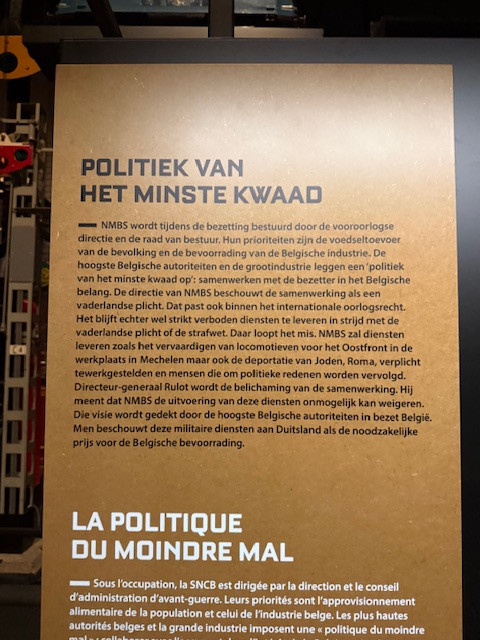


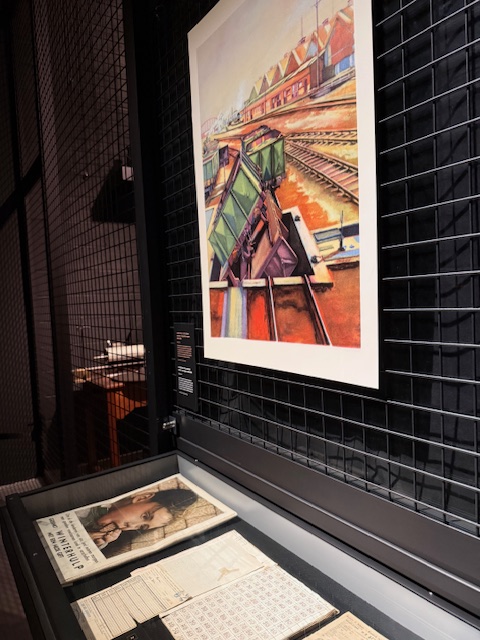
Historical reckoning
The exhibition represents a significant act of historical reckoning. Following calls from representatives of the Jewish community and NMBS / SNCB itself, Belgium’s Federal Government commissioned a scholarly investigation into the railway’s wartime role, carried out by CegeSoma and completed in early 2024.
The findings confirmed that the railways were indeed involved in the transport of deportees, while emphasising the importance of understanding these actions within their historical context and as part of a broader framework of collective responsibility.
A subsequent report by the Group of Experts, chaired by Françoise Tulkens, put forward thirty recommendations for truth-telling, remembrance, and moral redress. While the government has yet to announce how it will implement these proposals, NMBS / SNCB has chosen not to wait.
This exhibition and its accompanying educational initiatives are its first tangible steps in acknowledging and sharing the lessons of its past.
Eloquent, unflinching, and deeply researched, ‘Belgian Railways Under Occupation: Between Collaboration and Resistance’ does not seek to offer easy conclusions. Instead, it invites reflection—on moral choices made in impossible circumstances, on institutional responsibility, and on the enduring importance of remembrance. It stands as both an act of education and of quiet courage, ensuring that this difficult history is neither forgotten nor simplified.
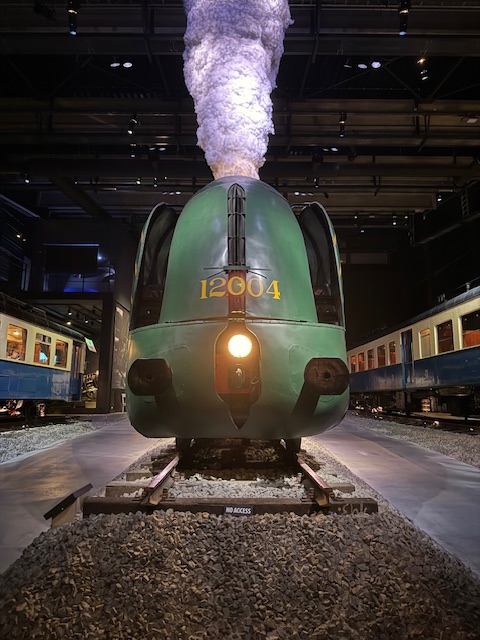
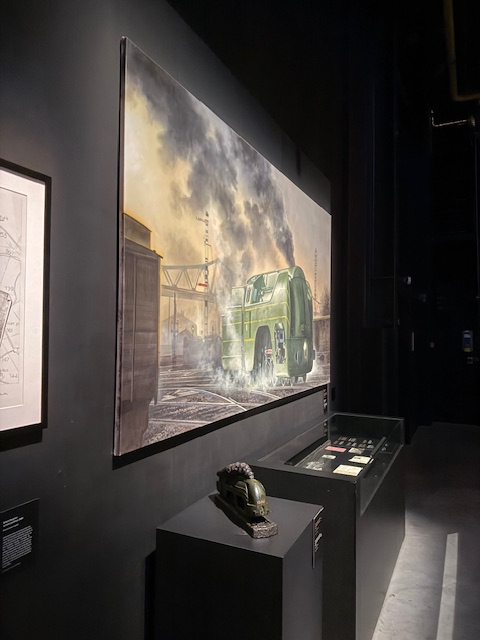


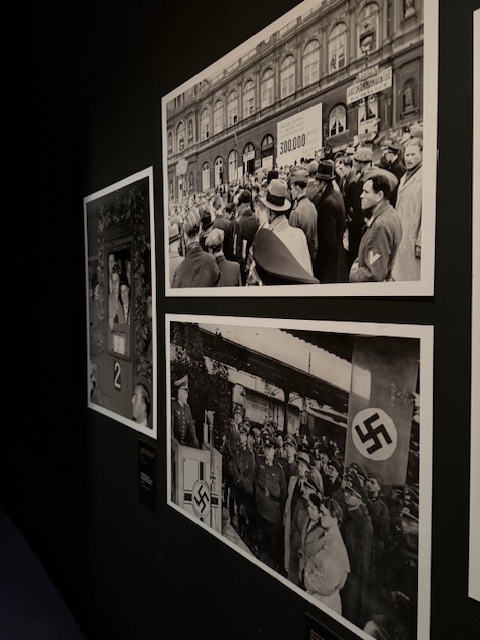


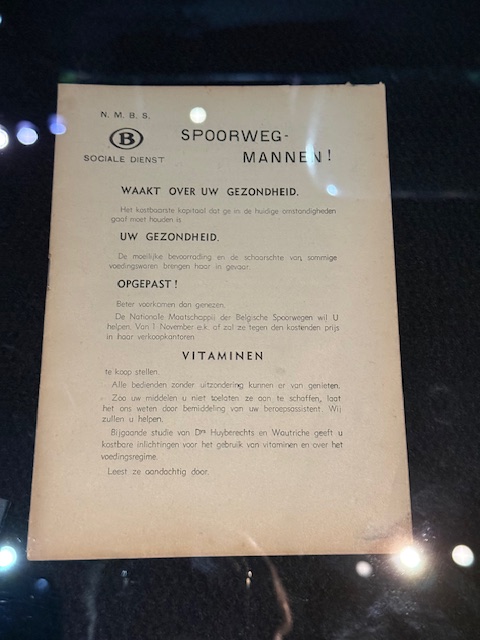
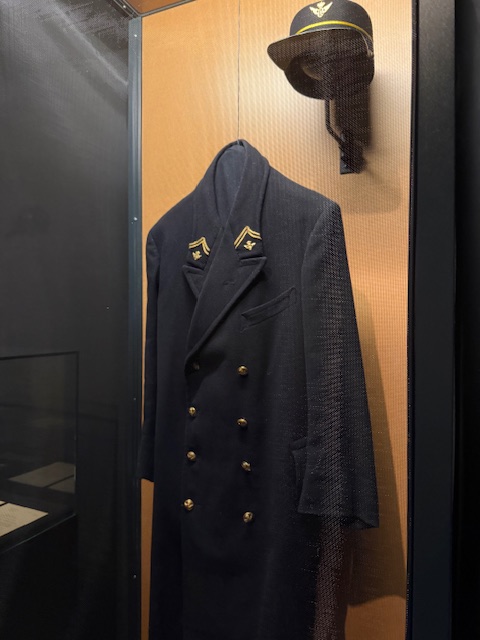







A visit
The day I visited, the Grand Ticket Hall was closed to be prepared for an event. Train World always intertwines temporary exhibitions with the permanent collection. The museum also adapts its permanent collection accordingly.
That works, but did Dennis and I miss panels? It could well be. So I’m not sure I’m a fan of this modus operandi.
As for the exhibition itself, I found it very interesting. Nothing is clear-cut in war and hindsight makes judging perhaps too easy.
Railway and transport museums
- REVIEW | Conservatoire National de Véhicules Historiques & Musée d’Histoire de la Brasserie de Diekirch car and beer museums in Diekirch, Luxembourg.
- A visit of the Flemish Tram and Bus Museum – Vlaams Tram- en Autobusmuseum (VlaTAM) in Antwerp.
- MONTREAL | Exporail – Canadian Railway Museum in Saint-Constant.
- REVIEW | Motion and emotion at the London Transport Museum.
- BAVARIA | Lokwelt – Locomotive World in Freilassing .
- REVIEW | Orient-Express exhibition at Train World, Brussels’ railway museum.
- REVIEW | Train World exhibition ‘From Peking to Hankow: a Belgian adventure in China’.
- PHOTOS | Train World railway museum in Brussels.
- Railway and transport museums (not) to visit.
- Nuremberg Transport Museum / DB Museum.
- Slovenian Railway Museum in Ljubljana.
- VIDEO | Mail Rail and The Postal Museum in London.
- Plans for a steam train heritage service between Brussels and Mechelen shelved.
- PHOTOS | Museo del Ferrocarril de Madrid Delicias railway museum.
- VIDEO | Museu del Ferrocarril de Catalunya – Catalonia Railway Museum in Vilanova.
- REVIEW | Romanian Railway Museum ‘Muzeul CFR’ and Bucharest.
- PHOTOS | UK’s National Railway Museum (NRM) in York.
- PHOTOS | Swiss Museum of Transport Verkehrshaus in Lucerne.
- PHOTOS | Het Spoorwegmuseum – Dutch Railway Museum in Utrecht.
- VIDEO | Return to Spoorwegmuseum Utrecht for the dining car exhibition ‘Tosti’s, truffels, treinen’.
- VIDEO | Stoomtram Hoorn – Medemblik steamtram light rail in Holland.
- Visiting Odense and the Danish Railway Museum.
- Deutsches Museum’s Verkehrszentrum or Transport Centre in Munich.
Exploring Brussels
- BELGIUM | Meise Botanic Garden.
- REVIEW | ‘Jules Verne 200: An Immersive Journey’ in Brussels.
- REVIEW | ‘A Century of Belgian Comics’ at the Comic(s) Art Museum Brussels by the Belgian Comic Strips Center.
- MUSEUM | House of European History in Brussels.
- Visiting the European Parliament in Brussels.
- RIDE & DINE | Brussels Tram Experience.
- REVIEW | M-Gallery Le Louise in Brussels.
- Inside the Royal Palace of Brussels.
- Brussels’ Atomium.
- REVIEW | Orient-Express exhibition at Train World, Brussels’ railway museum.
- The orange world of Design Museum Brussels.
- AfricaMuseum in Tervuren near Brussels.
- Brussels Planetarium.
- Brussels’ Gare Maritime.
- Brussels’ Pannenhuis Park and L28 Park.
- Brussels’ Senne Park.
- The Hotel. Brussels.
- REVIEW | ‘Royals & Trains’ exhibition at Train World in Brussels.
- Ducal and Imperial Palace of Coudenberg in Brussels.
- MIMA – Millennium Iconoclast Museum of Art in Brussels.
- Villa Empain in Brussels.
- Pullman Brussels Centre Midi.
- Autoworld automobile museum in Brussels.
- Royal Museum of the Armed Forces and Military History in Brussels, Belgium.
- Royal Military Museum, War Heritage Institute, Brussels, Belgium.
- PHOTOS | Train World railway museum in Brussels.
- Josaphat Park and residential Schaerbeek.
- BRUSSELS | BELvue Museum of Belgium.
 Trip By Trip
6 Comments Add yours