
A re-emerging GoVolta will launch its first international train services to Berlin and Hamburg in Germany on 19 March 2026. From that date, the company will run three weekly services between Amsterdam in the Netherlands and Berlin, and three weekly services between Amsterdam and Hamburg.
The initiators, Hessel Winkelman and Maarten Bastian, presented the plans during a press event in Breda in North Brabant. Ticket sales have already begun, with prices starting at 10 euros. Travellers who book before 15 December will never pay more than 35 euros for a one-way second-class journey.
The new routes introduce daytime competition for the Amsterdam–Berlin connection for the first time, where Nederlandse Spoorwegen (NS) and Deutsche Bahn (DB) currently operate seven daily services.
There is also a night train run by European Sleeper. On the Amsterdam–Hamburg route, GoVolta will offer the first direct connection, as NS and DB currently require at least one transfer.
Lower fares, but not low-cost
Although GoVolta offers lower fares than the ICE, the company does not want to be seen as a low-cost operator. Comfort is given clear priority, including a standard restaurant car referred to as the Lounge. The company aims to attract travellers who currently do not choose the train, using competitive fares and package travel as incentives.
Timings
The Berlin timetable begins on 19 March with a departure at 08:34 from Amsterdam Central Station. The train will call at Amersfoort, Deventer, Hengelo, Bad Bentheim, Osnabrück and Hanover, arriving in Berlin at 15:09.
The return service leaves Berlin at 16:10 and arrives in Amsterdam at 23:55. According to Winkelman, the timetable contains deliberate buffer time to improve punctuality and allow delays to be recovered more easily.
The first Hamburg train departs on 20 March at 08:04 from Amsterdam, stopping at the same Dutch stations as the Berlin service. In Germany, it will stop in Bad Bentheim and Bremen, arriving in Hamburg at 13:26. The return service leaves Hamburg at 14:21 and arrives in Amsterdam at 20:26.
The travel time to Hamburg is 5 hours and 22 minutes, comparable to the current NS/DB journey including a transfer.
Less frequent
GoVolta is cheaper than existing operators, but its services are less frequent and sometimes slower. The Amsterdam–Berlin journey takes 6 hours and 35 minutes, with the return trip taking 7 hours and 45 minutes, compared with roughly 5 hours and 51 minutes on NS/DB.
The company emphasises that the longer schedule is designed to ensure more reliable operations. Next summer, it aims to offer daily services to both Berlin and Hamburg, and to launch an Amsterdam–Paris connection in December 2026.
Belgian rolling stock
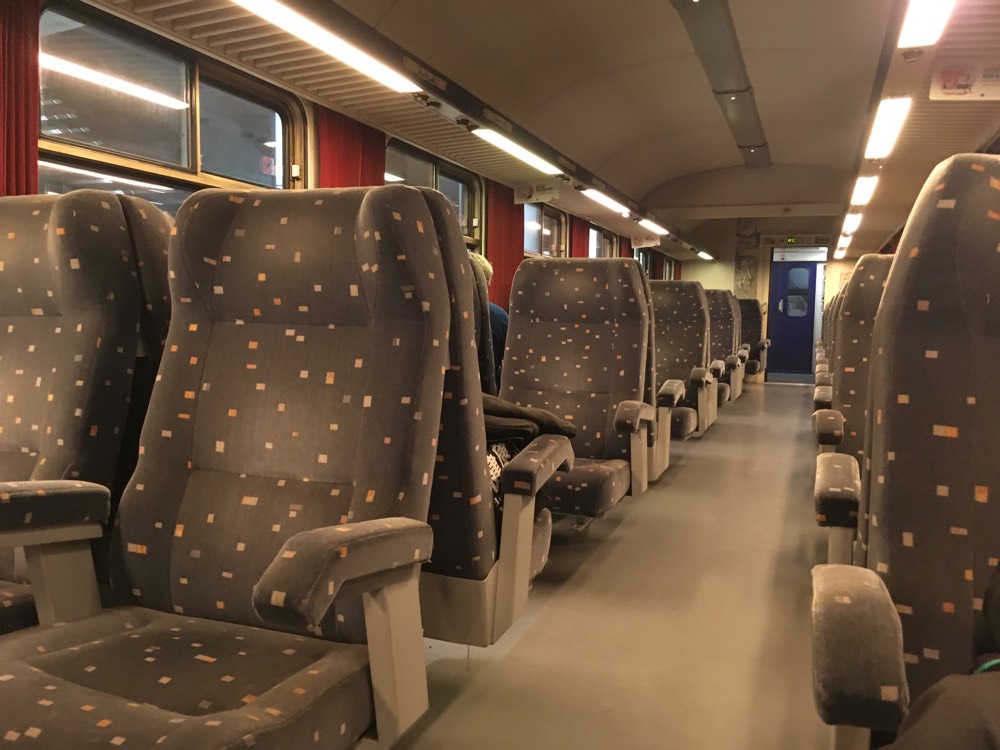
To operate its services, GoVolta has purchased thirteen I10 carriages from Belgian operator NMBS / SNCB. These approximately forty-year-old carriages were due to go out of service this year. Not all will be used. The standard composition is a locomotive, seven second-class (economy) carriages, one first-class (comfort) carriage, and a restaurant car. Maintenance is provided by Brouwer Technology. Seating is arranged with seats facing each other.

Baggage rules
A reserved seat is always guaranteed. Baggage rules, however, are stricter: two pieces of hand luggage are included, but large suitcases incur an extra fee. The company also introduces the XL Duo Seat, allowing passengers to book the opposite seat for extra space and a guaranteed forward-facing position.
Funding
The project encountered financial difficulties when Rabobank withdrew, leaving the venture on the brink of collapse. Eventually, GoVolta secured a strategic partnership with Keolis, a subsidiary of SNCF. Keolis provides traction in both the Netherlands and Germany, while GoVolta focuses on commercial activities and Brouwer Technology on maintenance.
Paris via Ghent
GoVolta has options for additional NMBS / SNCB carriages and is exploring a Paris in France expansion for 2027.
Proposed Dutch stops include Amsterdam, Haarlem, The Hague, Rotterdam, Lage Zwaluwe and Roosendaal, with Lage Zwaluwe chosen for its free parking.
In Belgium, GoVolta hopes to route services via Ghent. Cooperation with Keolis is expected to ease entry into the French market.
The former brand name GreenCityTrip will no longer be used and has been taken over by European Sleeper.
Yes, but…
Alongside the official announcements, independent railway commentator Jon Worth has raised several early observations about the project. He notes that GoVolta has attracted considerable attention but that even basic aspects, such as the company’s website, are currently problematic.
According to Worth, the site uses an unusual language setup in which travellers must switch to German to see German departures and to Dutch to see departures from the Netherlands. He also identifies puzzling elements in the published timetables.
For instance, the train appears to leave Berlin Gesundbrunnen at 15:46 and arrive in Hanover at 19:16, a journey time far longer than expected. When comparing the timings in both directions, he suspects that the routing may have been designed to avoid a reversal of direction around Berlin, but he characterises the arrangement as confusing.
Worth also notes irregularities in the Hamburg timings. In particular, the service will call at Hamburg Harburg rather than the main station, Hamburg Hbf. He points out that the difference between the eastbound and westbound travel times is roughly 45 minutes on the German section alone.
No air conditioning
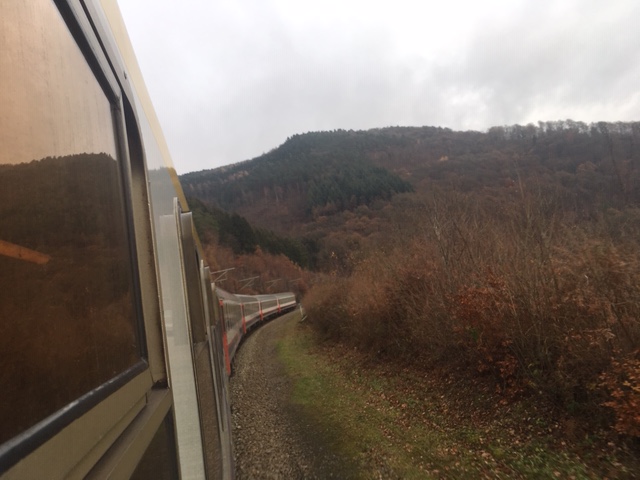
With regard to the rolling stock, Worth remarks that the I10 carriages being used have a maximum speed of 160 km/h and lack air conditioning, although refurbished versions capable of 200 km/h remain in service with NMBS / SNCB.
GoVolta will pair these carriages with a leased Siemens Vectron locomotive, a modern and reliable traction option.
Feasible but…
In summary, Worth suggests that the service is technically feasible but raises questions about its practicality.
The timetable may be workable but is far from ideal, the 1980s-style carriages will offer a retro experience, and operational reliability could be an issue given the challenges of running trains through Germany.
He also notes that while the cheapest fares are extremely low, prices rise steeply beyond the basic tier, making the business model difficult to interpret.
He argues that bundling train tickets with hotel packages might make more sense commercially, but the current state of the website makes it difficult to assess how robust or serious the overall proposition is.
With GoVolta preparing for launch, the service marks an ambitious new entry into the international rail market.
Yet, as Worth’s early comments suggest, the project will face scrutiny not only from established competitors but also from travellers and observers eager to see whether this combination of low fares, vintage rolling stock and complex timetables can deliver a consistent and appealing product.
More on night trains and transcontinental train travel
- Deutsche Bahn to offer a Cologne – Ostend / Bruges / Ghent – Cologne high-speed train connection in the summer of 2026?.
- Berlin-Hamburg-Stockholm night train saved by RDC Deutschland after Sweden stops subsidies.
- Rail should be functional, not fine art: EU leaders call for standardisation and lower costs.
- Subsidies for night trains? “You cannot fix this until someone builds more sleeper and couchette carriages”.
- European Sleeper to operate Paris – Brussels – Berlin night train route from March 2026.
- Leo Express and Arenaways plan direct train between Prague and Venice.
- Italo targets the German high-speed rail market.
- Trenitalia eyes expansion into Germany’s high-speed trains market.
- European Commission wants to link all EU capitals by high-speed train by 2040… and that’s not going to happen.
- Travellers in Europe increasingly open to choosing trains over planes for short-haul journeys.
- SBB CFF FFS announce night train to Malmö from April 2026.
- REVIEW | European Sleeper night train.
- Paris Nightjet axed: France’s withdrawal threatens Europe’s night train revival.
- TRAIN TRAVEL | European Union records 429 billion passenger-kilometres in 2023 but domestic travel still dominates.
- 2026 | Deutsche Bahn plans 4 ICE’s per day between Cologne and Antwerp and 16 per day between Frankfurt and Brussels.
- France opens rail network up for new domestic night train operator under new EU rules.
- Back-on-Track Europe warns the ‘night train revival’ is a false dawn.
- Iron Rhine gets renewed political attention in Belgium, the Netherlands and Germany.
- Leo Express: Bratislava – Ostend night train not a firm commitment.
- NMBS / SNCB sees popularity increase of international train travel.
- ÖBB prioritises Railjet over Nightjet: Is the night train revival a False Dawn?.
- Deutsche Bahn’s Antwerp – Brussels Airport – Leuven – Cologne ICE aims to attract tourists and Port of Antwerp-related business.
- VIDEO | Berlin start-up Nox to launch night trains with entirely private rooms from 2027.
- EUROPEAN SLEEPER | Brussels to Barcelona night train to stop in Avignon, Montpellier, Narbonne, and Girona.
- Trenitalia, Deutsche Bahn and ÖBB launch Frecciarossa EuroCity trains linking Berlin, Munich, Milan, Rome and Naples.
- The end of the Brussels – Berlin ÖBB Nightjet.
- European Commission commits to single-ticket train travel, Back-on-Track unconvinced it will happen.
- SNCF Réseau confirms feasibility European Sleeper night train linking the Netherlands, Belgium, France to Barcelona in Spain.
- EU train travel report sees increase in cross-border passenger trains and easier bookings.
- Brussels to Luxembourg by train under 2 hours by 2030?.
- Eurostar and five more train operators joined the European Agreement on Journey Continuation.
- ÖBB’s new Nightjet sleeper cars accommodate solo travellers with Mini Cabins.
- Trenitalia orders new Hitachi Frecciarossa trains suited for France, Belgium and the Netherlands.
- EUROCITY EC-8 | Basel to Cologne in SBB’s Panoramic Car.
- Trenitalia / FS confirms interest in connecting Spain to Brussels, Amsterdam and Berlin.
- REVIEW | Trenitalia Frecciarossa 1000 Paris – Milan in Business Executive.
- RAIL TOUR OF EUROPE | How easy is touring Europe by train?.
- Eight train connections between the Netherlands and Belgium by 2030?.
- REVIEW | ÖBB Nightjet Amsterdam – Zurich night train.
- Nightjet Vienna/Innsbruck to Brussels, or how we got thrown off the train in Aachen.
- Why the expensive ÖBB Nightjet is really not that expensive.
- Reliving the era of the great railway journeys, travelling overnight on Nightjet.
- How we plan a big rail trip.
- Ticket Distribution: the failure of railways to sell themselves.
- To use night trains in Portugal and Spain or not?.
- Night trains in Europe.
- Low-cost, long-haul trains to conquer Europe?.
- Fly now before it’s taxed and consider using the train instead.
Channel Tunnel updates
- #CROSSCHANNELRAIL | Expanding UK-Europe train links most realistically leading to Switzerland.
- Deutsche Bahn and Eurostar team up for Germany – London train link in early 2030s.
- CHANNEL TUNNEL | Virgin Trains gains access to Temple Mills, ORR snubs links to Germany and Switzerland.
- Eurostar unveils €2 billion Alstom ‘Celestia’ fleet of double-decker sustainable trains.
- Channel Tunnel competition plans hinge on depot access as Gemini Trains reveals Siemens–Uber partnership.
- Gemini Trains partners with Uber for Stratford to France Channel Tunnel route.
- CHANNEL TUNNEL | UK and Germany renew London-Berlin vows, Virgin Trains promise Alstom Avelia Stream train sets.
- 2025 | The Channel Tunnel prepares for more trains, more competition and new destinations.
- United Kingdom and Germany are aiming for a direct London – Berlin train link.
- Eurostar and St. Pancras Highspeed back major station expansion to double capacity amid growing international demand.
- EUROSTAR | London – Frankfurt, London – Geneva and Amsterdam – Antwerp – Brussels – Geneva from 2030?.
- Alstom wants its double-decker trains to ride through Channel Tunnel.
- CHANNEL TUNNEL | Uber Trains-branded Gemini Trains plan London-Brussels and London-Paris route via Stratford.
- London to Switzerland direct train moves a little closer with new bilateral agreement.
- Eurostar calls for UK national strategy and investment to shape future of Channel Tunnel Rail and promises 50 new trains.
- Ferrovie dello Stato Italiane (FS) plan to launch a new high-speed link between London and Paris.
- London St. Pancras Highspeed pledges financial support for cross-Channel rail services.
- Competition for Eurostar? Temple Mills International Depot has space for competitor’s trains.
- London St Pancras Highspeed and Getlink aspire to to triple train services to France, Belgium and the Netherlands and add services to Germany and Switzerland.
- Heuro wants to operate high speeds trains between Amsterdam, Antwerp, Brussels, Paris and London from 2028.
 Trip By Trip
7 Comments Add yours