
October 2022. As we wanted to test Trenitalia‘s Frecciarossa 1000 service from Paris to Milan, we planned a rail trip around it. From Antwerp to Paris with Thalys, the ‘Red Arrow’ to Milan and once in Italy continuing to Trieste and Bologna. The return trip took us to Basel in Switzerland to enjoy SBB‘s panoramic coach and Germany‘s Rhine route to Cologne. From there we got back to Belgium.
Bologna has many, many, many museums, bit it “cheats”, as many of these museums are actually rooms in one museum, the university museum called Musei di Palazzo Poggi or Poggi Palace Museums (in plural).
Palazzo Poggi was built during the 16th century on a design by Pellegrino Tibaldi, who was also the author of part of the frescoes in the interior. It stands in the true heart of the university area and was also, since 1803, the seat of the University. Inside the building there is the precious collection of the Institute of Sciences or Istituto delle Scienze, founded in 1711 by Luigi Ferdinando Marsili, consisting of a series of thematic rooms, the room dedicated to oriental art and the Carducci Hall.
List of museums (or rooms, actually)
The Collection of the Institute of Sciences or Collezione dell’Istituto di Scienze encompasses many museums.
The Museum of Ships and Ancient Geographical Maps or Museo delle navi e delle antiche carte geografiche displays the entire Chamber of Geography and Nautics of the Institute of Sciences, made up of precious naval models from the 17th and 18th centuries and contemporary geographical maps. The Institute brought together this elegant fleet of warships to study the advanced technology to which European nations entrusted their military and political fortunes, the security of trade and, therefore, the size of the State.


The Military Architecture Museum or Museo di architettura militare is dedicated to military and ballistic exercises and houses fortification schemes designed and built by the most eminent Italian, French and German engineers. The wooden panels, reproducing existing fortresses and strongholds or theoretical fortification systems, were an important tool for the study of town planning at the time. The second room houses models and artillery drawings, watercolour panels and paintings that illustrate the diplomatic activities of the Marsili.

The Human Anatomy Museum or Museo di anatomia umana houses the eighteenth-century anatomical waxes that belonged to the Institute of Sciences and that were added to the collection thanks to an idea by cardinal Prospero Lambertini, archbishop of Bologna, after seeing the first plates of the academic Clementine Ercole Lelli (1702-1766), passionate scholar of anatomy.
We confused this section with the Wax Museum or Collezione delle Cere Anatomiche “Luigi Cattaneo”, which something else, somewhere else.


The Giovan Antonio Obstetric Museum or Museo ostetrico “Giova Antonio Galli” is made up of anatomical wax plates, clay models and surgical instruments and was designed by the Bolognese doctor Giovan Antonio Galli (1708-1782). His purpose was to close the existing gap in the field of obstetrics between scientific knowledge and practical knowledge: doctors and surgeons held the theoretical knowledge, while midwives, who were often poorly educated, assisted women in labour with the help of experience alone.
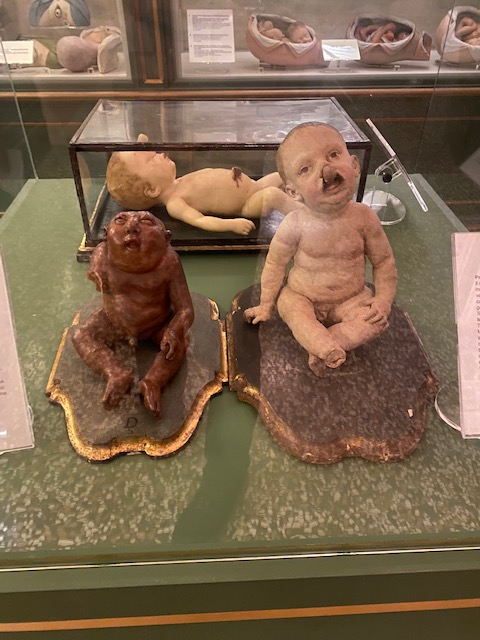

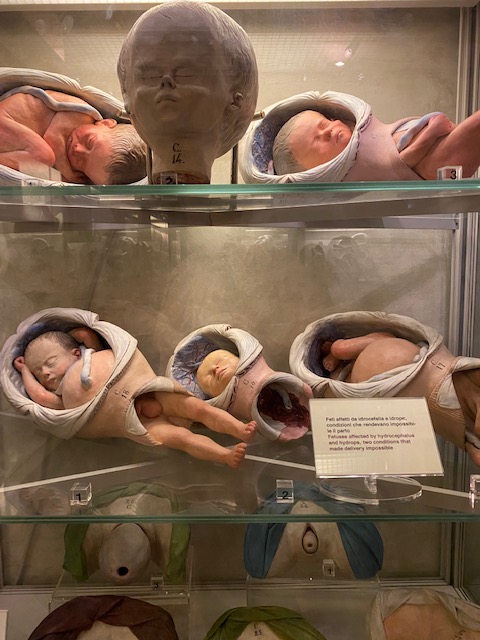

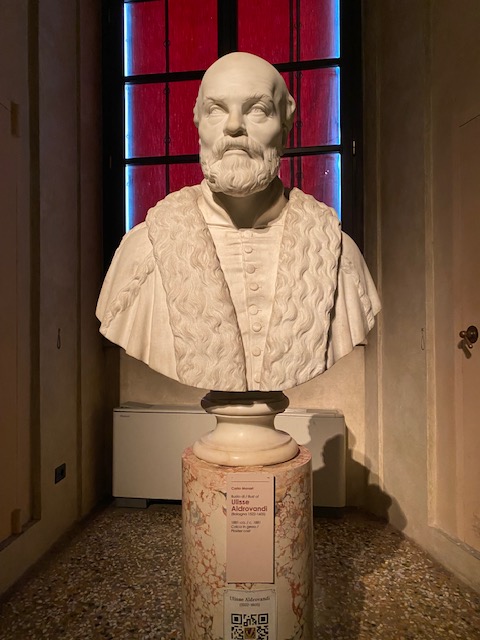
The Natural History Museum or Museo di storia naturale. In the 18th century these rooms were one of the most exciting wonders visible in Palazzo Poggi, consisting of the aggregation of various collections, including the Ulisse Aldrovandiana and Cospiana collections. The various materials that make up the museum concern geology, mineralogy, paleontology, botany, zoology and comparative anatomy.
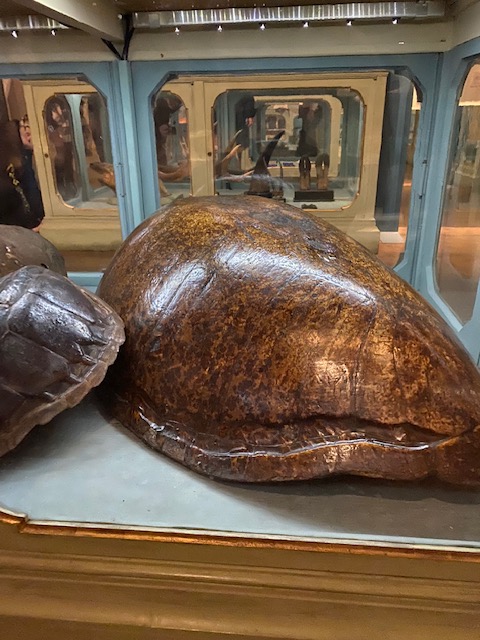
The Physics Museum or Museo di fisica. The fame of the Institute of Sciences was largely linked to the abundance and modernity of the equipment with which the physics rooms were equipped. Over the course of the century, new materials were added to the first donation of Marsili, made up of useful tools for the study of physical phenomena related to astronomy and biology, thanks above all to the intervention of Pope Benedict XIV and, later, of Cardinal Gioannetti.
The Museum of the Specola or Museo della specola is housed in the rooms, that in the ancient Specola, were dedicated to astronomical observation. The first two rooms display the instruments used by the astronomers of the Institute from 1704 to the early 19th century. In the Globes Room (Sala dei Globi) you can admire, among others, the Blaeu globes and an armillary sphere of D. Lusverg, donated by Pope Benedict XIV. Room dedicated to oriental art The works in this room come from two Bolognese collections: the woodcuts of the Fondazione del Monte di Bologna e Ravenna and those of the Centre for Far Eastern Art Studies.
The Collection of Japanese woodcuts of the Fondazione del Monte di Bologna e Ravenna. A collection of over 500 Japanese woodcut prints by some of the major Japanese artists of the 19th century, such as Hiroshige, Kunisada and Kuniyoshi. Of extraordinary interest are also the luxurious theatrical prints of Osaka. The Collection of the Centre for Far Eastern Art Studies currently consists of 160 woodcut prints and Japanese illustrated books, a collection of over 170 objects of different materials and 34 Chinese and Japanese paintings.
The Carducci Hall or Aula Carducci. The chair of Italian literature at the Studium in Bologna was assigned to Giosuè Carducci in 1860. The poet held his lessons in the hall named after him, which has now been restored.



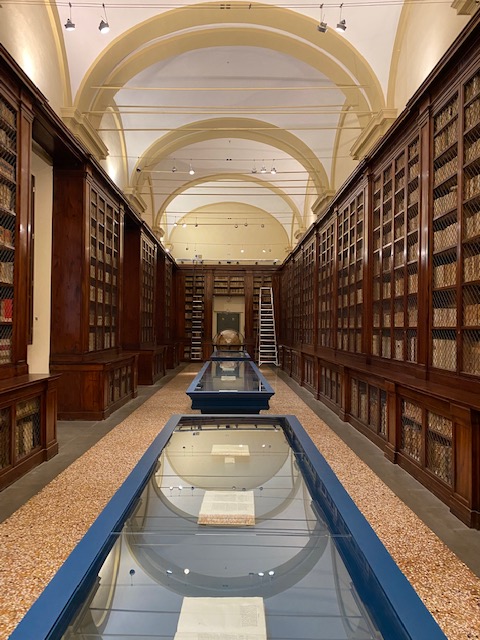
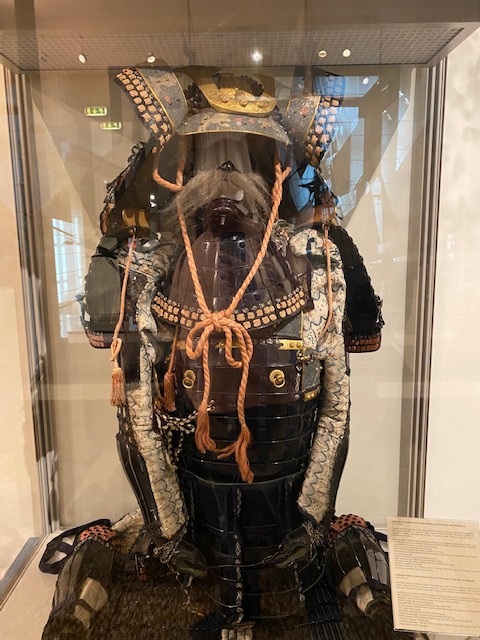
A visit
Each section is not huge, but there’s quite a lot to see. There are few explanations. Allow some two hours. Certainly the Obstetrics section is impressive.
Paris – Italy – Basel 2022
- REVIEW | Restaurant Le Train Blue at Paris-Gare-de-Lyon.
- REVIEW | Trenitalia Frecciarossa 1000 Paris – Milan in Business Executive.
- REVIEW | Just Hotel Milano.
- FYRA NOSTALGIA | Trenitalia Frecciargento Milan to Trieste on the ETR 700 ex-Fyra.
- REVIEW | Grand Hotel Duchi d’Aosta.
- TRIESTE | Miramare Castle.
- History of Trieste at Diego de Henriquez War for Peace Museum / Museo de la Guerra per Pace.
- ITALY | 1.5 day in Trieste.
- EMILIA-ROMAGNA | Sights and churches in Bologna.
- History of Bologna Museum at Palazzo Pepoli.
- REVIEW | The Social Hub Bologna.
 Trip By Trip
This such an site we visited Bologna. I really love these images. You visited these Museums and so amazing. Anita
LikeLiked by 1 person
Yes. And so many to see!
LikeLike
Awesome Bologna Museum!
Thank’s for share Timothy.
Have a nice day.
LikeLiked by 1 person
You’re welcome, Elvira. Have a lovely day.
LikeLiked by 1 person
Always a pleasure Timothy.
You as well have a lovely day.
LikeLiked by 1 person
What an interesting and eclectic mix of artifacts. The anatomy ones are fascinating. Maggie
LikeLiked by 1 person
They really are are the highlight!
LikeLike
Beautiful pictures, my experiences was a lot shorter, I landed at Bologna airport but destination was Carpi/Modena and on way back too tired to go on so skip sadly. Cheers
LikeLiked by 1 person
Thank you.
Capri is on my wish list. We went to Modena as well. That’s a story for the next two weeks 😉
LikeLiked by 1 person
I meant Carpi a town near Modena and 2 hrs from Bologna. My base for several years on business.
LikeLiked by 1 person
Ah 😉
LikeLiked by 1 person