
March 2025. We’re embarking on a train trip to Sicily. We fly from Brussels Airport to Leonardo da Vinci Rome Fiumicino Airport with ITA Airways. Then we take an Intercity Notte sleeper train by Trenitalia from Roma Termini Railway Station across Italy to Syracuse. Yes, the train is loaded on a ferry to cross the Strait of Messina. After visiting Syracuse, Catania and Palermo, we return to Rome, and home. With 25,832 km², Sicily is only 20% smaller than Belgium (30,689 km²). Quite a lot in four days.
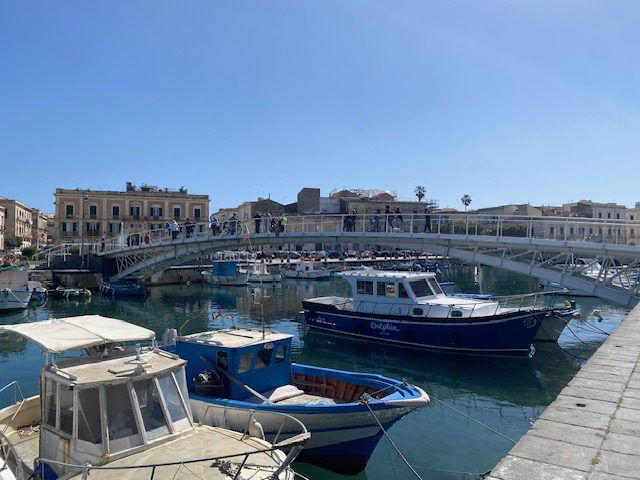
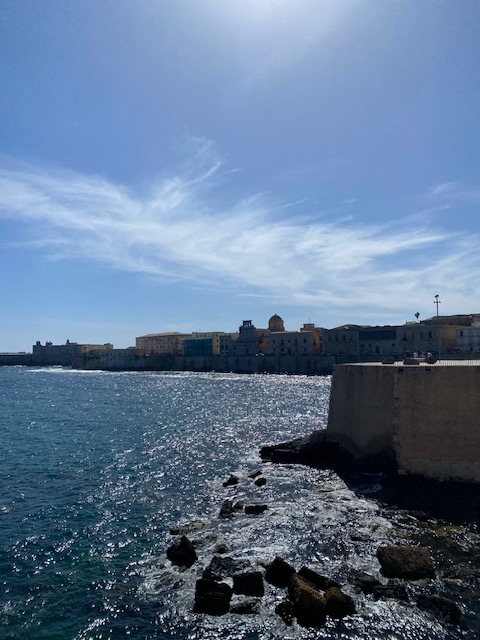
After the Neapolis Archaeological Park, we walked to Ortygia, an island linked to ‘mainland Sicily’ by two bridges. Ortygia and Sicily are only separated bu perhaps thirty meters of water.
Ortygia, known in Italian as Ortigia, is a small island forming the historical heart of Syracuse. Also called the Città Vecchia (Old City), it is one of the most atmospheric and culturally rich areas in the region, home to a wealth of landmarks, legends, and lived-in charm. The name derives from the Ancient Greek órtyx (ὄρτυξ), meaning ‘quail’, a nod to the island’s deep mythological roots.


When the animals still spoke and the gods lived on Earth
Myths and ancient stories are woven into Ortygia’s identity. According to the Homeric ‘Hymn to Delian Apollo‘, the goddess Leto stopped at Ortygia to give birth to Artemis, who then helped her mother reach Delos to deliver her twin, Apollo.
Other ancient sources suggest the twins were born in the same place—either Delos or Ortygia—though some identified Ortygia as an earlier name for Delos. The island is also connected with the myth of Asteria, Leto’s sister, who was said to have transformed into a quail and leapt into the sea, becoming the island itself.
In another tale, Eos, goddess of the dawn, abducted the hunter Orion to Ortygia, where he joined Artemis’s retinue and was later slain by her under conflicting accounts of jealousy, defiance, or attempted assault.

One of Ortygia’s most enduring legends is that of Arethusa, a nymph who fled the river god Alpheus. Artemis transformed her into a freshwater spring that emerged on the island as the famed Fountain of Arethusa, a tranquil spot still flowing today and surrounded by papyrus plants. This mythological link between Greece and Sicily reflects the island’s ancient Greek heritage, which remains visible throughout.
Historically, Ortygia was a strategic natural fortress, with harbours and enough land to support a significant population. As a result, its early history is closely tied to that of Syracuse itself.
Today, it is connected to the mainland by two bridges and retains its role as a central and vibrant part of the city, combining residential life with tourism, dining, and culture.



On offer
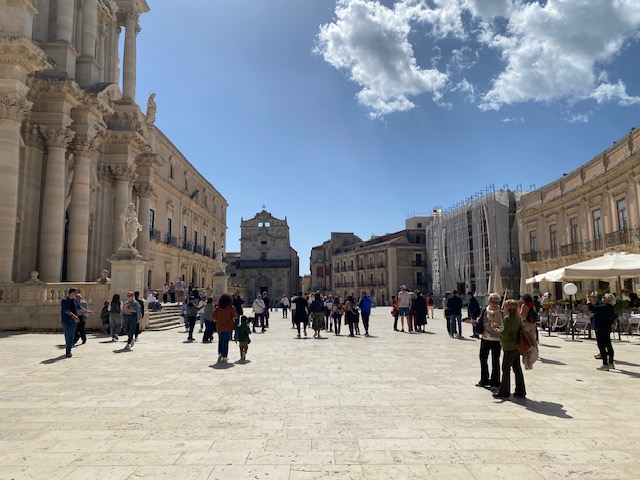
Walking through Ortygia is like stepping into a living museum. At its heart lies Piazza Duomo, an elegant square lined with Baroque palazzi and the Cathedral of Syracuse.
The cathedral is built over the ruins of a 5th-century BC Temple of Athena, and inside, visitors can still see the original Doric columns integrated into the structure. This layering of Greek, Norman, and Baroque elements captures the island’s unique character.






Fountain of Arethusa
Nearby, the Fountain of Arethusa offers a quiet view over the sea, its spring fed by underground sources and framed by papyrus reeds.

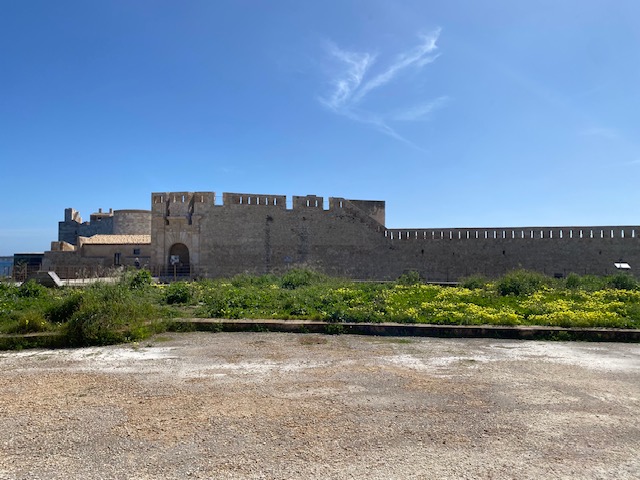
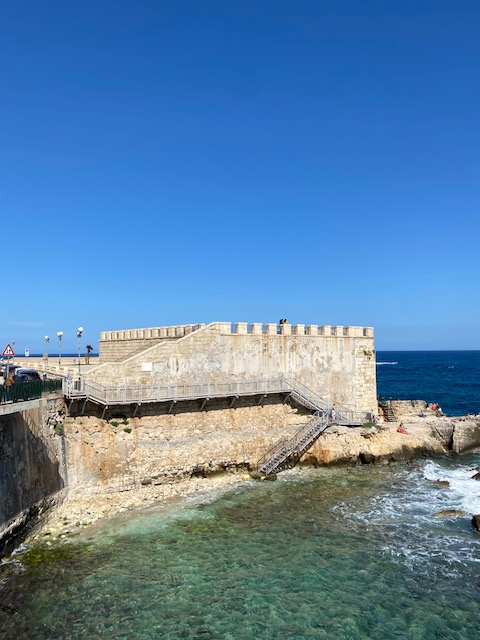
At the southern tip of the island stands the 13th-century Castello Maniace, a fortress constructed under Emperor Frederick II, offering panoramic views and a glimpse into the island’s medieval past.


Apollo
On the opposite end, near the entrance to the island, are the ruins of the Temple of Apollo—one of the oldest Greek temples in Sicily—marking Ortygia’s ancient origins.
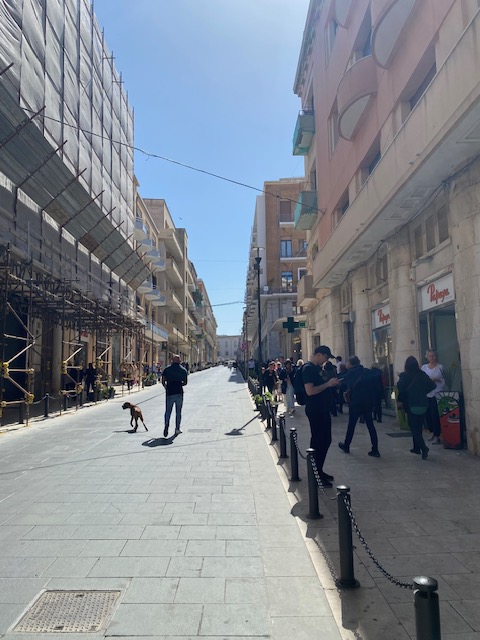
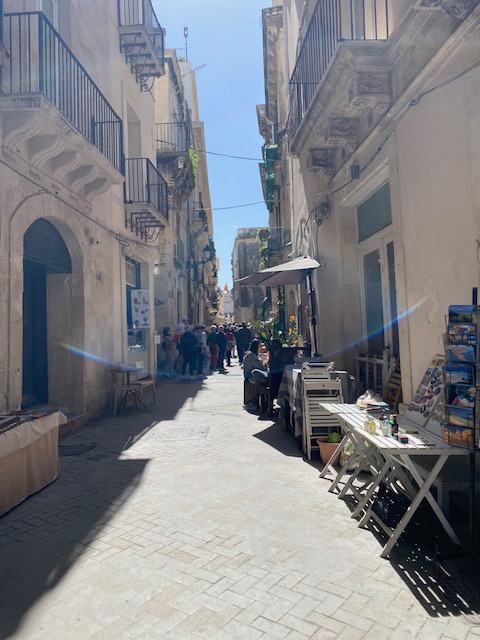
In between these landmarks lies a maze of narrow streets and hidden courtyards. Wandering them is an experience in itself, with limestone buildings glowing gold in the sunlight, wrought-iron balconies draped with laundry, and small chapels tucked between homes.
The former Jewish quarter, Giudecca, still contains remnants of its past, including a medieval mikveh, or ritual bath, preserved beneath a boutique hotel and accessible by guided tour.
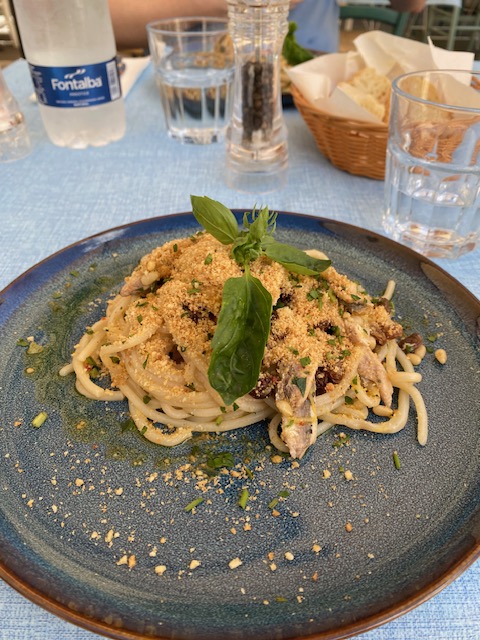
The local market, held daily near the Temple of Apollo, adds another layer to the island’s appeal. It brims with Sicilian produce, cheeses, seafood, spices, and street food favourites such as arancini and panelle.
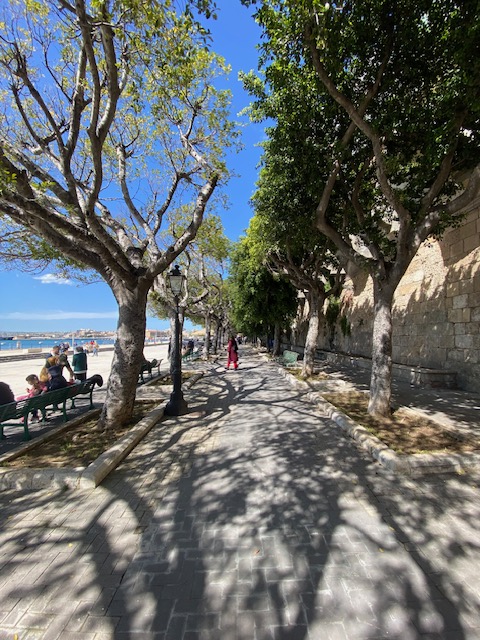
Ortygia also offers many seafront promenades, the Lungomare di Levante and Lungomare di Ponente, ideal for leisurely walks, especially at sunset. Lungomare literally means ‘by the sea’ (‘le long de la mer‘).
Scattered throughout the island are artisan workshops and small galleries showcasing ceramics, contemporary art, and traditional crafts.


Igor Mitoraj
While we were there, there was a retrospective exhibition of Igor Mitoraj. His works were – and are until 26 October 2025 – installed around Ortygia and the Neapolis Archeological Park.
Igor Mitoraj (26 March 1944 – 6 October 2014), born Jerzy Manika, was a Polish artist and monumental sculptor. He was known for his fragmented sculptures of the human body, often produced as large-scale installations in public spaces. His work has been exhibited internationally, primarily across Europe.
Mitoraj was born on 26 March 1944 in Oederan in Germany. His mother, Zofia Manika, was a Polish forced labourer, and his father, a French Foreign Legion officer of Polish descent, was being held as a prisoner of war. The relationship between his parents was brief, and after the end of World War II, he returned with his mother to Poland.
He spent his early years in the village of Grojec, where he lived with his grandparents. When his mother later married Czesław Mitoraj, both she and her son took on the family name.
The surname, in Polish, combines the words for ‘myth’ and ‘paradise’. Later in life, after moving to France, he changed his forename from Jerzy (George) to Igor.
Mitoraj completed his secondary education at an art school in Bielsko-Biała, and in 1963, he enrolled at the Kraków Academy of Art, where he studied painting under Tadeusz Kantor.
During his time as a student, he participated in several group exhibitions and held his first solo exhibition in 1967 at the Krzysztofory Gallery in Kraków. Although it is uncertain whether he graduated, in 1968—despite the travel restrictions imposed by the Communist regime—he moved to Paris.
This move was partly motivated by a desire to find his biological father, whom he never met, and to continue his art studies at the École Supérieure des Beaux-Arts.
In the early 1970s, Mitoraj developed an interest in Aztec art and culture. He spent a year in Mexico, travelling and painting, and this experience led him to pursue sculpture. He returned to Paris in 1974 and held a solo exhibition at the La Hune gallery in 1976, where he presented his first sculptural work. The exhibition’s success encouraged him to focus fully on sculpture.
Initially working with terracotta and bronze, a visit to Carrara in 1979 inspired Mitoraj to adopt marble as his principal medium. In 1983, he established a studio in Pietrasanta, near Carrara. In 2006, he was commissioned to design new bronze doors and a statue of John the Baptist for the basilica of Santa Maria degli Angeli in Rome.
In 2003, Mitoraj returned to Poland. He received the Gold Medal for Merit to Culture – Gloria Artis in 2005, and in 2012 was awarded the Commander’s Cross of the Order of Polonia Restituta. He died in a Paris hospital in 2014 and was buried in Pietrasanta, where he had maintained his studio for many years.
In 2016, Mitoraj’s works were exhibited in Pompeii. Italy’s culture minister, Stefano Contini, announced that the sculpture ‘Daedalus‘ would remain in Pompeii permanently as a gift to the country.
Mitoraj’s sculptural style drew on classical traditions, with a focus on the idealised human torso.
However, he introduced a post-modern element by deliberately truncating limbs, evoking the damaged state of many ancient classical sculptures. His work explores the beauty and vulnerability of the human body, the experience of suffering, and broader themes of human nature and its decline over time.
Some critics have described his style as bordering on kitsch.


So?
Ortygia is the Mediterranean in a nutshell. It reminded me of Rhodes in Greece, Valletta in Malta or Palma de Mallorca in Spain. Eclectic architecture, beige and marble colours, narrow streets. Definitely worth your time.
We missed out on Castello Maniace. It was closed when we wanted to visit.
 Trip By Trip
16 Comments Add yours