
A new independent analysis has laid out the most comprehensive roadmap yet for expanding direct high-speed rail services between London in the United Kingdom and mainland Europe. The #CrossChannelRail Final Report, published on 17 November 2025, is the result of an unusually detailed investigation that included visits to sixty-three stations across the continent, technical assessments of multiple train types, and conversations with railway operators, infrastructure managers and policymakers.
The report is the work of independent railway commentator Jon Worth. Born in the UK, holding also a German passport and primarily living in Burgundy, France; Worth visited many stations, and talked to people. His work is crowd funded.
His conclusions challenge many long-held assumptions about the limitations of the Channel Tunnel and identify a realistic set of new destinations where direct services from London could be introduced in the coming years.
Which trains?
At the centre of the report is a clear-eyed analysis of which modern high-speed trains are actually capable of running through the Channel Tunnel. The study confirms that several 200-metre train sets already in service or on order in Europe could, in principle, be approved for cross-Channel operation.
Siemens’s Velaro D (Class 407) and the newer ICE 3neo (Class 408) both meet the broad technical parameters required for long undersea tunnels.
Hitachi’s ETR1000 / Frecciarossa 1000, which has already demonstrated high performance across multiple signalling systems, is also a viable candidate.
Alstom offers two models of interest: the distributed-traction Avelia Stream, which has strong compatibility with the Channel Tunnel’s evacuation rules, and the forthcoming double-deck Avelia Horizon (Eurostar’s TGV-M). Although the Horizon is technically advanced, its door placement complicates evacuation when two units are coupled—an arrangement necessary to form a 400-metre train.
The report stresses that this does not rule out double-deck stock but does mean that the approval process may be more complex, and that distributed-traction single-deck trains such as the ICE 3neo, Velaro D, Avelia Stream or ETR1000 present a more straightforward path to authorisation.
Crucially, the study finds no fundamental technical barrier that would prevent new operators from deploying suitable trains in the next decade. Availability of rolling stock is no longer the primary constraint on expanding services from London.
Operators
Trenitalia, operator of the ETR1000, has the necessary technology and international operating experience, but its long-term interest in the London market remains uncertain. It may choose to focus on strengthening its existing European corridors rather than pursuing the costly and politically sensitive Channel Tunnel approvals process.
Gemini Trains, despite ambitious public claims, appears unlikely to enter the market without a clear path to fleet acquisition or depot access.
Evolyn, another proposed entrant, has yet to present a coherent strategy or credible timeline and is judged improbable as a serious contender.
In contrast, the Swiss Federal Railways (SBB CFF FFS) is actively assessing the feasibility of a London–Switzerland connection, backed by the political framework already agreed between Bern and London. Deutsche Bahn, once vocal about entering the London market, is considered unlikely to revive its earlier ambitions in the short or medium term.
Virgin Trains gained access to the Temple Mills depot, and they order Alstom train sets.
Passport control and stations
Instead, the most serious obstacles lie in the stations themselves. The United Kingdom’s border model—requiring security screening and pre-departure passport checks for passengers boarding London-bound international trains – forces every station on a potential route to provide secure, segregated access.
This means controlled entrances, dedicated departure platforms, passport booths and space for security equipment, all arranged so that no unchecked passenger can reach the train. The report’s station-by-station evaluation shows that while many European cities appear ideal on a map, their stations cannot meet these requirements without major rebuilding.
The core network – London St. Pancras, Paris-North, Brussels-Midi/Zuid and Lille-Europe – remains functional for international use, although St. Pancras is approaching its limits. Its international terminal can reliably process only two full-length trains per hour at busy periods, leaving little room for expansion.
Reopening Ashford International and Ebbsfleet International could ease pressure on St. Pancras and restore flexibility to the network, but the cost of staffing border and security operations at these stations remains unresolved. Without clarity on funding responsibilities, no operator is willing to commit to using them.
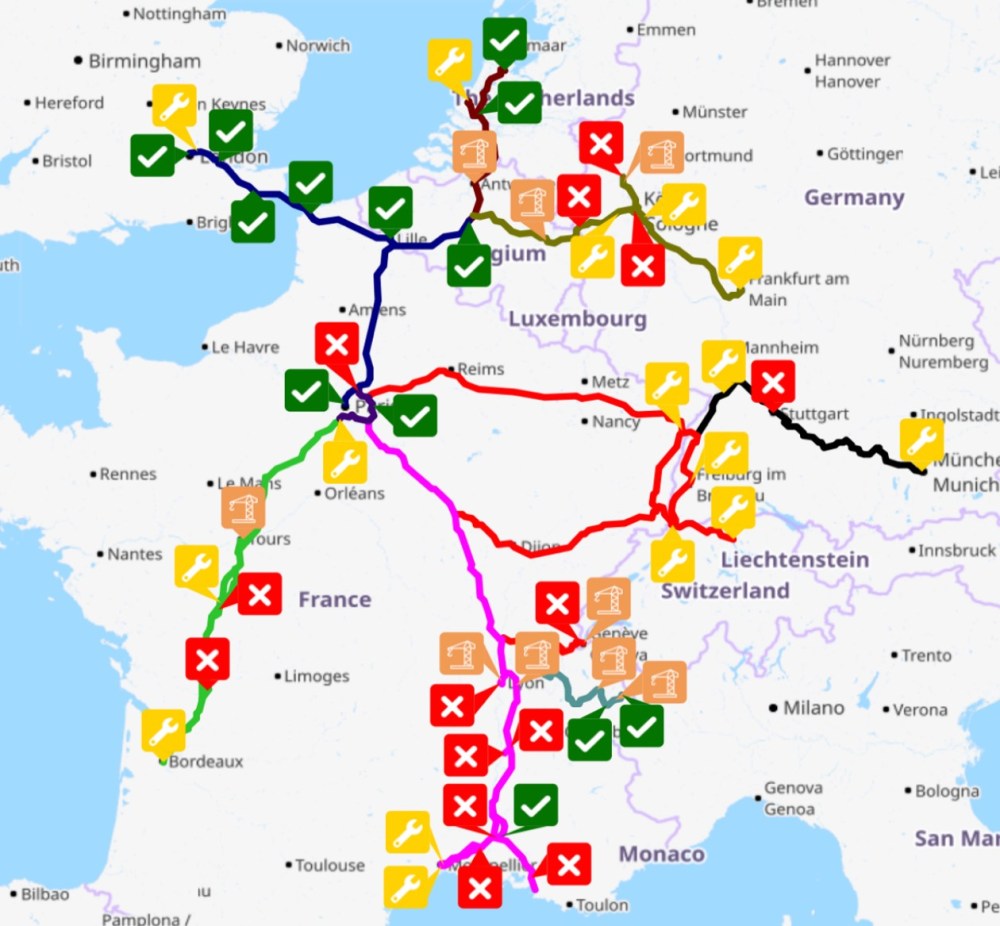
New destinations
Beyond the existing routes, the report identifies Western Germany and Switzerland as the most viable corridors for new services.
In Germany, Frankfurt am Main Main Station could be candidate. Frankfurt has platforms able to accommodate four-hundred-metre trains or two coupled 200-metre units, and possesses station layouts that can be adapted to secure-area requirements with building work.
Cologne Main Station wouldn’t work – there’s no space – but Cologne Bonn Airport Station and Horrem could.
The geometry of the lines into both cities is compatible with high-speed services, and cross-border operations via Belgium are technically straightforward.
Stuttgart Main Station is impossible but Munich Main Station, could serve as a stop. But Munich is far away from London. Another option is Karlsruhe.
Switzerland
Switzerland also emerges as a strong candidate for direct London services. Basel SBB is described as one of the easiest continental stations to adapt for UK-bound international departures.
Its platforms are wide, modern and flexible, and the station’s layout naturally lends itself to the creation of a dedicated secure zone.
Zurich Main Station, despite being one of Europe’s busiest hubs, offers similar potential, with several platform areas that could feasibly be converted for international use.
Switzerland’s political environment strengthens the case further: a UK–Swiss cooperation agreement signed in 2025 established a joint working group specifically to explore the reintroduction of cross-border long-distance rail links via the Channel Tunnel.
A parallel process has since started with Germany. Direct trains to Switzerland would eliminate the need for passengers to change trains across Paris—a journey widely regarded as one of Europe’s most inconvenient long-distance transfers.
France
The picture in France is far more complex. Although Paris and Lille function well as international terminals, many of France’s regional stations are fundamentally incompatible with Channel Tunnel requirements.
Lyon Part-Dieu, frequently cited as a desirable target for direct London trains, is so physically constrained that creating a secure boarding area would require complete reconfiguration of the station.
Marseille St. Charles, with its historic layout and complicated passenger flows, faces similar obstacles. High-speed stations such as Avignon TGV and Montpellier South of France, while seemingly ideal on paper, lack the platform geometry and terminal-side access needed for segregated boarding.
Even in cases where parts of the station are spacious, the lack of enclosed, easily controlled space makes compliance extremely difficult.
The report notes that while Bordeaux St. John could technically be adapted, the stations further along the route – Poitiers, Angoulême, Tours – prove so problematic that running international trains via these corridors becomes commercially unattractive.
The Alps
The French Alps present even greater challenges. Stations such as Chambéry, Annecy and Grenoble lack both platform length and the physical space needed for secure entrances. Their constrained sites, surrounded by dense urban fabric or mountainous terrain, make major reconstruction unlikely. The report therefore considers direct London–Alps services essentially unfeasible for the foreseeable future.
Netherlands
In the Netherlands, the situation is simpler but no more encouraging. Amsterdam and Rotterdam already host Eurostar services, but other Dutch stations lack the space or infrastructure to handle UK border processes.
Without large-scale redevelopment, the report judges that expansion in the Netherlands is effectively capped.
Narrowing it down
These findings narrow the realistic set of new destinations to a small, strategically significant group: Cologne, Frankfurt, Basel and Zurich. All four cities have stations that can be adapted, lie on high-speed routes compatible with long-distance international operation, and are supported by political interest in cross-border connectivity.
The report argues that if operators deploy appropriate trains—such as the ICE 3neo, Velaro D, Avelia Stream or ETR1000—services to these cities could begin once terminal capacity and border-staffing questions are resolved.
In summary, the #CrossChannelRail Final Report overturns the idea that technical or engineering limits prevent London from gaining new direct links to mainland Europe.
Modern train types exist, signalling compatibility is manageable, and the Channel Tunnel’s safety rules are no longer the primary sticking point. Instead, the real barriers are architectural, bureaucratic and political.
With relatively modest investment and government cooperation, London could soon see trains running directly to Germany and Switzerland, opening up a new era of cross-European mobility.
Other destinations remain theoretically attractive but practically impossible until major station reconstruction takes place. The next decade of cross-Channel rail will therefore be shaped not by what is technologically possible, but by what stations can realistically host the border controls required for a London-bound train.
Who is John Worth?
John Worth has spent more than a decade trying to make all his business travel by train. Working independently with clients across Europe has meant complex routes and frequent frustrations, which led him from 2021 onward to focus seriously on European Union railway policy. He questioned why cross-border problems persist and what he could do to help fix them.
He launched the Trains for Europe campaign to address the shortage of night trains and the rolling-stock issues behind it. In 2022 he completed #CrossBorderRail, crossing every internal EU border reachable by train; the project has continued in various forms, joined in 2025 by #CrossChannelRail on the Channel Tunnel.
John’s transport commentary appears on this site, separate from his earlier political communication work. He is not a railway insider—his background is in EU political communication—but he relies on rail to live sustainably and always writes from a passenger’s perspective. His articles focus on improving European railways, especially cross-border travel, and are designed for informed travellers rather than technical specialists.
His work is independent and crowdfunded; he has no employment in the transport sector. He is a member of Bündnis 90/Die Grünen without any transport policy role.
Channel Tunnel updates
- CHANNEL TUNNEL | Virgin Trains gains access to Temple Mills, ORR snubs links to Germany and Switzerland.
- Eurostar unveils €2 billion Alstom ‘Celestia’ fleet of double-decker sustainable trains.
- Channel Tunnel competition plans hinge on depot access as Gemini Trains reveals Siemens–Uber partnership.
- Gemini Trains partners with Uber for Stratford to France Channel Tunnel route.
- CHANNEL TUNNEL | UK and Germany renew London-Berlin vows, Virgin Trains promise Alstom Avelia Stream train sets.
- 2025 | The Channel Tunnel prepares for more trains, more competition and new destinations.
- United Kingdom and Germany are aiming for a direct London – Berlin train link.
- Eurostar and St. Pancras Highspeed back major station expansion to double capacity amid growing international demand.
- EUROSTAR | London – Frankfurt, London – Geneva and Amsterdam – Antwerp – Brussels – Geneva from 2030?.
- Alstom wants its double-decker trains to ride through Channel Tunnel.
- CHANNEL TUNNEL | Uber Trains-branded Gemini Trains plan London-Brussels and London-Paris route via Stratford.
- London to Switzerland direct train moves a little closer with new bilateral agreement.
- Eurostar calls for UK national strategy and investment to shape future of Channel Tunnel Rail and promises 50 new trains.
- Ferrovie dello Stato Italiane (FS) plan to launch a new high-speed link between London and Paris.
- London St. Pancras Highspeed pledges financial support for cross-Channel rail services.
- Competition for Eurostar? Temple Mills International Depot has space for competitor’s trains.
- London St Pancras Highspeed and Getlink aspire to to triple train services to France, Belgium and the Netherlands and add services to Germany and Switzerland.
- Heuro wants to operate high speeds trains between Amsterdam, Antwerp, Brussels, Paris and London from 2028.
More on night trains and transcontinental train travel
- Rail should be functional, not fine art: EU leaders call for standardisation and lower costs.
- Subsidies for night trains? “You cannot fix this until someone builds more sleeper and couchette carriages”.
- European Sleeper to operate Paris – Brussels – Berlin night train route from March 2026.
- Leo Express and Arenaways plan direct train between Prague and Venice.
- Italo targets the German high-speed rail market.
- Trenitalia eyes expansion into Germany’s high-speed trains market.
- European Commission wants to link all EU capitals by high-speed train by 2040… and that’s not going to happen.
- Travellers in Europe increasingly open to choosing trains over planes for short-haul journeys.
- SBB CFF FFS announce night train to Malmö from April 2026.
- REVIEW | European Sleeper night train.
- Paris Nightjet axed: France’s withdrawal threatens Europe’s night train revival.
- TRAIN TRAVEL | European Union records 429 billion passenger-kilometres in 2023 but domestic travel still dominates.
- 2026 | Deutsche Bahn plans 4 ICE’s per day between Cologne and Antwerp and 16 per day between Frankfurt and Brussels.
- France opens rail network up for new domestic night train operator under new EU rules.
- Back-on-Track Europe warns the ‘night train revival’ is a false dawn.
- Iron Rhine gets renewed political attention in Belgium, the Netherlands and Germany.
- Spain’s Renfe sends Talgo VI rolling stock to Leo Express in Czechia and Slovakia.
- Leo Express: Bratislava – Ostend night train not a firm commitment.
- NMBS / SNCB sees popularity increase of international train travel.
- ÖBB prioritises Railjet over Nightjet: Is the night train revival a False Dawn?.
- Deutsche Bahn’s Antwerp – Brussels Airport – Leuven – Cologne ICE aims to attract tourists and Port of Antwerp-related business.
- VIDEO | Berlin start-up Nox to launch night trains with entirely private rooms from 2027.
- EUROPEAN SLEEPER | Brussels to Barcelona night train to stop in Avignon, Montpellier, Narbonne, and Girona.
- Trenitalia, Deutsche Bahn and ÖBB launch Frecciarossa EuroCity trains linking Berlin, Munich, Milan, Rome and Naples.
- The end of the Brussels – Berlin ÖBB Nightjet.
- Dutch budget train GoVolta postponed after not getting funds.
- Eurostar scraps direct Amsterdam – Brussels – Marseille summer train service.
- European Commission commits to single-ticket train travel, Back-on-Track unconvinced it will happen.
- Switzerland, Czechia and Belgium top railway network density in Europe.
- SNCF Réseau confirms feasibility European Sleeper night train linking the Netherlands, Belgium, France to Barcelona in Spain.
- European Sleeper night train service from the Netherlands and Belgium to Barcelona now delayed to 2027.
- EU train travel report sees increase in cross-border passenger trains and easier bookings.
- Brussels to Luxembourg by train under 2 hours by 2030?.
- Eurostar and five more train operators joined the European Agreement on Journey Continuation.
- ÖBB’s new Nightjet sleeper cars accommodate solo travellers with Mini Cabins.
- Trenitalia orders new Hitachi Frecciarossa trains suited for France, Belgium and the Netherlands.
- EUROCITY EC-8 | Basel to Cologne in SBB’s Panoramic Car.
- Trenitalia / FS confirms interest in connecting Spain to Brussels, Amsterdam and Berlin.
- Sampling NS’ new train and future Benelux rolling stock ICNG.
- REVIEW | Trenitalia Frecciarossa 1000 Paris – Milan in Business Executive.
- RAIL TOUR OF EUROPE | How easy is touring Europe by train?.
- Eight train connections between the Netherlands and Belgium by 2030?.
- REVIEW | ÖBB Nightjet Amsterdam – Zurich night train.
- Nightjet Vienna/Innsbruck to Brussels, or how we got thrown off the train in Aachen.
- Why the expensive ÖBB Nightjet is really not that expensive.
- Reliving the era of the great railway journeys, travelling overnight on Nightjet.
- How we plan a big rail trip.
- Ticket Distribution: the failure of railways to sell themselves.
- To use night trains in Portugal and Spain or not?.
- Night trains in Europe.
- Low-cost, long-haul trains to conquer Europe?.
- Fly now before it’s taxed and consider using the train instead.
 Trip By Trip
14 Comments Add yours