
July 2024. Steve and I are cruising on the Norwegian Getaway, a Breakaway class ship by Norwegian Cruise Line or NCL. Interestingly, our stay on board happened shortly after the Getaway paid a visit to the dry dock for some refurbishments. The route? Piraeus, which is the port of Athens in Greece; followed by Mykonos; two days in Istanbul in Turkey or Türkiye; then Kusadasi or Kuşadası for Ephesus; Rhodes; Santorini (Thira or Thera) and back to Piraeus. Oddly enough, the itinerary offered no sea days.
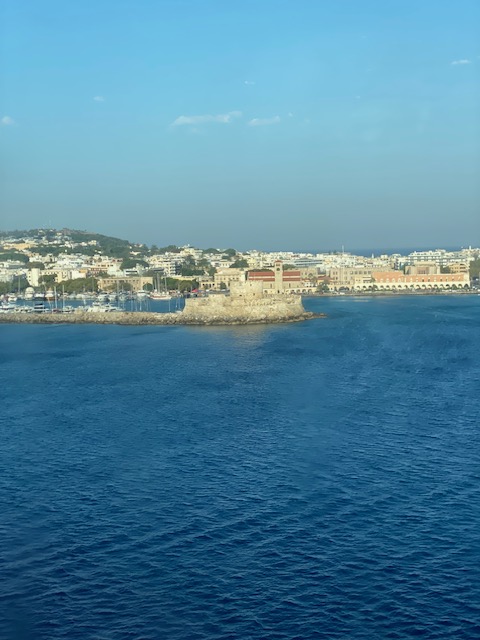
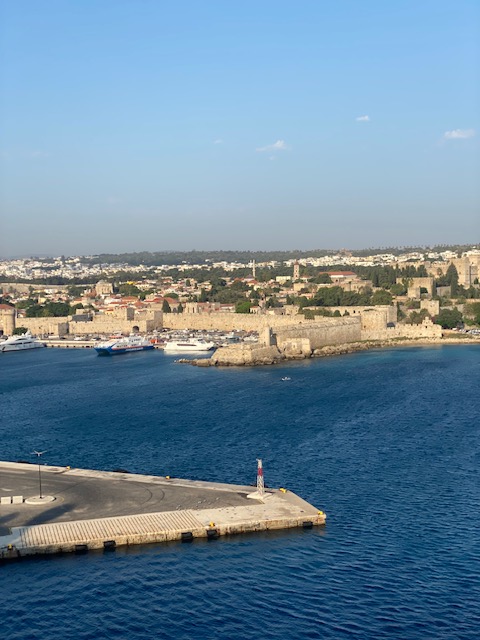
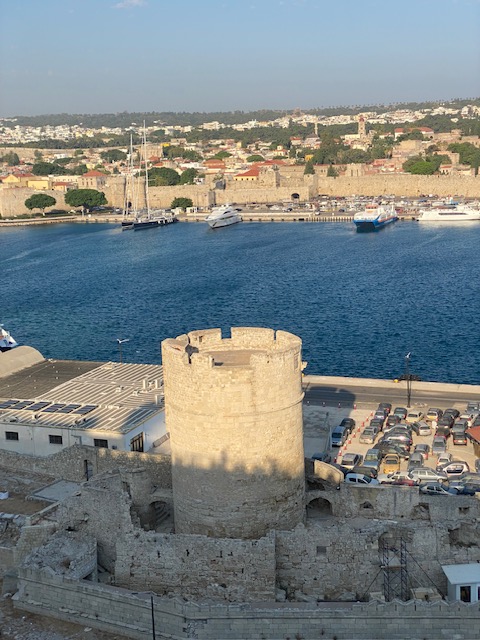
Scorching heat or not, we wanted to at least have taste of Rhodes Old Town. When the Norwegian Getaway sailed into port, it had struck us how atypical The city of Rhodes looked.
Rhodes as an island
Rhodes (Greek: Ρόδος, romanized Ródos), the largest of Greece’s Dodecanese islands (Δωδεκάνησα means Twelve Islands, but the archipelago counts more islands), holds the distinction of being its historical capital.
The island’s principal town and administrative center is Rhodes city, home to over 50,000 inhabitants in 2011. The island’s total population in 2022 was approximately 125,000. Located northeast of Crete and southeast of Athens, Rhodes is often referred to as the ‘Island of the Sun‘, due to its association with the sun god Helios, or ‘The Pearl Island‘. Its moniker ‘The Island of the Knights‘ stems from the rule of the Knights of Saint John from 1310 to 1522.
Historically renowned for the Colossus of Rhodes, one of the Seven Wonders of the Ancient World, the island’s Medieval Old Town is a UNESCO World Heritage Site. Today, Rhodes stands as one of Europe‘s most popular tourist destinations.

Early history
The island’s story starts with the arrival of the Minoans in the 16th century BC. Greek mythology weaves a tale of the Telchines, a Rhodian race associated with Danaus, lending the island the epithet ‘Telchinis’.
The 15th century BC witnessed the Mycenaean Greek invasion. Following the Bronze Age collapse, Cyprus became Rhodes’ primary external contact. Legend claims Rhodian participation in the Trojan War under Tlepolemus‘ leadership.
The 8th century BC marked the emergence of the Dorian city-states of Lindus, Ialysus, and Camirus. These, along with Kos, Cnidus, and Halicarnassus, formed the Dorian Hexapolis.
Pindar‘s mythos links the island’s birth to Helios, the sun god, and the nymph Rhodos, with their sons inspiring the cities’ names. Diodorus Siculus adds a layer to the myth, recounting Actis, Helios and Rhode’s son, as the founder of Heliopolis in Egypt and the architect of Egyptian astrology.
The latter half of the 8th century BC saw the sanctuary of Athena adorned with votive offerings, reflecting cultural exchange with the Asia Minor and Syria.
Kameiros, an earlier Bronze Age site, exhibited a contemporaneous sequence of carved ivory figurines. The cemeteries of Kameiros and Ialyssos yielded exquisite examples of Orientalizing Rhodian jewelry, dating from the 7th and early 6th centuries BC.


Classical Rhodes
The Persian invasion of Rhodes in the 5th century BC was met with Athenian resistance, resulting in Persian defeat. Rhodes subsequently joined the Athenian League. While remaining a league member during the Peloponnesian War (431-404 BC), Rhodes ultimately opted for neutrality.
Rhodes’ strategic position as the eastern gateway to the Aegean Sea made it a pivotal trade hub. Phoenician merchants established prosperous colonies within its Greek cities. In 408 BC, the island’s cities united, forming a single territory with Rhodes as its new capital. Athenian architect Hippodamus is credited with designing the city’s grid-like layout.
The island’s independence was short-lived, as it fell under the dominion of King Mausolus of Caria in 357 BC, followed by a brief Persian occupation in 340 BC.

Hellenistic and Romand Rhodes
Rhodes fell under Alexander the Great‘s dominion in 332 BC following his Persian conquest. Upon Alexander’s death, his generals, the Diadochi, divided his empire. Rhodes forged strong commercial and cultural ties with Ptolemy‘s Egypt, forming the Rhodo-Egyptian alliance that dominated Aegean trade in the 3rd century BC.
The city blossomed into a maritime, commercial, and cultural center, with its coinage circulating widely in the Mediterranean. Renowned for its schools of philosophy, science, literature, and rhetoric, Rhodes rivaled Alexandria in intellectual pursuits. Its sculptors, influenced by Pergamon, developed a dramatic style later exemplified in the Laocoön group.
Antigonus‘ son, Demetrius, besieged Rhodes in 305 BC to break its Egyptian alliance. Despite colossal siege engines, he retreated after a year, leaving behind valuable equipment. The Rhodians used the proceeds to construct the Colossus of Rhodes, a statue honoring their sun god, Helios.
Throughout the 3rd century BC, Rhodes prioritized independence and commercial dominance, particularly in the grain trade. Balancing relations between the Antigonids, Seleucids, and Ptolemies was crucial. Rhodes possessed a formidable navy, manned by skilled sailors, as a tool of leverage. The city also extended its influence to the Caria coast, known as the Rhodian Peraia.
This delicate balancing act continued until the late 3rd century BC when the weakening Ptolemaic power tempted Seleucid ambitions. A coalition led by Rhodes checked Philip V of Macedon‘s naval power but was overwhelmed by his superior army. Turning to Rome, Rhodes joined a coalition that defeated the Seleucids in the Roman-Seleucid War (192-188 BC). Rewarded with territory and enhanced status, Rhodes remained under Roman influence.
However, Rhodes’ neutrality during the Third Macedonian War (171-168 BC) strained Roman relations. Despite avoiding war, Rhodes’ status was reduced to a “permanent ally” of Rome, essentially a veiled loss of independence. The island later became a cultural hub for Roman elites, yet its once-privileged status eroded due to political machinations.
By the 1st century AD, Rhodes had become a favored exile destination for Romans, including Emperor Tiberius. The island’s association with Paul the Apostle and the establishment of early Christianity further enriched its historical tapestry.
Byzantine Rhodes
With the Roman Empire‘s division in 395 AD, Rhodes entered a prolonged Byzantine era. The island served as the capital of the Islands province, encompassing most of the Aegean archipelago. Its strategic location made it a vital trading port between Constantinople and Alexandria.
Rhodes played a pivotal role in maritime law, contributing to the ‘Rhodian Sea Law‘ that influenced Mediterranean maritime practices for centuries. The island endured invasions by the Sassanian Persians in 622-623 AD and the Arabs in 654 and 673 AD, though Byzantine rule was reestablished on both occasions.
The 8th to 12th centuries saw Rhodes as part of the Cibyrrhaeot Theme, a Byzantine administrative district. Shipbuilding and commerce thrived during this period. Brief Seljuk Turkish occupation in the 11th century was reversed by Emperor Alexios I Komnenos during the First Crusade.
As the Byzantine Empire weakened in the 13th century, Rhodes experienced periods of local rule under the Gabalas family and occupation by Genoa. Ultimately, the island returned to Byzantine control before its final chapter under Byzantine rule began.
Knights Hospitaller
The Byzantine era on Rhodes concluded in 1306 with the island’s occupation by the Knights Hospitaller, also known as the Knights of St. John. These crusader knights had previously been based in the Holy Land but relocated to Cyprus following its fall. Rhodes became their new stronghold.
Under Hospitaller rule, Rhodes flourished. The knights transformed the island into a formidable fortress, building a complex of defensive walls and towers. Their architectural legacy is evident in the medieval city of Rhodes, a UNESCO World Heritage Site.
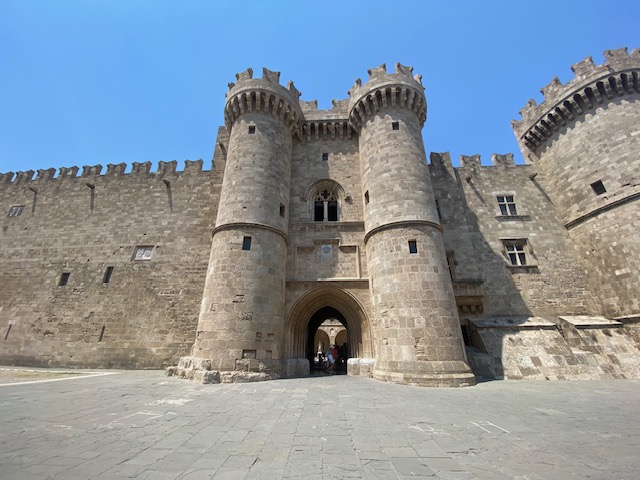
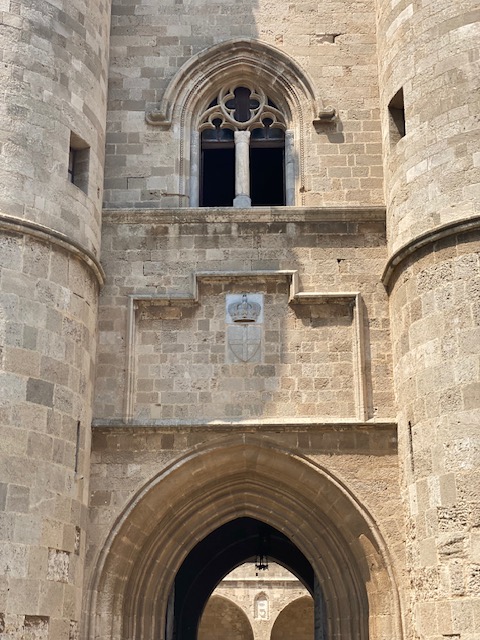
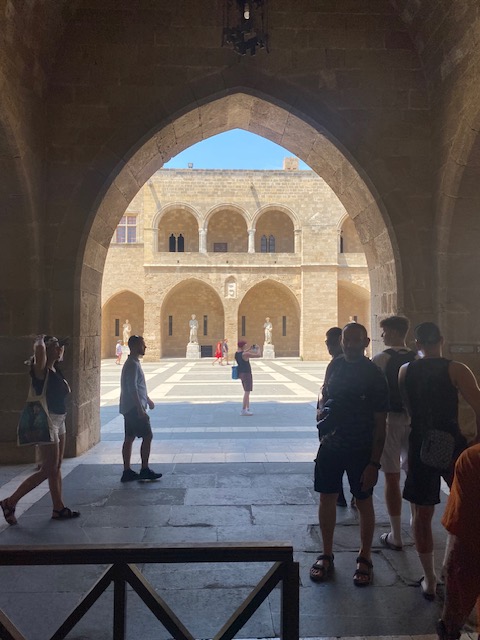
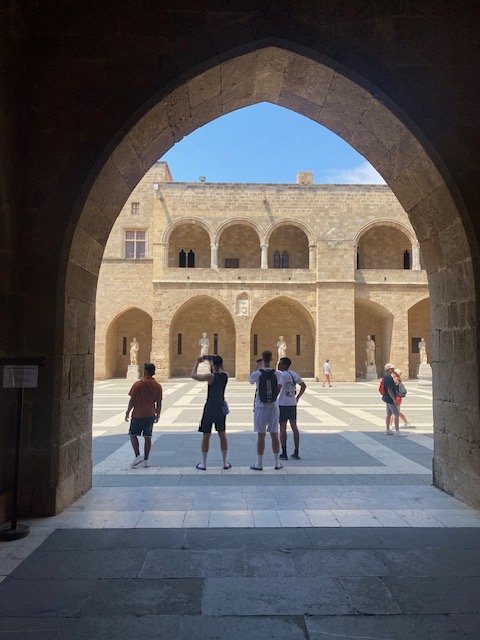
The Palace of the Grand Master, a masterpiece of Gothic architecture, stands as a testament to their power and influence.
The Knights of Rhodes were not only warriors but also administrators, diplomats, and patrons of the arts. They established a stable and prosperous society on the island, promoting trade and commerce. However, their strategic position in the eastern Mediterranean Sea made them constant targets for the Ottoman Empire.
Despite numerous attacks, the Knights successfully defended Rhodes until 1522, when they were finally defeated by the formidable Ottoman forces led by Suleiman the Magnificent. The fall of Rhodes marked the end of a chapter in the island’s history and the beginning of a new era under Ottoman rule.



Ottoman rule
The Ottoman conquest of Rhodes in 1522 marked a significant turning point in the island’s history. Under the rule of Suleiman the Magnificent, the Knights Hospitaller were defeated after a grueling six-month siege. The fall of Rhodes solidified Ottoman dominance in the eastern Mediterranean.
Initially, Rhodes was granted a degree of autonomy, but by 1546, it was incorporated into the Ottoman administrative structure as the Sanjak of Rhodes. While the island retained some economic importance, its strategic significance diminished as the Ottoman Empire expanded.
The Ottoman period brought a blend of cultures to Rhodes. The city’s medieval architecture was adapted to suit Ottoman tastes, with the addition of mosques, baths, and other Islamic structures. The island’s population became increasingly diverse, with Turks, Greeks, and Armenians coexisting.
Despite facing challenges such as piracy and economic fluctuations, Rhodes gradually recovered during the 18th century. The island benefited from increased trade and a growing agricultural sector. However, the island’s status as a peripheral province within the vast Ottoman Empire limited its development.
The late 19th century witnessed a resurgence of Greek nationalism, which had a profound impact on Rhodes. The island’s Greek population began to agitate for union with Greece. This growing sentiment, coupled with the decline of the Ottoman Empire, set the stage for the island’s eventual liberation.

Italian occupation of Rhodes
The Italian occupation of Rhodes marked a significant turning point in the island’s history. In 1912, during the Italo-Turkish War, Italy seized Rhodes and the other Dodecanese islands from the Ottoman Empire. The Treaty of Ouchy in 1912 and the Treaty of Lausanne in 1923 officially assigned these islands to Italy.
The Italian period brought substantial changes to Rhodes. The Italians invested heavily in infrastructure, developing the island’s economy and improving living conditions. They restored many historical sites, including the Palace of the Grand Master, and introduced modern urban planning concepts.
However, the Italian occupation was also marked by a strong emphasis on Italianization. The government encouraged Italian immigration and promoted the Italian language and culture. While this led to some tensions with the Greek majority, it also contributed to a period of relative stability and economic growth.
Rhodes played a crucial role during World War II. The island was heavily fortified by the Italians and later became a battleground between Italian and British forces. The Dodecanese Campaign of 1943 saw fierce fighting, ultimately resulting in the island’s occupation by the British.
The Italian legacy on Rhodes is still evident today in the island’s architecture, infrastructure, and some cultural aspects. While the occupation was a complex period with both positive and negative impacts, it undeniably shaped the island’s trajectory into the modern era.
British occupation and reunification with Greece
Following the Italian surrender in 1943, the British launched the Dodecanese Campaign in an attempt to seize control of the islands, including Rhodes. However, the Germans, anticipating this move, swiftly occupied the islands, including Rhodes, in September 1943.
The British occupation of Rhodes didn’t occur until the end of World War II, on 8 May 1945, when the German forces surrendered. The British military administration took control of the island and the other Dodecanese islands.
The British period was relatively short-lived. The Greek population on Rhodes, like the rest of the Dodecanese, had long yearned for unification with Greece. The British, recognizing this aspiration and the strategic importance of maintaining good relations with Greece, supported the idea of reunification.
In February 1947, the Treaty of Paris formally assigned the Dodecanese islands, including Rhodes, to Greece. This marked the end of a long and complex history for the island, culminating in its reunification with its cultural and historical homeland.
The integration of Rhodes into Greece brought significant changes. The island became an integral part of the Greek state, sharing its political, economic, and social systems. While the transition had its challenges, it also opened up new opportunities for Rhodes and its people.
Part of Greece
The reunification of Rhodes with Greece in 1947 marked a new chapter in the island’s history. The integration process was gradual but ultimately successful. The island benefited from investments in infrastructure, education, and healthcare, aligning with the broader development goals of Greece.
Tourism, which had begun to flourish under Italian rule, experienced a significant boom following reunification. Rhodes’ rich history, stunning beaches, and warm climate made it an increasingly popular destination for international visitors. The island’s economy became heavily reliant on tourism, leading to the development of hotels, resorts, and related services.
While tourism remains the backbone of Rhodes’ economy, efforts have been made to diversify the island’s economic base. Agriculture, particularly olive oil production, continues to be important. Additionally, there has been growth in sectors such as yachting, conferences, and renewable energy.
Rhodes has also experienced significant urban development. The island’s capital, Rhodes City, has expanded, and new residential areas have emerged. Efforts to preserve the island’s historical heritage have been balanced with the demands of modern life.
Today, Rhodes is a thriving Greek island, blending its rich history with contemporary amenities. It remains a popular tourist destination while also striving for sustainable development and economic diversification.




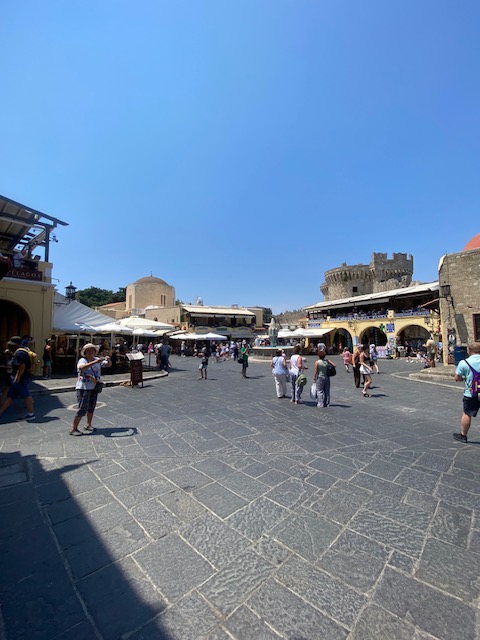
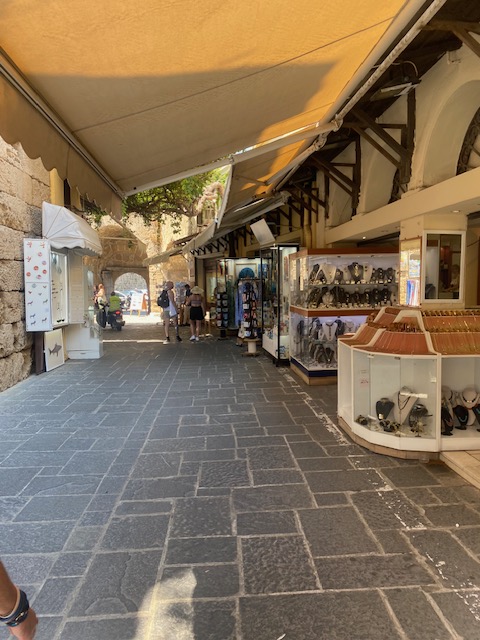


Rhodes Old Town
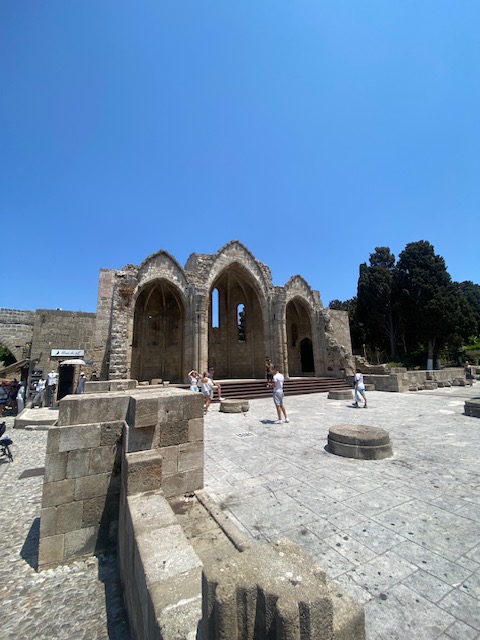
Rhodes Old Town is a UNESCO World Heritage Site and a prime example of medieval architecture, vibrant life, and historical treasures.
At the heart of the Old Town stands the Palace of the Grand Master. Once the residence of the Grand Master of the Knights, it now houses a museum showcasing the island’s history.
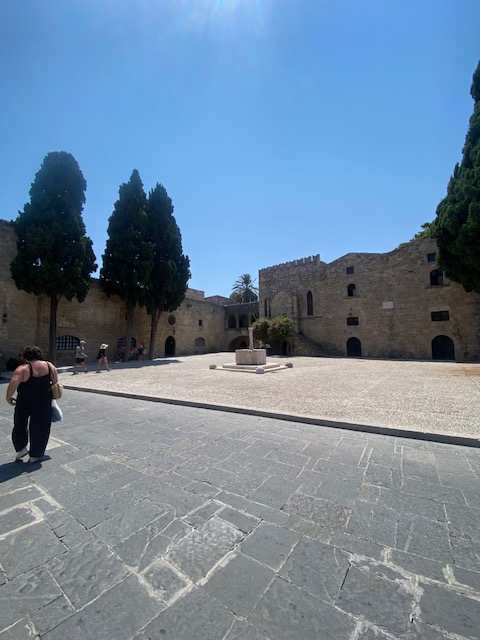
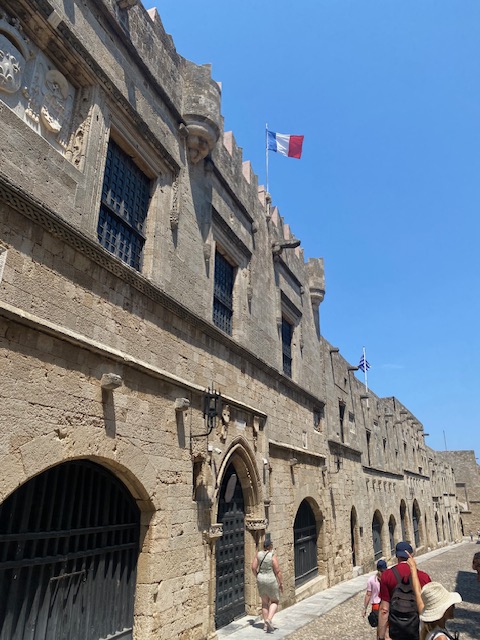
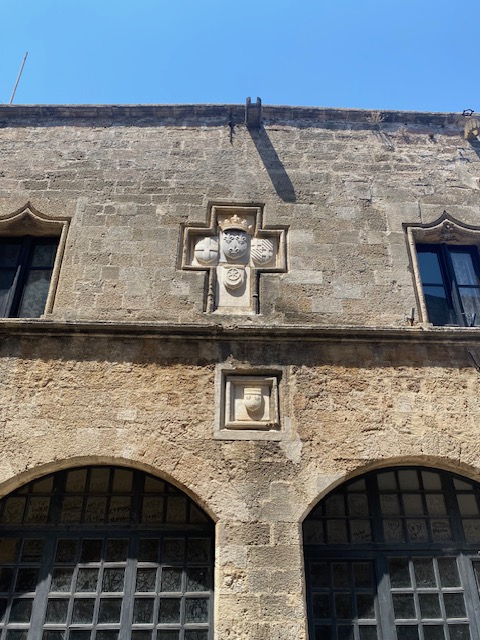
The Street of the Knights (Οδός Ιπποτών) is mentioned in all guidebooks. Lined with historic buildings, including the Hospital of the Knights (now the Archaeological Museum), this street evokes the ambiance of medieval times.
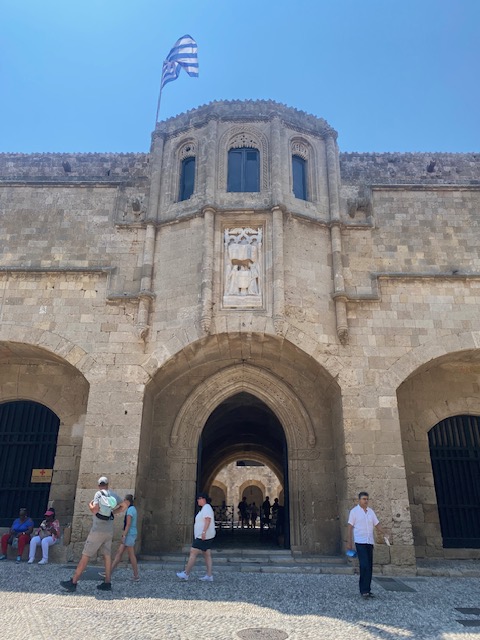

The Street of the Knights
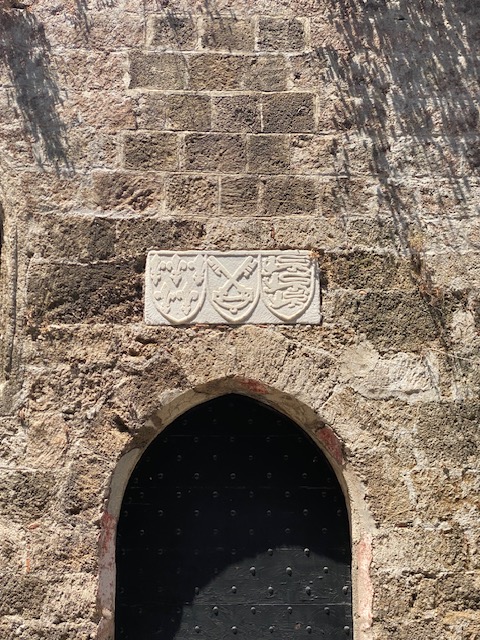
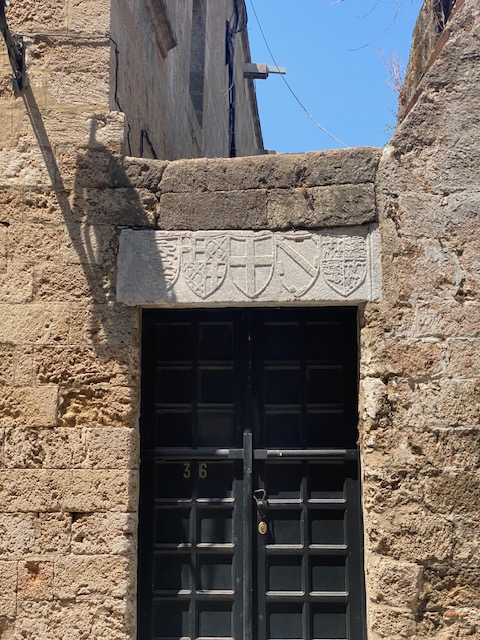
Once an artery connecting the city to the acropolis, the street now offers a captivating journey through time. Its imposing stone buildings, once the inns of the various knightly orders, stand as silent sentinels of the past. Each inn represented a different European nation, from England to Provence, and bore the distinctive architectural style of its homeland.
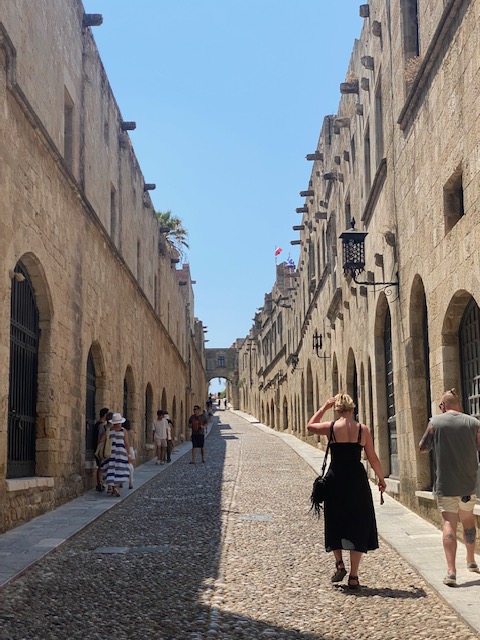



And further…
Beyond the main attractions, the Old Town invites exploration. Wander through the narrow, winding streets, discovering hidden squares, charming shops, and traditional tavernas. The Jewish Quarter, with its rich history, is a lesser-known gem.
For panoramic views, climb the Clock Tower, offering a bird’s-eye perspective of the city and the harbor. You can visit the Mosque of Suleiman the Magnificent or the Ottoman Library.
Whether you’re a history enthusiast, a shopaholic, or simply seeking a leisurely stroll, Rhodes Old Town offers something for everyone. Its timeless charm and rich heritage make it an unforgettable destination.
So?
We just had a stroll in the Old Town. We did not visit the Palace of the Grand Master. Perhaps while on a future cruise.
Rhodes Old Town reminds me of Valletta on Malta, of Dubrovnik in Croatia, of Palma de Mallorca in Spain, on Perpignan and Carcassonne in France. Mediterranean medieval towns.
2024 Athens – Mykonos – Istanbul – Kusadasi – Rhodes – Santorini – Athens Cruise on the Norwegian Getaway
- Flying Airbus A320neo with Aegean Airlines from Brussels to Athens return.
- REVIEW | Athenarum Portus Life & Style Hotel in Piraeus.
- GREECE | A modest exploration of Piraeus.
- NORWEGIAN CRUISE LINE | Before you sail, online check-in and Embarkation Day.
- GREECE | Mykonos ft Archaeological Museum, the Windmills and massive crowds.
- NORWEGIAN GETAWAY | Balcony Stateroom with included access to the Thermal Spa.
- ISTANBUL | Beylerbeyi Palace – Blue Mosque – Grand Bazaar.
- NORWEGIAN GETAWAY | Activities – sports – entertainment – common areas.
- ISTANBUL | Galataport – Sirkeci Railway Station – Hagia Sophia – Topkapi Park.
- Bars & Lounges on Norwegian Getaway.
- Ephesus.
- Restaurants and food on Norwegian Getaway.
- RHODES | Lindos and its acropolis.
 Trip By Trip
They have had their fair share on conquerors in Rhodes. It looks fabulous and is on my list 😊 Maggie
LikeLiked by 1 person
It’s very touristy, but also worth a visit.
LikeLiked by 1 person