
We haven’t travelled to the Grand Duchy of Luxembourg since 2018 and 2019, but in January 2025 we returned to get a taste of the Alstom Coradia Stream HC which the Société Nationale des Chemins de Fer Luxembourgeois (CFL) runs under the name Série 2400. The Coradia Stream HC was a candidate to become NMBS /SNCB‘s AM30, until it was (all but) decided Construcciones y Auxiliar de Ferrocarriles (CAF) from Spain would adapt its CAF Civity Duo. Although that decision is being challenged. While in the grand duchy, we also visited Schengen and Diekirch. 2025 is big year for the country, as on 3 October, Grand Duke Henri (Henry) will abdicate in favour of his son, Guillaume, who will become Grand Duke Guillaume V (or William V).
After arriving at Luxembourg Railway Station in Luxembourg City, we immediately took a bus to Schengen. You know Schengen because of terms such Schengen Treaty, Schengen Agreement, Schengen Zone or Schengen Area.
Well, Schengen is firstly a town in Luxembourg.


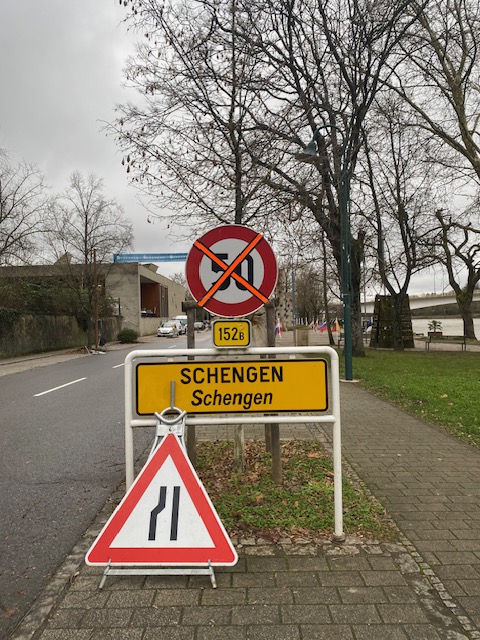

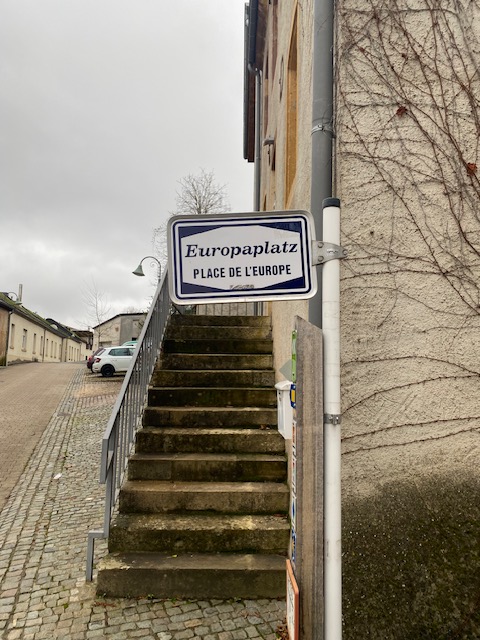
What is Schengen?
Schengen is located in the canton of Remich. Situated in the southeast of Luxembourg, Schengen lies at the tri-border area where Luxembourg meets Germany with the state of Saarland and France with the cultural and historical region of Lorraine in the administrative region of Grand Est.
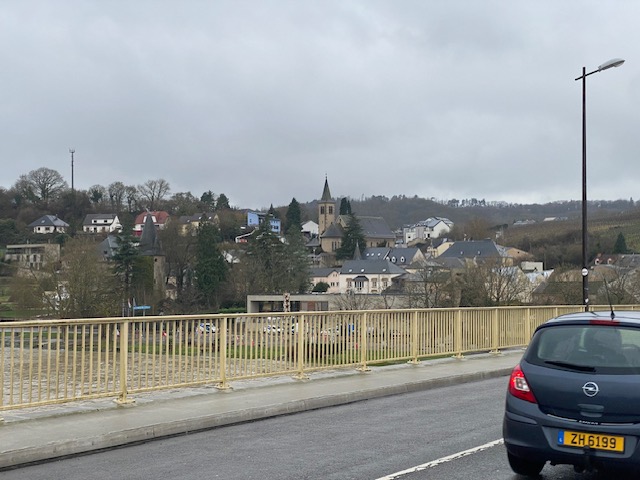
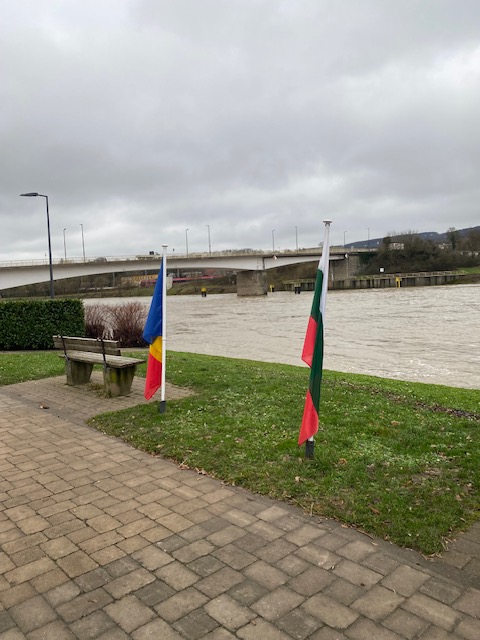
Across the Moselle River, the German municipality of Perl can be reached via the historic Moselle Bridge, with the French municipality of Apach located to the south. To the north of the bridge, the Schengen Viaduct serves as a motorway connection between Luxembourg and Germany.
The municipality includes several localities: Bech-Kleinmacher, Bürmeringen, Elvingen, Emeringen, Remerschen, Schengen, Schwebsingen, Wellenstein, and Wintringen. The town hall is located in Remerschen.

Wine
The village of Schengen itself is a small wine-producing community along the Moselle River. Historically, it served as the principal town of the municipality, which was previously named Remerschen.
On 3 September 2006, the municipality was renamed Schengen in recognition of the globally significant agreement signed there in 1985.
Its partner municipality is Ischgl in Austria.
Schengen and the Agreement
The Schengen Agreement, signed on 14 June 1985 aboard the anchored passenger ship MS Princesse Marie-Astrid, marked the start of a borderless Europe by abolishing internal border controls and introducing the free movement of people and goods.
Museum
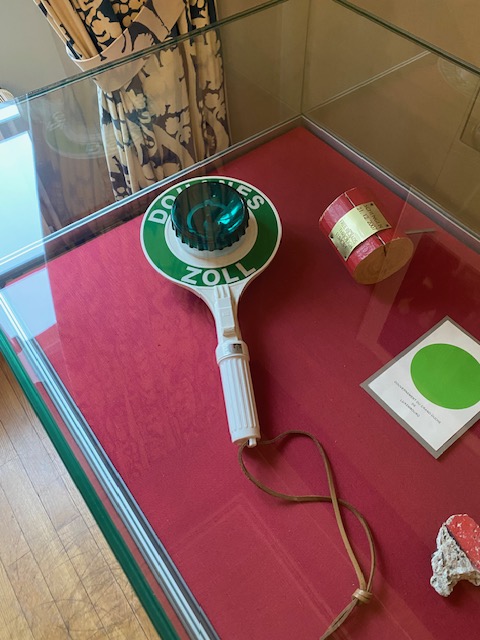
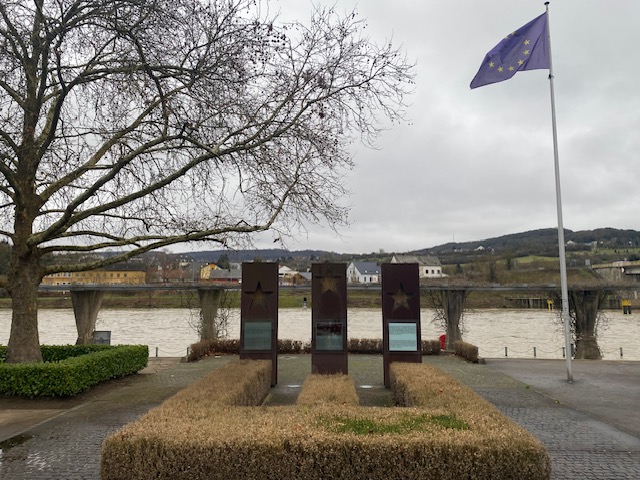
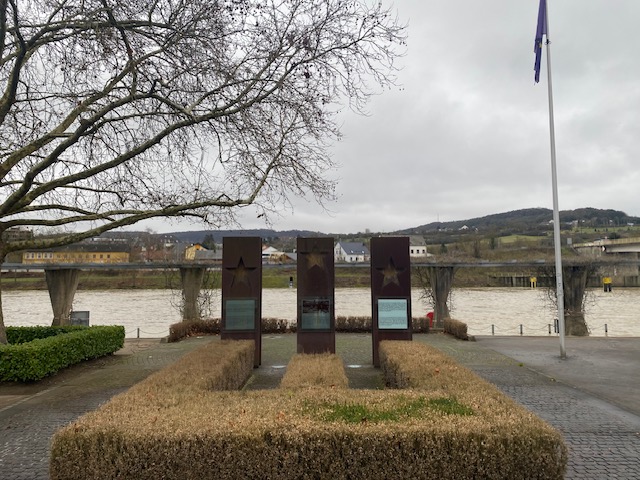
The European Museum and a monument on the banks of the Moselle commemorate the treaty, which, together with subsequent implementing agreements, forms the ‘Schengen Acquis‘.
This agreement came into effect on 26 March 1995 and is considered a cornerstone of European integration, comparable to the introduction of the euro in 1999.
In February 2010, a segment of the Berlin Wall was placed in front of the European Information Centre in Schengen.
Later that year, on 13 June, the European Museum was inaugurated to celebrate the 25th anniversary of the Schengen Agreement. Covering 200 square metres, the museum offers historical photos, film clips, sound recordings, and statements from those involved in the agreement’s creation.
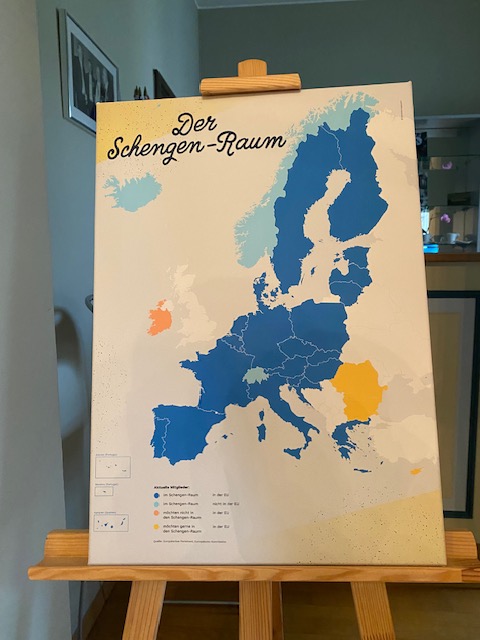
An interactive map illustrates the shifting borders and power dynamics within Europe since 1815 and clarifies the differences between the Schengen Area and the European Union.



Landmarks
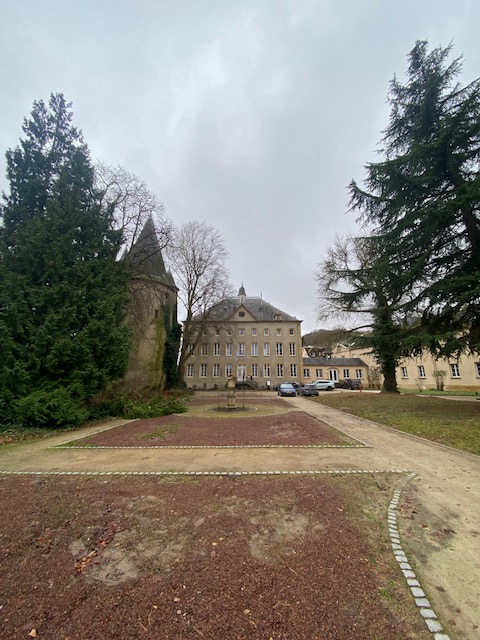
Schengen is home to several landmarks, including Schengen Castle, which dates back to a 13th-century moated fortress. Its reconstructed baroque garden is part of the Gardens Without Borders network.
The castle, formerly used by the Sisters of St. Elisabeth as a holiday and children’s home, was converted into a hotel in 2010 before closing in 2014. It was sold to the Regus company in 2016. It is now again a hotel.
Other attractions include the Church of the Redeemer and the vineyards along the Moselle near Schwebsingen.
In vino veritas
The Luxembourg Wine Route begins in Schengen and follows the Moselle northeast to Wasserbillig, while the German side of the river features the Southern Wine Moselle region, part of the larger Mosel-Saar-Ruwer wine area.
According to historians, a watercolour by Goethe depicts a tree of freedom in Sierck, set against the backdrop of the Schengen Stromberg.
The Schengen Agreement
The Schengen Area comprises 29 European countries that have formally abolished border controls at their shared borders. As a key component of the European Union‘s (EU) area of freedom, security, and justice (AFSJ) policy, it largely operates as a single jurisdiction with a common visa policy for international travel. The area is named after the Schengen Agreement of 1985 and the Schengen Convention of 1990, both signed in Schengen.
Of the 27 EU member states, 25 participate in the Schengen Area. Cyprus and Ireland remain outside its framework. Cyprus is bound by treaty to join in the future, but its geopolitical situation, stemming from Turkey’s invasion and occupation of Northern Cyprus in 1974, complicates this process.
Ireland, however, maintains an opt-out and enforces its own visa policies.
Denmark, while part of the Schengen Area, holds an opt-out from the broader AFSJ policy and participates in Schengen on an intergovernmental basis. Denmark’s autonomous territories, Greenland and the Faroe Islands, are exempt from Schengen rules. Due to this arrangement, Denmark does not hold voting rights concerning the introduction or revocation of Schengen-related measures.
The Schengen Area also includes the four member states of the European Free Trade Association (Iceland, Liechtenstein, Norway, and Switzerland), which have signed association agreements with the EU.
Additionally, the microstates of Andorra, Monaco, San Marino, and Vatican City are de facto part of the Schengen Area due to their size and the impracticality of maintaining border controls.
The Schengen Area covers over 4.59 million square kilometres and is home to more than 450 million people.
Approximately 1.7 million individuals cross an internal European border daily for work, with international commuters accounting for up to a third of the workforce in some regions.
In 2015, there were 1.3 billion crossings of Schengen borders, including 57 million freight crossings by road, valued at €2.8 trillion.
The reduction in trade costs due to Schengen ranges from 0.42% to 1.59%, depending on geography and trade relationships, and even non-Schengen countries benefit from this arrangement. However, Schengen members have reinforced external border controls with non-Schengen states.
Background
Historically, European borders were largely open before World War I, facilitating travel such as the Grand Tour for the wealthy. Border controls and visas became common during the interwar years.
After World War II, the formation of customs unions between European nations marked the beginning of increased integration.
The Nordic countries allowed free movement and residence among themselves in 1954, and the Benelux countries opened their mutual borders in 1960. These developments foreshadowed broader European integration, including the formation of the European Communities (EC) in the 1950s, though the EC did not initially address border control.
The Schengen Agreement, signed on 14 June 1985 by five European Economic Community (EEC) members—Belgium, the Netherlands, Luxembourg (Benelux), France, and West Germany—marked the first step toward abolishing internal border controls.
The Schengen Convention, signed in 1990, expanded on this framework by proposing a common visa policy. These agreements, originally outside the EEC framework, created the Schengen Area, which became operational on 26 March 1995.
As more EU states joined the Schengen Agreement, the Amsterdam Treaty of 1997 integrated the Schengen rules into EU law, effective in 1999. Amendments to the agreement now follow EU legislative procedures, in which non-EU Schengen members do not participate.
The United Kingdom and Ireland opted out of the Schengen Agreement, citing their preference for maintaining the Common Travel Area (CTA), which allows passport-free movement between them and the Crown Dependencies. While Ireland has shown interest in joining Schengen, it remains outside the arrangement to preserve its open border with Northern Ireland.

Visa
The common visa policy allows nationals from certain countries to enter the Schengen Area without a visa for up to 90 days within a 180-day period, while others require a visa for entry or transit.
As of 2025, the Schengen Area includes 29 countries, with Iceland and Norway participating as members of the Nordic Passport Union. Switzerland joined in 2008, and Liechtenstein followed in 2011.
Romania and Bulgaria are the newest members, with air and sea border controls lifted on 31 March 2024 and land borders on 1 January 2025. Although their accession was delayed due to concerns about corruption and organised crime, these issues were addressed through negotiations and positive evaluations under the EU’s Mechanism for Cooperation and Verification.
The Schengen Area also encompasses four microstates—Andorra, Monaco, San Marino, and Vatican City—which maintain open borders with Schengen members. Meanwhile, Cyprus must meet technical criteria in areas such as air borders, police cooperation, and data protection before joining the Schengen Area.

A visit of Schengen
As a town, and without its significance in the history of European integration, Schengen is not that noteworthy. The museum was closed when we were there. It looked closed for renovations.
The Schengen castle is more of a mansion or manor. The visitor centre offers a souvenir shop and a small exhibition space. I forgot to photograph a model of the MS Princesse Marie-Astrid.
For lunch, we crossed the bridge into Germany, where Perl does have a restaurant. Isn’t that a nice illustration of hassle-free border-crossing?


Question for you:
How often do you or did you cross an international border on foot? We certainly haven’t done this a lot.
So?
I’m glad to have been in Schengen. There isn’t that much to see, but this small town is a symbol of free movement. Something which is becoming a rare commodity.
Post-pandemic travel requirements
- Spain demands personal data from all tourists.
- United Kingdom introduces mandatory Electronic Travel Authorisation (ETA) for US, Canada, Australia, EU citizens from 2025.
- European Union, Switzerland, Iceland, Norway, Liechtenstein introduce European Travel Information and Authorisation System (ETIAS) from May 2025.
 Trip By Trip
Despite it being a small place, it has a interesting history. I knew about Schengen but not how it involved or who or what. So interesting and great that you were able to walk across the border no problems. They can be problematic in many other places. I live in Australia so the only border crossing is via the airport!
LikeLike
I remembr my first stime in Australia back in 2011, how excited my Aussie friends were for a state border. 🙂
LikeLiked by 1 person
Haha. Must have been a non event. When I was a child though, there was a tick gate across the Queensland New South Wales border. They stopped and examined every vehicle for fruit and animals as they crossed the border.
LikeLiked by 1 person
It was at the Gold Coast and my host did make a fuss of it lol.
LikeLiked by 1 person
* it may have been Surfers Paradise.
LikeLiked by 1 person
Not Surfers. The border is at Coolangatta and Tweed Heads, about 20 minutes drive further south. You can see a pic of the border sign towards the end of this post of mine from years back: https://forestwoodfolkart.wordpress.com/2019/06/24/a-famous-evening-walk-coolangatta/
LikeLiked by 1 person
Aha yes I see now!
LikeLiked by 1 person