
Just days before the 2025 summer holidays for politics in Belgium, which starts after the National Holiday on 21 July, the Flemish Government approved the project for a bicycle bridge over the River Scheldt in Antwerp. Flanders will pay the bill, Gazet van Antwerpen reports.
This decision, announced as part of the newly approved Integrated Investment Programme (Geïntegreerd Investeringsprogramma, or GIP), puts an end to recent speculation over potential budget cuts and confirms that the project will move forward as originally planned.
The bridge, which is expected to cost approximately 250 million euros, will be financed from the Oosterweel liveability fund—a pot of 1.25 billion euros set aside for infrastructure projects that improve quality of life around the broader Oosterweel link.
250 million is a minimum
While the final cost will be determined after contractor bids are evaluated, experts agree that 250 million euros is the minimum necessary for a bridge of the size and complexity Antwerp envisions.
The structure must accommodate passage of seagoing vessels, with an estimated 1,000 such ships passing annually, requiring parts of the bridge to open and close. The total span will be about 1,080 metres.
First deadline: September 2025
Flemish Minister for Mobility and Public Works Annick De Ridder (N-VA) stated that nothing has changed regarding the initial plans or budget. The formal tender process is under way, with contractors currently preparing bids.
The Flemish Government expects to appoint a contractor in September 2025, with the final contract award to take place in spring 2027. If all goes to plan, the bridge will be completed by 2030.
Where?
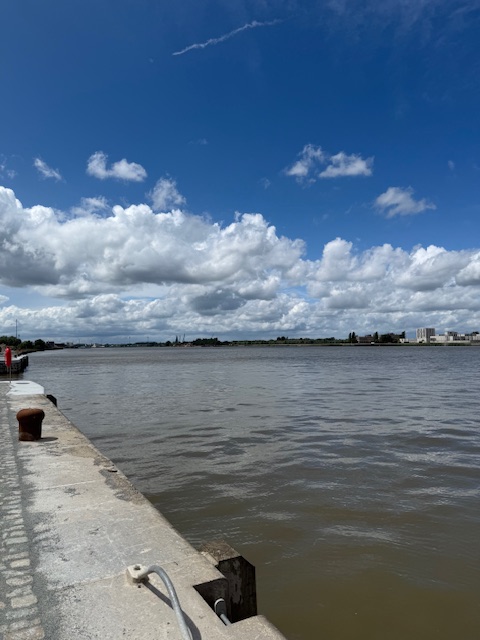
On the right bank, the bridge will connect to the Scheldt Quays near New South (Nieuw Zuid), allowing cyclists to link up with existing routes along the Scheldt, as well as the Singel and Ring cycle paths and the Bicycle Freeway (Fietsostrade) to Boom.
On the left bank, the bridge will tie into the current and planned cycling networks, including elevated berms in Ringpark West and the redesigned riverbanks from Burcht to the Zwijndrecht border above Blokkersdijk. It will also connect with the Waasland cycling network and the Fietsostrade stretching from Antwerp via Beveren, Sint-Niklaas (St. Nicholas, Saint-Nicolas) and Lokeren to Ghent.
Criticisms
Despite the government’s commitment to the project, the bridge has drawn criticism from several political parties and local officials, particularly over the opportunity cost of allocating so much money to a single piece of infrastructure.
The PVDA, CD&V and Groen parties have all voiced concerns that more pressing mobility and safety needs are being neglected in favour of what they characterise as a prestige project.
The marxist PVDA faction leader in the Antwerp city council, Manal Toumi, argued that the people of Antwerp were sold empty promises. The tram lines included in the city’s coalition agreement, she said, will not be realised during this legislative term.
Toumi noted that as early as January her party had warned these tram plans would not materialise without financial support from Flanders. That support has now proven absent, confirming their concerns.
Toumi further criticised the government’s claim that it is prioritising infrastructure projects with the greatest leverage for achieving a modal shift away from car usage. In her view, expanding public transport options is the most effective way to get more people onto trains and trams, yet the government’s investment decisions show no sign of such priorities.
The christian democrats of CD&V also expressed scepticism. Councillor Pieter De Cock acknowledged the need for a new and permanent link between Antwerp’s left and right banks but questioned whether this had to be an extremely costly bridge.
He cited earlier debates indicating the bridge would need to open several times a day to allow shipping traffic to pass. CD&V stressed that the bridge is being paid for from the same pool of money intended for other liveability projects, including green spaces and cycling infrastructure. Every euro spent on the bridge, they said, is one less available for projects such as the Ring Parks.
Ecologist party Groen, meanwhile, criticised what it sees as the insufficient attention paid to road safety in the broader investment plan.
According to party leader Bogdan Vanden Berghe, the traffic safety budget accounts for just three percent of the total, which he described as wholly inadequate for a government claiming safety as a top priority.
Vanden Berghe questioned how much would be invested in removing so-called death strips—narrow, dangerous sections of cycle lane—and condemned the recent cancellation of 72 planned average speed checks on regional roads. He warned that many experts have already labelled this a setback for road safety.
Groen also pointed to other mobility projects that now risk being shelved, such as the proposed tram along the A12, which was intended to relieve congestion on the Brussels Ring, and the promised expansions of Antwerp’s tram network, which were meant to reduce car dependency in and around the city.
Pushing through
Despite the criticism, the Flemish Government argues that the cyclist bridge and other included infrastructure projects, such as the expansion of the Port of Antwerp’s container capacity and improvements to major traffic corridors like the Antwerp Ring and Scheldelaan, will benefit the entire region.
Other projects
Among the other confirmed projects in the GIP are the redesign of the N011 road surface between Ekeren and Brasschaat, the upgrade of the St. Anne jetty on Linkeroever (Left Bank), studies for the renewal of Viaduct 122 in Wilrijk, the renovation of the Noordlandbrug cycling bridge, and various improvements to tram lines and depots across Antwerp.
Also included are works at Antwerp International Airport in Deurne, stabilisation at Galgenweel, and improvements to cycling infrastructure in Kalmthout, Kapellen, and Kontich, among others.
2027
The GIP outlines infrastructure investments across Flanders up to 2027, with a total of 2.2 billion euros allocated annually over the current legislative period.
The 2027 and 2028 plans are expected to be finalised next year. Although the exact budget line for the Scheldt cyclist bridge is not itemised in the current GIP, officials have confirmed that the original budget and scope remain intact.
On the look of Antwerp
- ANTWERP | New city park at Scheldt Quays in Nieuw Zuid opened: a green oasis by the water for every Antwerp resident.
- Antwerp-Linkeroever Railway Station to reopen in 2026.
- ANTWERP | Design team selected for Meir redevelopment.
- Antwerp-Berchem Railway Station up for major revamp.
- ANTWERP | Top Boerentoren to be restored to 1930 look unless new plans are approved.
- City of Antwerp presents design proposals for Meir redevelopment.
- Flanders selects Bovenbouw Architectuur and Christ & Gantenbein as architects for M HKA museum of contemporary art.
- ANTWERP | Redevelopment of the Paardenmarkt one step closer.
- ANTWERP | New owners to explore future for Shopping Stadsfeestzaal on the Meir.
- ANTWERP | Groenplaats redesign planned for 2026.
- ANTWERP | ‘Blinds’ Martin Margiela at Schuttershofstraat.
- ANTWERP | Flemish Culinary Centre Smaakhaven at Loodwezen to open in 2029.
- Antwerp unveils texts and names for monument in honour of WWII victims.
- City of Antwerp commissions ‘Collectie Centrum’ to store heritage collection.
- 17th century Antwerp Citadel decorative vase gets prominent place at KMSKA.
- Antwerp erects cenotaph for deceased Congolese from 1894 World Exposition.
- ANTWERP | Redesign works of Wapper start in 2026.
- ANTWERP | Final design Linkeroever Scheldt Banks South approved.
- ANTWERP | Preliminary design of Ringpark ‘Cluster Centraal’ approved.
- Which flags get to fly at Antwerp City Hall?.
- ANTWERP | Market exploration questions the future of the Stadsschouwburg Theatre Building.
- ANTWERP | Murals in Voetgangerstunnel repainted.
- ANTWERP | Restoration of Vleeshuis to start in 2025.
- Antwerp-South Railway Station and surroundings get makeover.
- ANTWERP | Northern Pavillion at Scheldt’s Northern Terrace gets revamp.
- AREAS OF ANTWERP | St. James’ Church (Sint-Jacobskerk).
- AREAS OF ANTWERP | St. Paul’s Church (Sint-Pauluskerk).
- AREAS OF ANTWERP | Scheldekaaien or Scheldt Quays.
- AREAS OF ANTWERP | Zurenborg.
- AREAS OF ANTWERP | Cogels-Osylei between Berchem and Antwerp’s Zurenborg neighbourhood.
- AREAS OF ANTWERP | De Gerlachekaai at the Scheldt.
- AREAS OF ANTWERP | Sint-Andriesplein.
- Rainbow zebra crossing in Borgerhout.
- Rainbow zebra crossings of Antwerp.
- Rainbow zebra crossing in Berchem.
- Antwerp designs future of Scheldt Left Bank riverside.
- ANTWERP | Major revamp of the Meirbrug – Suikerrui – Scheldt Quays axis to complete the Via Sinjoor.
- ANTWERP | Looking for Linkeroever Railway Station.
- PHOTOS | Het Steen, Antwerp’s new Visitor Centre.
- VIDEO | Walking the future Spoorpark between Zurenborg (Antwerp) and Borgerhout.
- 5 spots in Antwerp to soak up the sun for free..
- ANTWERP | Community centre coStA to become ANDRS in 2027 after major revamp.
 Trip By Trip
3 Comments Add yours