
On 1 January 2024 we wrote about how rising prices affect travel. Not only the price of flights, but also the price of activities. Pricing was a topic the year before, 2023. In 2024, conventional and social media dug into the issue of overtourism. Articles about locals protesting, Instagrammers posting about big crowds in Japan for instance. A pertinent example, as we’re travelling to the Land of the Rising Sun later this year.
For your information, this post is a very long one. If you want to skip the arguments, scroll to the end to the paragraph ‘Outtakes’ and further. We won’t hold it against you.
Once this became apparent, we started collecting articles and posts on the subject, because overtourism has become ‘a thing’, a theme, an issue. Will 2025 be the year of overtourism?
Overtourism raises a few questions. What is overtourism? How does it affect us? Which places suffer? Is it a growing phenomenon? But also, is the pot calling the kettle black? Locals complaining about nuisance, but causing nuisances when travelling themselves. Also, perhaps the same locals complain about over tourism, but yet many local jobs are dependent upon those tourists.
Is the issue of overtourism overrated? Is it exaggerated? Are we getting overdosed on the matter and thus we start not being bothered anymore? Not unlike climate issues.
What is a ‘tourist’? What is a ‘visitor’? Is there an objective difference or is it just what we make of it? Let’s try to look at the issue on the basis of news stories and online content which came up in 2024.
The rise of mass tourism
Until the mid-20th century, holidays were a luxury for the wealthy. The advent of air travel, economic growth, and statutory leave in the 1960s transformed travel into a middle-class staple.
Since then, the industry has boomed, with tourism often outpacing global economic growth. As middle-class populations in Asia and Africa expand, the demand for travel is expected to rise further, intensifying the challenges of managing mass tourism.
What is overtourism?
Overtourism refers to the excessive influx of tourists to a destination, where the number of visitors overwhelms the local infrastructure, environment, and community. This occurs when a destination’s capacity to manage tourism sustainably is exceeded, leading to a range of negative consequences.
One major impact of overtourism is environmental damage. Natural attractions such as beaches, forests, and coral reefs often suffer from pollution, erosion, and overuse. For example, the Great Barrier Reef in Australia and Maya Bay in Thailand have experienced significant harm due to large numbers of visitors. The increased presence of tourists contributes to waste, air, and noise pollution, further degrading the environment.
Another consequence is the strain placed on infrastructure. Public services, transportation networks, and facilities such as water and sewage systems often struggle to cope with overcrowding. Traffic congestion becomes a common problem, particularly in urban areas or small towns, making daily life difficult for local residents.
Overtourism also threatens cultural heritage. Local traditions and practices may be altered or even lost as destinations cater to the preferences of tourists rather than preserving authentic experiences. Heritage sites like Machu Picchu in Peru or Venice in Italy have faced deterioration from excessive foot traffic, while local cultures risk being commercialized or overshadowed.
For residents, overtourism often leads to rising costs of living. Tourism demand drives up the prices of real estate, goods, and services, making it difficult for locals to afford life in their own communities. In cities like Barcelona in Spain and Dubrovnik in Croatia, many residents have been forced to move away due to these economic pressures.

Overcrowding further disrupts daily life, leading to frustration and resentment towards visitors. Even tourists themselves can have negative experiences when faced with long wait times and crowded attractions.
A heavy reliance on tourism can also make destinations economically vulnerable. When events like a pandemic or natural disasters disrupt travel, communities that depend heavily on tourism revenue may face severe financial hardship.
Examples of overtourism include Venice where massive crowds and cruise ships strain the city’s infrastructure; Bali in Indonesia, which struggles with excessive waste and water usage; and Japan, where a low yen and the popularity of Japanese pop culture have drawn tourists from afar (Europe and America) and from nearer, Asia.
To address overtourism, destinations are implementing various strategies. These include regulating visitor numbers through quotas and reservation systems, promoting sustainable tourism practices, educating travelers about responsible behavior, and investing in infrastructure to accommodate tourists in a more sustainable way.
Striking a balance between the economic benefits of tourism and its social and environmental impacts is essential to preserving both the destination and the quality of life for its residents and visitors.
Encouraging or discouraging tourism?
In Europe, popular tourist destinations like Barcelona, Mallorca, and Venice are implementing measures to reduce visitor numbers due to the challenges of overtourism, De Standaard reported on 23 July 2024. These include discouraging cruise ships, capping hotel rooms, and restricting short-term rentals like Airbnb.
Venice has even introduced entry fees on peak days, reflecting growing resistance to the influx of tourists.
Conversely, countries outside Europe, such as Saudi Arabia and Japan, are actively working to attract more visitors as part of their economic strategies.
Saudi Arabia is focusing on luxury tourism through its Vision 2030 plan, aiming to diversify its economy beyond oil. Projects like the Magna resort in the Gulf of Aqaba, featuring 15 luxury hotels and a 450-metre-long bridge hotel, exemplify this push.
The country plans to increase annual tourist numbers from 27 million to 60 million by 2030, including 3 million visitors from the People’s Republic of China.
Similarly, Japan aims to double its pre-pandemic tourist numbers to 60 million by 2030, leveraging the weak yen and easing entry procedures to attract more visitors, especially from neighbouring Asian countries.
Elsewhere, Greenland and Iceland are embracing tourism as a means of economic growth. Greenland has invested in infrastructure like airports to support its growing tourism sector, which emphasises sustainability to protect its fragile ecosystem. International flights now land nearer the capital of Nuuk.
Afghanistan, under Taliban rule, is also developing its tourism sector, with initiatives to guide and protect visitors and establish a tourist training institute. Despite these efforts, countries like Saudi Arabia, Japan, and Greenland are mindful of potential downsides, focusing on strategies to manage tourism sustainably and mitigate its negative impacts.
The culprit called cruising
A favourite scapegoat for overtourism is cruising. Yes, cruise ships tend to sail to the same ports and its cruisers swarm in an often too small community, not being able to handle it. A prime example is Santorini, in Greece. In July 2024, Steve and Timothy cruised with Norwegian Cruise Line in the Aegean Sea. They did go ashore in Mykonos, and it was a mess. So much, they turned Santorini into a sea day.
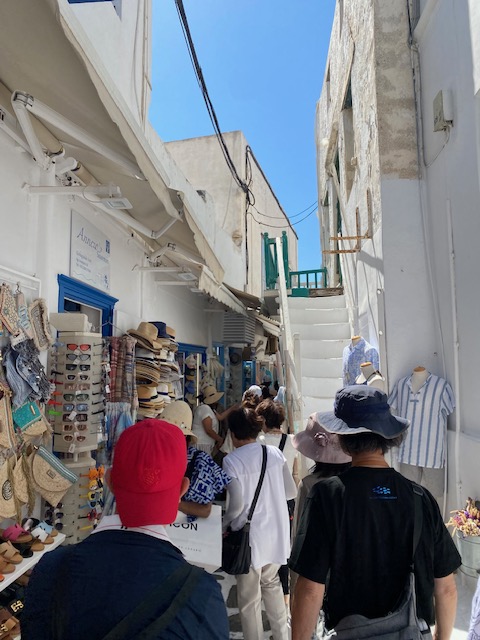
For Santorini, 2024 was the busiest summer yet, Het Nieuwsblad reported on 5 August 2024. Locals have described it as “the worst season ever”, as the island contends with overwhelming visitor numbers.
Renowned for its picturesque views and iconic architecture, Santorini draws 3.4 million tourists annually and is a popular stop for cruise ships. On peak summer days, as many as 17,000 cruise passengers arrive, placing significant strain on an island with only 20,000 permanent residents.
To address these challenges, Santorini’s mayor has proposed capping daily cruise passengers at 8,000, aligning with growing anti-tourism sentiments across Europe.
The Cruise Lines International Association (CLIA) has expressed support for maintaining this limit and is considering diversifying routes to alleviate pressure on Greece’s busiest destinations. However, local tour operators argue that the island’s image is skewed. While Santorini is overrun with tourists during July and August, it becomes much quieter in the evenings and during off-peak months, with hotel occupancy dropping to just 30% after the high season.
The impact of mass tourism extends beyond Santorini, with Greece as a whole experiencing a significant increase in visitors.
Tourism revenues nationally rose by 16% in the first five months of 2024, and the total number of tourists is expected to surpass the previous record of 33 million. Despite its economic benefits, the surge in tourism has amplified concerns about sustainability and the strain on local communities.
Capping cruises
On 6 August 2026 cruisetuber Gary Bembridge from Tips For Travellers posted an overview of cruise destinations imposing restrictions.
In Europe, popular destinations like Barcelona, Valencia, Palma de Mallorca and the Canary Islands are taking steps to curb cruise traffic, including capping the number of ships and banning larger vessels.
Protests against overtourism have become frequent, with locals demanding limits on the influx of visitors. For example, Barcelona’s mayor is supporting efforts to reduce cruise terminals, while Valencia plans to prohibit mega ships by 2026.
Greece, especially islands like Santorini and Mykonos, is also considering measures to control overcrowding, with the Prime Minister hinting at future restrictions. Venice has long restricted large ships, redirecting them to alternative ports such as Trieste.
By the way, Trieste is an underrated destination. Are we now ruining the city by offering this alternative?
Similarly, Dubrovnik has capped cruise ships at two per day to manage tourist numbers.
Elsewhere in Europe, ports like Amsterdam in the Netherlands, Bruges in Belgium, and Icelandic destinations are tightening controls. Amsterdam plans to halve cruise traffic by 2026, while Bruges has reduced ship numbers due to concerns about turning the city into a tourist trap. Iceland’s Ísafjörður has capped daily cruise visitors at 5,000, citing insufficient infrastructure.
Norway is moving towards stricter environmental standards, requiring zero-emission ships in its fjords by 2035, with interim restrictions beginning in 2026. That’s why Danny went in September 2024. You’ll read about that cruise soon.
The Arctic island of Svalbard will limit ship capacity to 200 passengers from 2025, reflecting concerns about preserving delicate ecosystems.
Outside Europe, Alaska has long imposed restrictions on cruise numbers, with Glacier Bay allowing only two ships daily. Juneau plans to limit daily passengers starting in 2026, with potential for stricter measures. In Canada, Bar Harbour has reduced cruise passengers to 1,000 per day, though the decision faces legal challenges.
In the Caribbean, Key West has struggled to enforce limits on large cruise ships due to state interventions. Meanwhile, French Polynesia restricts ships with over 3,500 passengers to just a few islands and imposes daily disembarkation caps, particularly on smaller islands like Bora Bora.
Culprit number 2: Airbnb
Many cities suffer of a too high percentage of short-term rental apartments, also known as bed & breakfasts. Made famous by Airbnb. Amsterdam, Barcelona, Lisbon in Portugal.
But also in Belgium. The rise of Airbnb has led to a massive increase in short-term rentals, putting pressure on cities such as Antwerp, Brussels and Ghent.
Where the platform was originally intended for individual landlords, large players now dominate, managing entire buildings under fictitious profiles.
This causes rising rents, social disruption and nuisance. In Antwerp, the number of Airbnbs has increased by 264% since 2016, and more than 80% are entire apartments, not shared spaces, De Morgen reported on 2 November 2024.
In addition to rising prices and displacement of local residents, properties are sometimes used for illegal activities, such as prostitution. Cities are taking various measures, including stricter regulations and limits on rentals, to control this growth and restore the balance between tourism and liveability. But are these measures affective?
If you look close enough, you will see many key boxes next to doors. These boxes have combination lock and when open, unlocks the key. A common practice for Airbnb lodgings.


Airbnb in Lisbon
Lisbon is on the verge to a referendum to restrict the rental of residential apartments to tourists, following the submission of a petition with 11,000 signatures to the city council, De Morgen reported on 9 November 2024. The proposal seeks to ban tourist rentals in buildings designated for residential use, requiring visitors to stay in hotels or guesthouses instead.
The housing crisis in Lisbon, as in many European cities, has reached critical levels. Activist Raquel Antunes highlighted that in some neighbourhoods, more than half of the properties are used for short-term tourist rentals. She argued that the city must prioritise housing for its residents to address the escalating housing shortage and restore the social function of homes.
The proposed referendum would ask Lisbon’s population two key questions: whether to revoke existing tourist rental permits and whether to prohibit the issuance of new ones.
Over the past decade, more than 20,000 residential properties in Lisbon have been converted into short-term holiday rentals, contributing to the city’s record rise in house prices. Lisbon is now considered the European city with the highest number of short-term rentals per capita.
Similar measures are being pursued elsewhere in Europe. Barcelona plans to prohibit tourist rentals in residential buildings from 2028, as announced by its socialist mayor, Jaume Collboni.
In Budapest in Hungary, a district held a referendum on this issue in September, where a narrow majority of 54% supported restrictions. These efforts reflect a growing trend among European cities to prioritise housing for locals amidst increasing pressure from tourism.

Running out of patience
2024 shattered tourism records, with an astounding 1.5 billion global travellers, De Morgen reported on 5 August 2024. Yet, resistance to mass tourism is mounting. Can this booming sector be restrained? And should it? Increasingly, cities are becoming spaces for visitors rather than residents.
This tension played out vividly this summer in Barcelona, where two sun-seekers, relaxing at a Taco Bell, found themselves the target of water pistols wielded by irate locals. Their message was unambiguous: “Tourists go home”.
In the Canary Islands, protests escalated further. Islanders staged a hunger strike to halt the construction of luxury hotels, which persisted despite their efforts. Following this, tens of thousands rallied under the slogan, ‘Canarias have a limit’.
Similar protests swept Mallorca, Ibiza, and Málaga this summer, with demonstrators rejecting the impacts of overtourism. Amsterdam, too, faced discontent, as residents threatened legal action over the city surpassing 20 million overnight stays in a year.
The backlash against tourism is not new. Anti-tourist graffiti has long adorned Spanish streets, but the scale of protests this year is unprecedented. After the quiet of the pandemic years, when cities and beaches reverted to residents, tourism has surged back, with the UN World Tourism Organisation (UNWTO) estimating 1.5 billion tourists in 2024. By the end of the decade, this figure may reach 2 billion, making tourism one of the fastest-growing global sectors.
Paradox of popularity
As tourism expands, destinations are struggling to cope. According to professor Jan van der Borg of KU Leuven, the rapid growth of visitors far outpaces the availability of new attractions. This imbalance results in overtourism, where the “carrying capacity” of a location is exceeded.
Van der Borg compares this to overcrowding at a garden party: with too many guests, the lawn may be irreparably damaged.
The adverse effects of overtourism are stark. Boracay in the Philippines became an “open sewer” due to tourist influx. In Venice, there are now more hotel beds than residents. Amsterdam’s cultural heritage is eroding, with traditional businesses replaced by tourist-oriented shops. This phenomenon, often termed ‘Disneyfication‘, optimises cities for visitors while marginalising residents.
The costs of tourism
While tourism contributes 10% to global GDP and sustains 1 in 10 jobs worldwide, the benefits are offset by significant costs. Rising housing prices, environmental damage, increased waste, and pressure on local infrastructure all weigh heavily on communities. These costs disproportionately affect residents while profits largely flow to external players, such as international hotel chains and real estate speculators.
This disparity is starkly illustrated by César Nebrera, a Spanish chef on Ibiza, who cannot afford housing due to skyrocketing rents despite working in the tourism sector.
Similarly, Amsterdam resident Jasper H. van Dijk laments the loss of local amenities as the city becomes a playground for visitors.
Seeking balance
Cities worldwide are introducing measures to manage tourism’s excesses. Venice has implemented a €5 tourist tax on busy days, Dubrovnik charges €30 for entry to its historic centre, and Portofino fines visitors who linger too long while taking photos. Some places, like Bhutan, have gone further, imposing a daily tourist tax of $200.
Despite these efforts, transformative changes remain rare. Higher taxes and pricing could reduce mass tourism but risk making travel an elite pursuit, reversing decades of progress in accessibility.
Towards responsible tourism
According to American journalist Paige McClanahan, author of ‘The New Tourist‘, the key lies in promoting conscious travel. Tourists should prioritise the preservation of the places they visit.
Similarly, Van der Borg suggests policymakers and businesses should guide tourists towards better choices, such as visiting destinations during off-peak periods or exploring lesser-known attractions.
Florence or Firenze offers an example: its Uffizi Gallery redistributed famous artworks to smaller regional museums, relieving overcrowding while benefiting nearby communities. While such measures won’t halt mass tourism, they can mitigate its impacts and foster more sustainable practices.
Ultimately, unchecked tourism risks alienating locals and damaging the very attractions that draw visitors. Balancing the interests of residents, businesses, and tourists is essential to preserving both the industry and the communities it depends on.
Not better closer to home
“The Lesse now feels like Walibi,” lamented Dinant Mayor Thiery Bodlet at the end of August 2024. The Lesse is a river in Wallonia popular for kayaking. Walibi is a theme park and a household name in Belgium.
Local residents are growing increasingly exasperated with the influx of day-trippers. On a warm day, between 4,000 and 6,000 people take to the water. “The sheer number of tourists disrupts the tranquillity of the area”, Mayor Bodlet told De Standaard. “What was once a serene journey through nature is now becoming an attraction akin to Walibi.”
“Paradoxically, while many places are overwhelmed, others are desperate for more visitors”, the much sought after Jan van der Borg responded. “The problem is that so many people flock to the same destinations, at the same time, using the same modes of transport. This concentration creates unbearable crowds. It’s partly driven by social media, where platforms like Instagram and TikTok promote certain places as must-visit spots.”
Only benefitting the few
“Mass tourism imposes significant burdens on many while benefitting only a few”, Van der Borg says.
“This resistance is a positive development. Governments must take it seriously because the carrying capacity of many places has been exceeded. If they don’t act, cities could become hollowed out, and tourists will eventually stop coming.”
Barcelona plans to revoke all existing Airbnb permits by 2028 to make housing more available for permanent residents.
Sympathy for protesters
A YouGov survey across seven European countries has revealed significant concerns about overtourism, with Spain emerging as the most strongly affected, The Guardian reported on 13 September 2024.
One-third of Spaniards believe their local area has too many international visitors, rising to nearly half in Catalonia, where Barcelona’s 1.6 million residents host approximately 32 million tourists annually. Spain also showed the highest level of negative sentiment toward foreign tourists, with 28% expressing unfavourable views.
The impact of short-term holiday rentals, often blamed for driving up rents and reducing local housing availability, was particularly pronounced in Spain. Over a third of respondents viewed the sector as harmful, and nearly half held a negative opinion of it. The Spanish government has pledged stricter regulation of holiday lets, while Barcelona plans to phase out all such rentals by 2029. Similar sentiments were noted in other countries, though at lower levels.
Across Europe, there was widespread support for measures to curb overtourism. Many respondents backed the introduction of booking systems for popular sites, tourist caps, and restrictions on new hotel construction in overcrowded areas.
Spain, France, and Germany showed the strongest sympathy for protests against mass tourism, with around two-thirds expressing support. Authorities in cities like Amsterdam, Venice, and Athens have already implemented measures such as tourist taxes, entry fees, and limits on cruise ships.
Despite concerns about rising living costs, housing prices, and cultural erosion, residents acknowledged the economic benefits of tourism, including job creation and improved infrastructure. As cities struggle to balance these competing interests, calls for stricter regulation and strategies to promote sustainable tourism are growing.
Outside Europe: Bukchon Hanok Village
Bukchon Hanok Village, a historic district in central Seoul in South Korea renowned for its traditional Korean houses, or ‘hanok‘ is one of the city’s most popular tourist attractions. Despite a resident population of just 6,000, the area draws an overwhelming 6.6 million visitors annually, leading to growing tensions between locals and tourists. Complaints about noise, litter, and the disruption of residents’ privacy have steadily increased.
In response, authorities have announced measures to manage the influx. Since October 2024, Bukchon is the country’s first ‘special management area’ introducing restrictions such as a tourist curfew from 5 PM to 10 AM.
Tourist buses will be limited in key areas, and colour-coded zones—red, orange, and yellow—will indicate crowd levels to help authorities manage foot traffic. Violators of the new rules may face fines.
While some residents hope these measures will restore tranquillity to the area, others, including local business owners, remain sceptical. Cafe owner Lee Youn-hee argues that the curfew will have minimal impact, as most tourists leave before sunset. Signs in multiple languages urging visitors to maintain quiet were introduced in 2018, but challenges persist.
Oriol and Timothy were there in October 2024, after the measures came into effect and after this story was published in Het Nieuwsblad on 12 July 2024. And yes, it was crowded. Everyone wanting that same photo, because, well, that’s the pretty photo to take. But all this announced measures seemed futile.

Japan
Japan has been overwhelmed by tourists since it reopened its border after COVID-19. Helped by a low yen and ‘revenge tourism’, many people found their way there. Europeans and Americans but also Chinese and Korean tourists.
On Instagram, many influencers tackle the subject. Crowded places, tourists not respecting the distinctive Japanese culture. As in Korea, everyone wants to do the same activities and see the same sights.
Andre R. Carillo is a Filipino-American influencer living in Taiwan. He gives some advise on Instagram. “Be realistic, prioritize, research, and then have fun.”
“At the same time, try not to stress too much about it. I wouldn’t want the planning process to get in the way of you enjoying your trip! If you’re more of a spontaneous traveler, then this might be easier for you, but for type A people like myself, it’s hard not to worry about making sure the itinerary is perfect.”
“Here are some things that I had to ask myself when planning my trip: What are the top three destinations I care most about getting there before the crowds do? What are some spots I wouldn’t mind if we missed out on? What activities do I want more time for? Nature, shopping, food? How much sleep does my itinerary allow for? At the end of the day, your trip is what you make of it.”
Andrew Pugsley, from Canada, and Meng Delvey, from China, run the YouTube channel Tokyo BTM. They explore gay Japan and specifically Gay Tokyo. In December, they discussed overtourism in Shinjuku Ni-chōme, Tokyo’s queer district.
Bottom line of their video is the influx of tourists has changed the vibes in the gaybourhood. Locals now sometimes stay away.
Respect
Often, this tourists in Japan related content points at (the lack of) respect. Japanese culture is distinctive and peculiar. Insular. And tourists don’t respect customs and habits enough.
But it’s more and broader than that. Travel being available to a larger group of people, respect becomes a bigger issues. Your destination will probably have other expectations of behaviour than your own community.
Devil’s advocates
Not everyone follows the narrative. “Who will stand up for the budget traveller? Time and again, Ryanair travellers are the scapegoat in the whining about quarreling Brits in the Amsterdam red light district or the sinking Venice – not because of climate change, but because of the cumulative overweight of tourists”, reporter Max De Moor writes in De Standaard on 29 August 2024.
Marijke Schreiner, director of the Dutch hostel chain Stayokay, is completely fed up with the stereotypes. In an interview with the Amsterdam city newspaper Het Parool, she makes a case.
“We send our children on a school trip to Athens or Rome, but the other way around it becomes an unfair story. While this city should be there for everyone”, she snaps back at Amsterdam residents complaining.
Schreiner was triggered is the proposal of municipal councillor Myron von Gerhardt (VVD), who advocated to attract “quality tourists”.
In other words: tourists with deep pockets, who can fill the city coffers with visits to the posh P.C. Hooftstraat and stay in the even posher Conservatorium Hotel.
“The fact that they do not go to the red light district to prostitute themselves, but hire discreet escorts, is more than a bonus. How does this shrewd liberal think he can achieve that? By increasing the tourist tax for cheaper accommodation. That will teach that pot-smoking rabble”, De Moor quips.
Hypocrisy
Fortunately, there is Schreiner, who stands up for the ordinary men and women from her dormitories. They also go to the Anne Frank House. In passing, she gives her compatriots a taste of their own medicine:
“People complain about the crowds here, but pack their own suitcases to Barcelona or Paris. Look at what our Dutch youngsters do on their graduation trip to Chersonissos in Greece or Prague in Czechia – you sometimes feel ashamed to death.”
Yes, madame, we would like to add, look at what those sixteen-year-olds from the ‘quality segment’ are up to in Knokke-Heist. This seaside in Flanders near the Dutch borders attracts Dutch 16-year-olds who learn to party hard(y) on the go.
Of course, as a hostel owner, she has to defend her business interests, but she hits a chord: “It can’t be that we go out into the world and then say that the world should stay away from here?”
Nothing is simple
Another devil’s advocate is Jan Peeters of Travel360° Benelux. On the same day as De Moor, the travel specialist made a case on his medium.
“Every opportunity was seized during the months of July and August to publish an article, column or opinion piece in the traditional media about the negative consequences of ‘overtourism’. What struck me most is that this term is increasingly used as a container concept, to include everything that can go wrong with tourism”, Peeters writes.
“The whole discussion threatens to move in a direction where all nuance is lost. A memory of the foaming pro-vaccine vs. anti-vaccine discussions comes to mind. Time for nuance.”
“The cities that quickly roll off the tongue and are invariably mentioned as examples in articles are Barcelona, Venice and Dubrovnik. And recently Ghent too, but that was just for laughs.”
“According to the Top 100 City Destinations Ranking WTM, published by Euromonitor International, Barcelona is only in 23rd place of the most visited cities by tourists. Venice is in 38th place and Dubrovnik does not even appear in the top 100…”
In those cities, a part of the population has a feeling that can best be described as ‘tourismophobia‘. On the one hand understandable, on the other dangerous: such “tourismophobia’ can easily be captured by extreme thinking groups – who often fight against just about anything.”
“A quick thought exercise. On to the Canary Islands. Unlike in Venice or -say- Bruges, for example, it is wise to count tourists in terms of overnight stays for many destinations and not in terms of arrivals.”
“The ‘overnight percentage’ is the result of comparing tourist overnight stays with the total (including that of the resident population). That is to say, in simple figures, if the inhabitants of the Canary Islands generate 821 million overnight stays (2.25 million inhabitants for 365 days per year) and we register 127 million tourist overnight stays (15 million tourists for an average stay of 8.5 days), then the total number of overnight stays is 948 million and the overnight rate is 13.3%. Hmm.”
“A comment immediately; those 13% are largely concentrated in specific places on the islands. But those places have been stimulated by the local economy and -certainly!- by the government, to receive more and more tourists for decades.”
“Of course: this is only part of the ‘tourismophobia’ discussion. But it does show that the subject is complicated, that there is room for nuance and that the debate should therefore go beyond the slogans and slogans.”
“Tourism causes nuisance in certain parts of the world. And all the players involved must find solutions for that. But the tourism industry cannot simply allow itself to be slaughtered in overheated, sloganeering debates. Because nothing is simple.”
“Not travelling anymore won’t make the world a better place”
“Not travelling anymore won’t make the world a better place” argues journalist Paige McClanahan in De Standaard on 17 August 2024. She wrote book ‘The New Tourist’. “Pointing fingers at others doesn’t solve anything. We’re all tourists”, she emphasises.
For those passionate about travel like us, this overtourism reality can provoke a crisis of conscience. McClanahan reflects on this paradox: “Traveling is part of who I am. I love it. Yet, at times, it feels caricatural. A purely economic act”.
In her book, McClanahan draws on Richard Butler’s 1980s life cycle model for tourist destinations, which illustrates how tourism degrades local quality of life and eventually diminishes the experience for visitors.
Tourism, she notes, often becomes “a snake biting its own tail”. In cities like Barcelona, this phenomenon is particularly evident. Long-time residents are priced out, and the city centre loses its soul, mirroring developments in Amsterdam.
Yet McClanahan highlights positive examples like Liverpool in the United Kingdom. Once one of Europe’s poorest cities, Liverpool transformed through a focus on culture and urban development, revitalising its economy and community. “The key was involving residents”, she says, citing it as an example of how tourism, when thoughtfully managed, can bring widespread benefits.
Her own experience in a small French Alpine village demonstrates this balance. “Tourism keeps the village alive, though it comes with challenges. Local authorities play a crucial role in shaping sustainable tourism policies”, she explains. For instance, Denmark‘s capital Copenhagen’s reward system encourages sustainable tourist behaviour, a small but significant sign of changing attitudes.
Tourists v. travellers
McClanahan rejects the distinction between ‘tourists’ and ‘travellers’ arguing it fosters unhelpful divisions. “We’re all tourists, no matter how much we want to believe otherwise. Looking down on others for being ‘tourists’ doesn’t solve the problem”, she says.
Instead, she advocates for embracing the idea of a ‘new tourist’, someone who travels with humility, curiosity, and empathy. Such travellers engage meaningfully with destinations and their inhabitants, striving to minimise harm while gaining a deeper understanding of the world.
Social media, she acknowledges, is both a blessing and a curse. While platforms like Instagram democratise travel storytelling, they also fuel herd behaviour and superficial experiences.
“If you’re drawn to a place by an Instagram photo, you risk overlooking its true essence”, McClanahan warns. She encourages using social media to share deeper, more thoughtful narratives rather than ego-driven snapshots.
Staying home?
When asked if staying home might be the ultimate solution, McClanahan firmly disagrees. “Global crises such as climate change, pandemics, geopolitical tensions demand cultural empathy and collaboration across borders. Travel fosters these qualities. Done right, tourism can be a powerful force for good, both individually and collectively.”
Still, the environmental impact of flying remains a significant challenge. McClanahan acknowledges the slow progress in developing greener aviation technologies but urges travellers to make conscious choices. “Some people refuse to fly, and I respect that. Others fly less or weigh their necessity. It’s all part of practising more mindful tourism.”
Ultimately, McClanahan believes thoughtful travel can promote mutual understanding and enrich lives, provided we address its consequences responsibly. “Travel, at its best, changes our perspectives and connects us. That’s something worth preserving.”
Tourist v. visitor
Paige McClanahan rejects the distinction between tourist and traveller. Interesting.
When the City of Antwerp press service communicates tourism statistics, it uses both ‘tourists’ and ‘visitors’. ‘Visitors’ sounds nicer, softer and more local.
It’s unclear of the choice of words is on purpose. We’re writing this blog post in December 2024 and Antwerp is very crowded with Christmas shoppers and visitors of the Winter in Antwerp Christmas market. On other occasions during the year, ‘Antwerp is full’ for one or other event.
The Meir, the main shopping street is full. These shoppers and Christmas market visitors can also be a nuisance. They walk slowly. They walk without paying attention to their surrounding. They forget people live and work here.

So is this less of nuisance than overtourism? Perception says yes. Isn’t that a bit xenophobic? What makes mass turnout of people from the vicinity less annoying than the mass turnout from people from further afield?
Fear of missing out (FOMO) does not limit itself to obvious tourist activities such as sightseeing or sunbathing. It also affects shopping, drinking and eventing.
We’re asking you.
Overtourism v. crowded
So if tourists and visitors are the same. Or not? Are they? Then a next question is: what is the difference between overtourism and ‘just really, really crowded’?
Take the Oxford Street and Regent Street area in London in England. They are crowded, really, really, really crowded. It’s not fun walking or shopping there. Yet Oxford and Regent Street aren’t mentioned in overtourism stories.
When is a place suffering from overtourism? When is it just really, really crowded?
The Sifnos case
Professors advocate the spread of tourism to ease the burden on the current hotspots. But the case of the Greek island of Sifnos shows that’s not a sustainable solution. De Morgen investigated on 9 September 2024.
Tourism on Sifnos is surging, raising concerns among locals about its future and character. Once considered a serene and lesser-known alternative to destinations like Santorini and Mykonos, Sifnos is increasingly appearing in media promotions and social media posts as a must-visit location. Residents are alarmed at the island’s transformation, fearing it may follow in the footsteps of its overcrowded and overdeveloped neighbours.
Civil engineer Andreas Kalogiros highlights the issue by pointing to new villas on the island, many of which fail to blend with the landscape or adhere to traditional architecture. These modern constructions, often built by foreigners, feature wide windows, flat roofs, and swimming pools that strain the island’s limited water resources.
Between 2018 and 2022, Sifnos issued 121 building permits, with numbers rising annually, and many projects now include pool, a controversial feature given the island’s chronic water scarcity.
The rise in tourism has been dramatic. In July and August 2023, Sifnos saw 80,000 visitors, a stark increase from a decade ago when it primarily attracted Greek tourists.
Now, international interest has skyrocketed, aided by endorsements from publications like Vogue and visits by high-profile figures such as Barack Obama and Tom Hanks. This influx has driven up prices significantly, making the island increasingly unaffordable for locals, while demand for luxury accommodations dominates.
The pressure on infrastructure is palpable. Accommodation shortages, high rental prices, and limited medical resources—only one doctor served the island during peak season—are among the growing concerns. The shift toward catering to affluent international tourists has also excluded many Greeks, who can no longer afford to holiday on the island.
Overdevelopment and overtourism have plagued other Cycladic islands, such as Mykonos and Santorini, where unmanageable visitor numbers and environmental degradation have diminished their authenticity.
Sifnos, however, still has the opportunity to curb these excesses. Efforts are underway, including proposals to limit building permits, ban new swimming pools, and enhance enforcement of construction regulations. Local authorities and groups like Europa Nostra, a cultural heritage organisation, warn that unchecked growth could irreversibly damage the island’s unique character.
Despite the challenges, Kalogiros emphasises that not all development is harmful. Some new constructions align well with the island’s traditional aesthetic, proving that tasteful integration is possible.
Nonetheless, debates about how to manage tourism growth remain divisive, with economic interests often at odds with preservation efforts.
Hotel owner Giorgos Diaremes summarises the tension: “Tourists bring money, which is essential for the island’s survival. But we must prevent Sifnos from becoming another Mykonos. In the end, money drives decisions, and those with money will build.”
The future of Sifnos hangs in a delicate balance, with its residents, authorities, and visitors determining whether it will retain its charm or succumb to overcommercialisation.
Our experiences
We travel a lot and we also have been to places suffering from overtourism. Florence, Barcelona, Lisbon, Porto, Dubrovnik, Seoul, Jeju, Mykonos, Santorini, Granada and the Alhambra, Seville, Córdoba, … We cruise, we fly.
But we also travel by train. We also visit places which are lower than A or B on tier lists. New Orleans in the United States. Dessau, Weimar, Coburg, Kassel and Bonn in Germany.
Sp yes, we have seen first-hand how overtourism is an issue.
Outtakes
What can we learn from all this?
- Overtourism is real and is harmful. Outpricing locals on the housing problem is a big problem. Seeing shops with goods such as food or clothes disappear in favour of souvenir shops pushes real people with normal lives away.
- Some places are really crowded, but is that overtourism? Where do we draw the line?
- Is spreading tourism and promoting ‘new’ places the answer? It seems affective as widening motorways. It just attracts more traffic.
- What is a tourist? What is a visitor? Where do we draw the line? Where do we draw the the line between ‘us’ and ‘them’?
- Tourism benefits only the few (directly), while the burdens of tourism is shared by the many. Somehow, this should change.
- Many of us are both victims and culprits. In one of the De Morgen articles, there’s a line which sums up the issue. “The Amsterdam resident who is fed up with the British turning his city into a stallion’s ball may himself be partly responsible for the fact that Bali has become an unaffordable yoga resort.”
Overtourism overdose?
Overtourism is real. And locals over OD’ing on overtourism. But perhaps there’s an overdose of overtourism analyses. And we added one to the pile.
Is there a solution to the phenomenon? No.
Maybe a good crisis. With political turmoil in the Eurozone, especially in Germany and France; with Donald J. Trump‘s second presidency, with Russia v. Ukraine, with a failed coup d’état in South Korea, with China v. Taiwan, with the Middle East, we may be close to a catastrophe of biblical proportions.
Thát will solve the ouvertourism issues. But obviously, we don’t want a global crisis.
Post scriptum
In case the world does not end in 2025, we’re planning trips to Sicily, the US, the Baltic States and Japan. For our Sicily trip, we go via Rome. 2025 has been decreed as a jubilee year there so this promises quite some crowds.
Previous end-of-year and new year’s insights
- 2024: rising prices affect travel plans and vacation activities.
- 2023: coping with staff shortages and strikes.
- 2022: continuation or progress?.
- 2021 a fresh start or a transition year?.
- This was 2020: COVID-19 and a myriad of coronavirus countermeasures.
- 2020: near, far, where-ever we are.
- Onwards to 2019.
- Sharing our travel experiences trip by trip.
 Trip By Trip
515 Comments Add yours